Register for an account and never miss a forecast again!
North Coast
We put some clicks on the sleds and accessed the Samuel Gl/Nadahini area from via the Parton river. Access via the Parton will still be doable as long as it stays cool but some of the creek bridges were getting small and the thinner snowpack through the buckbrush zone will get punchy pretty fast if it heats up. The day started out pretty cloudy but improved into the afternoon allowing us to access some of the higher alpine valleys. South aspects are either wind smashed, scoured, or melted out at this time while northerly aspects and lower angle southerlies are holding great snow. 30cm of powder in many places. We observed no avalanches and did not have any other signs of instability. Surface snow was moist below 1000m on our way home at the end of the day. We probed 300cm of snow on the glaciers.
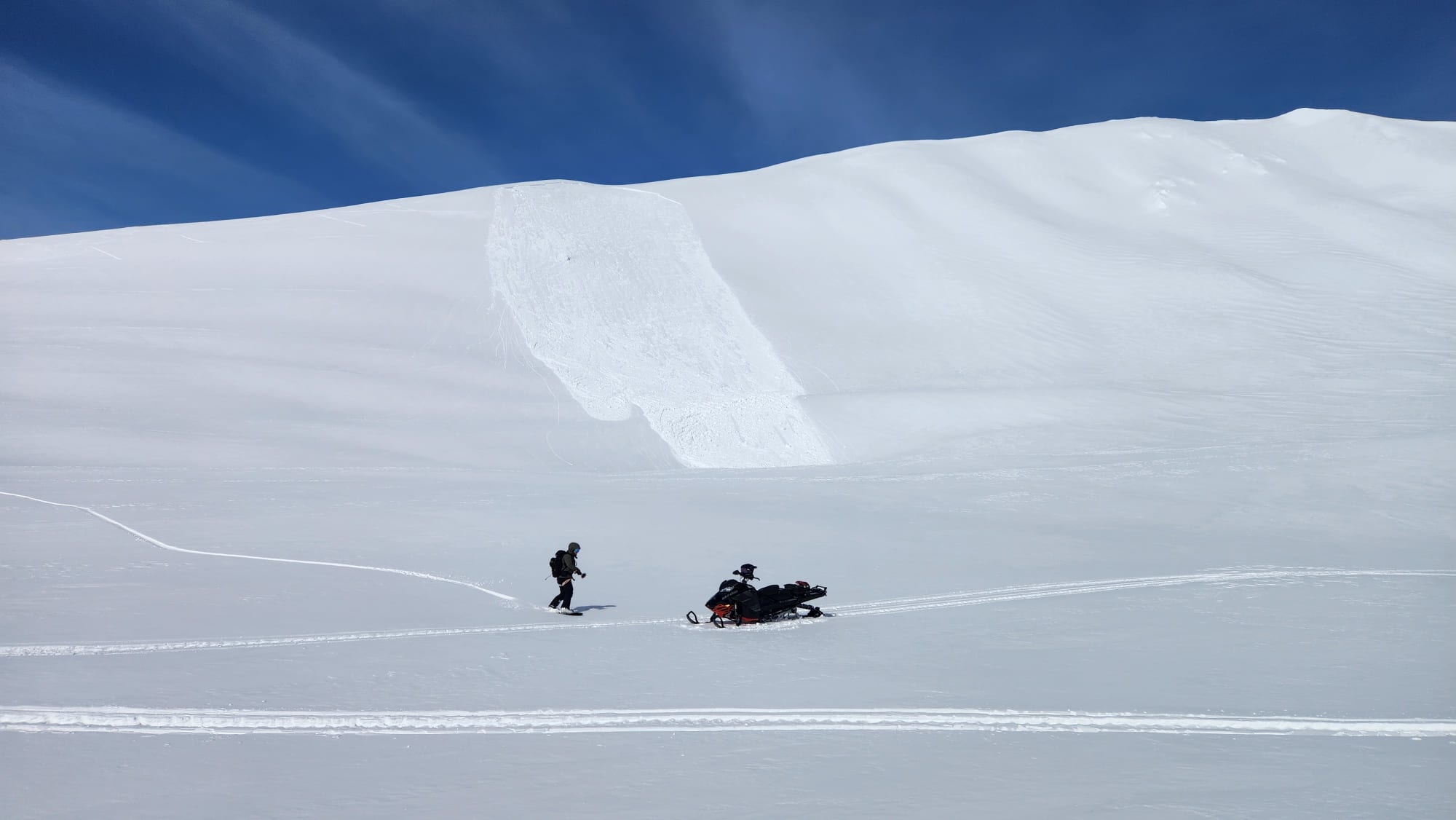
We spent the day riding east and west of the highway in Haines Summit from high point parking area. 10-20cm of low density snow has fallen since the weekend and covered most of the Easter weekend sled and ski tracks. The new snow has been blown around a little by the wind but in general, riding was quite good. At higher elevation up in the Summit we didn't find any significant wind slab development and we didn't get any snowpack test results in a test pit we dug at 1600m in a north facing alpine bowl. One notable observation we made on our way back to Haines was a size 3 Na persistent slab avalanche on a convex southeast facing shoulder at 850m elevation. This avalanche likely failed on a thick crust that formed late last fall or on the Jan 30 rain crust. The crown was 1m deep and the avalanche propagated up to 100m and ran up to 300m in the valley bottom forming a large debris pile. Likely triggered by a sudden warming of the snowpack.
Not the bluebird days of Whites Pass! Super low vis and flat light so we chose a more supported shrub E/ENE slope for reference. Dug a pit on convex NE aspect to find the low probability high consequence DPL down 95cm. Significant WL down 45cm could easily step down. Stability was solid and we received no results. Skiing was colourful, mostly death crust with a side of wind slab.
Rode mellow slopes on Marinka Hill SE-aspect at 3,500'. Found protected snow away from the wind and solar effect. Drifted slopes had between 15-30cm wind slabs that was failing upon isolation over a 3cm hard old snow surface crust with facets underneath. More solar S-aspects had a sun crust from the day prior that warmed up then re-froze the surface. Noticed size 2 debris piles in Rainy Hallow and steep Three-guardsmen chutes that likely sloughed off over the widespread hard surfaces (melt-freeze crusts) after the recent snow. Saw scouring on southerly aspects and heard reports of softer non-wind effect deposits on the north side of three-guardsmen.
New snow was falling over a supportive crust today in the low elevation trees skiing at Marinka’s Hill. Warmth at the end of the last storm left a thick crust up to 1200m but with 10cm already on top, ski conditions were improving. This capping crust and a low forecasted hazard at treeline meant we felt comfortable skiing steep, convex terrain. We enjoyed dust on crust conditions and moving through the big timber on the south end of the pass.
1600m S-aspect -6C moderate S winds scattered then overcast. Thin breakable crust near the road that became more supportable higher up. Wind swept variable conditions. Areas of lightly drifted powder. Light active surface transport from the wind. Visible icy sun crust in shallow exposed spots.
We went exploring in the Kusawak area today. 5 cm of new snow sits above a variety of wind affected surfaces from last weekend. At lower elevations this softer snow was capped by a thin crust that kept the soft snow from blowing away and made sled travel pretty easy. At higher elevations the new snow had blown around more but up to 20cm of soft snow could be found in sheltered bowls. Visibility was in and out but there were signs of last weekend’s avalanche cycle up to size 3 on large, southerly slopes. We avoided rocky outcrops and places were the snowpack transitioned from thick to thin. We kept our travel conservative today as we are still getting to know this area.
New snow the last few days. Was camped out March 18-20. Clear March 18, intense wind overnight, 19 and 20 socked in and snowing, relatively calm winds. Approx 30cm new snow (some likely from 15-17th storm). Completed a CT, isolated down to 120cm. CTM15 (BRK) @ 35cm. Two weak layers identified: one down 35cm (3cm thick facets), another down 55cm (2cm thick). Of note: no natural avalanches seen (surprising given the snow and warming), no whumpfing or shooting cracks. Little solar effect re: socked in (but was warm, est -5 to -1C). Variable snow, sastrugi still in places (less sheltered, wind loaded places on glacier). Eg, at lower elevation and same aspect as above CT, had fresh snow sitting on ~4cm thick styrofoam-like snow with facets underneath.
We headed out for a beauty of a ski off the pass and ended up sniffing out some fluffy stuff and pillows to boot. We observed very isolated cracking on wind features along the ridgeline and observed no other obvious signs of instability during our tour. We found laid-over buried surface hoar in hand pits just above the road ~20cm from the surface which seemed to disappear as we climbed in elevation. We dug a quick pit at 750m on a 24* W aspect (HS 175cm) to look for those special SH crystals but didn't find any... We did, however, find propagating results in our stability tests (more info on snowpack page). Although the slab was quite soft and unconsolidated, we took the easy propagation as a heads up to keep our slope angles in check and write off the tempting steeper skiing nearby. Turns out low angle loving was ideal for keeping the pow skiing prioritized and avoid digging deeper into the mostly supportable crust below. Considering weather, we observed temps of -5*C at the road and gradual warming to 0*C throughout our tour with broken/overcast skies and S-1 precip throughout the day before a pulse of S2+ precip as we finished off our skiing in the evening. The crystals falling from the sky were generally needles (which you don't see every day) and were large fluffly clusters of needles at the end of the day! Winds were consistently calm and the filtered soft light really complimented the soft pleasant skiing.
At the surface dense snow over a crust that softened higher up. Dug a pit at 2,300' on a SW-aspect total snow depth 170cm. New snow totals were 45cm over reactive 6-8mm buried surface hoar and old weak near surface facets. This was a very distinct layer and propagated in an extended column test ECTP21 down 45cm. Beneath the recently buried 1/8-10 surface hoar was the old surface hoar layer that formed 12/31 down 90cm. Near the very bottom of the snowpack was a pocket of weak snow down 135cm.
We did an exploratory drive to the Haines Pass to see how the snow was looking. We did a very short ski at 5 mile but the alders are still close to the surface / exposed. Snow at 5 mile had a heavy powder on top of what seemed to be like a melt crust and snow below large trees was icy and hard packed. We drove back to Marinka's hill and did a short tour on mellow slopes. Still many rocks waiting to be covered. 5 - 10cm of power on top of a harder wind affected surface that became more prominent as we climbed. Temp was -3, overcast, low visibility, calm wind.
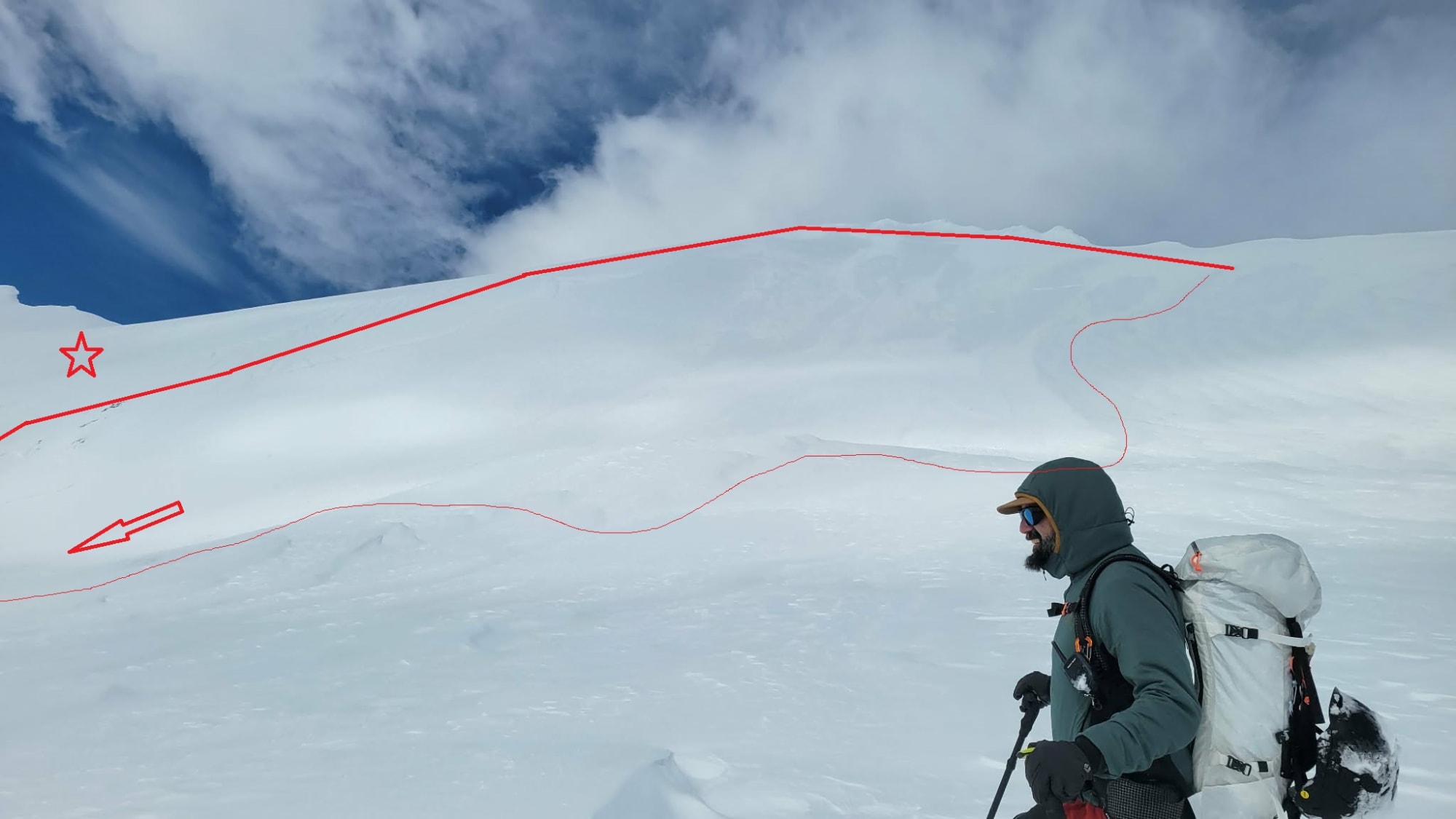
We skied up Mount Kelsall to a point near the summit where we we turned around due to our route traveling along a knife edge ridge which we deemed unsafe. Intense Northerly winds were reverse loading the ridge, creating cornices overhanging both sides. Strong winds were gusting all day with a lot of snow being stripped off mountains and transported far off, instead of being deposited in the lee. Temperature was -10 but felt like -25 with wind chill. The glacier skied surprisingly well with the a soft, supportive, wind affected surface. A north aspect of the mountain South of Kelsall lake had a size 2 natural wind slab on it of unknown date. The debris did look fairly fresh but croen line was not visible. See photo.
March 8-9 at 5-Mile: All aspects up to 800m had either a thin wind slab or crust at the surface, usually underlain by 20cm of facets. No signs of instability and multiple loose size 1s were seen on steep solar aspects, probably from the weekend. Surface snow remained dry even with the clear skies.
Soft rain crust on top of a wet snow pack. Skis broke through the crust easily from the top and then made it challenging to turn the skis underneath it. Some snow balls had formed and rolled down before the rain event. Snow had fallen off around trees, making the snow more consolidated underneath them. Watch out for the crust layer after a new snow event.
Went to Three Guardsmen but a fog enveloped the entire mountain, so I decided not to go up there. I went opposite up the gentle slope. For some reason it was not as wind affected as it could have been, or as much as Nadahini was just yesterday. The ski down was AWESOME! Even though I couldn't see that well, I followed my skin tracks for the most part. If you go here, this is great terrain for those nastier days when you don't want to be skiing something dangerous. Make sure you wax em up though, since it is pretty low angle.
Weather was warm, around 0 C. Light snow still falling all day. Wind about 15-25 kmh coming from S. Haines Pass had about 10cm of new snow on last Sunday, but due to high winds this was very variable, with some lee features much deeper than that, and windward features often scoured and icy. Didn't go above the treeline due to visibility being poor. I tried to trigger some inconsequential slabs on convex rolls. I could not trigger anything larger than 1-2 square feet in slab size, even on the worst convex rolls on wind loaded terrain. There appeared to be a significant weak layer buried in the snow, but the storm/wind slab was not yet hardened or tough enough to propagate cracks. I.e. the lateral bonding of the slab was weak. I would be concerned, however, as this slab hardens and compacts, over what appeared to be faceted snow. As such, the skiing on Wednesday was pretty good. At about 8pm I went up a final time, and more snow had accumulated on the cross-loaded lee features by then. Amazing skiing, since I was pretty confident the slab hadn't formed up yet after repeated ongoing testing. I didn't see any avalanches, whumpfs or shooting cracks. I tried moving around to the NE slope, towards the steeper, more consistent-grade N face of Nadahini. I wanted to avoid the S wind, but it just followed me around the mountain and scoured the places I wanted to ski. So I just went back to the mellower E slope, which had some bushes and terrain features that deposited a lot of great powder on the lee side.
Observations from an AST class: Beautiful day with no wind. Many wind slabs have now faceted into soft, and almost rideable shape though conditions remain variable. 2 whumps from hard wind slab on facets, and moderate sudden compression test results down 30cm on slightly rounded surface hoar. See snowpack obs for more detail
See my other post from the same day at Nadahini. After triggering class 1, 1+ Slab on 30 to 35 degree convex slopes there, I decided to skin up the small mountain directly opposite the three guardsmen which is almost all less than 30 degrees. Because of the White out conditions, I liked this small hill because there were no threatening start zones above me that I couldn't see in the fog. This hill, unlike Nadahini, despite it being the same day, was very windy (SW @ approx 15-25 kmh) and very wind affected. Snow conditions varied from dry powder to hard icy wind-affected snow and transitions and rolls were difficult to see in the flat light. Some sastrugi was visible. The ski down was ok, obviously challenging due to flat light and variable quality wind affected snow. No further witnessed slabs or shooting cracks.
Initial observation of conditions put the Avalanche risk at low due to no critical warming, only 1 to 2 inch of recent snow, no signs of cracks or slab avalanches, no wind loading. So I embarked up the E face of nadahini in 30-35 degree slopes ("challenging" or blue terrain per ATES map), starting from the green shack. Weather was some very light snow, totally overcast with flat light, and no wind. Once I reached top of treeline I noticed a shooting crack that went deeper than the 1-2 inches of new snow and under the medium density crust that had formed from the warming last week. It was several meters long. Soon after that I triggered a class 1, 1+ slab just above a bowl I just finished traversing. The release was very loud. Crown was just under a convex roll which flowed into the small bowl. The slab moved only 10m or so and stopped, but the crown was over 1 foot deep (I did not get closer for a better measurement. See the picture). This made me reassess the dangerator and avaluator and immediately ski back down and stick to <30 degree slopes the rest of the day. Especially since the slab was deep and probably indicating a very weak layer buried @ 30+ cm & possible persistent slab problem. And this terrain is very undulating so lots of convex rolls and some flat spots (terrain traps). Additionally, due to the near white-out I could not see anything above me especially in the Alpine so could not assess start zones above me. However, the ski down was magnificent with great terrain and great powder conditions with a medium density crust a few inches below the surface.
Avalanche Canada