Register for an account and never miss a forecast again!
South Rockies
Powder felt bottomless. The top layer (6-10 cm) sluffed off incredibly easily on steeper slope angles, but skiing in tight trees made each sluff isolated/small.
Today we traveled to a thin snowpack area south of highway 3 in Crowsnest Pass. We found 150 cm of snow at treeline on a north-facing slope. Probing around we found the upper snowpack is well-consolidated over a weak lower snowpack. We didn’t see any new avalanches, It seems like the first bite of sun and warming from last week has tapered off. The skiing was not great, variable and wind affected. The sastrugi was the best skiing! 😩
Two natural large avalanches were reported in this area during the warming period over the weekend. These avalanches had deep crowns that could have involved the facets at the base of the snowpack that we have not seen avalanches on in this area for some time. Areas, where this problem may be a concern, are shallow snowpack areas where the bottom snowpack is generally weak with variable depths of consolidated snow above that can be triggered by human activity. This area does not see a lot of recreational traffic and is a good reminder that sharing is caring.
Weather forecast today called for “Sunny breaks” and Occasional flurries”. Well, we had all-day proper snowing in York Creek …. 20 cm of storm snow on the ground at 1900 m when we arrived, 30 cm by the time we headed home. The wind has been blowing at Moderate (enough to transport snow and build cornices and wind slabs) from the SW for the last couple of days, and that continued today at ridgetop. Once again, (pattern this winter), the trick was to select lower angle sheltered terrain to avoid those wind slabs (they were definitely out there in exposed areas at Treeline and above). It stayed cool all day, and we saw no avalanches. We did however observe signs of instability in an open glade on a North aspect at 1900 m (cracking from our skis) and were able to juuust about get a small slab to move stubbornly when we tested a little steep feature where there was no consequence. The other trick today was keeping our A-Arms away from the stumps and rocks in the shallower snowpack at lower elevations :-(
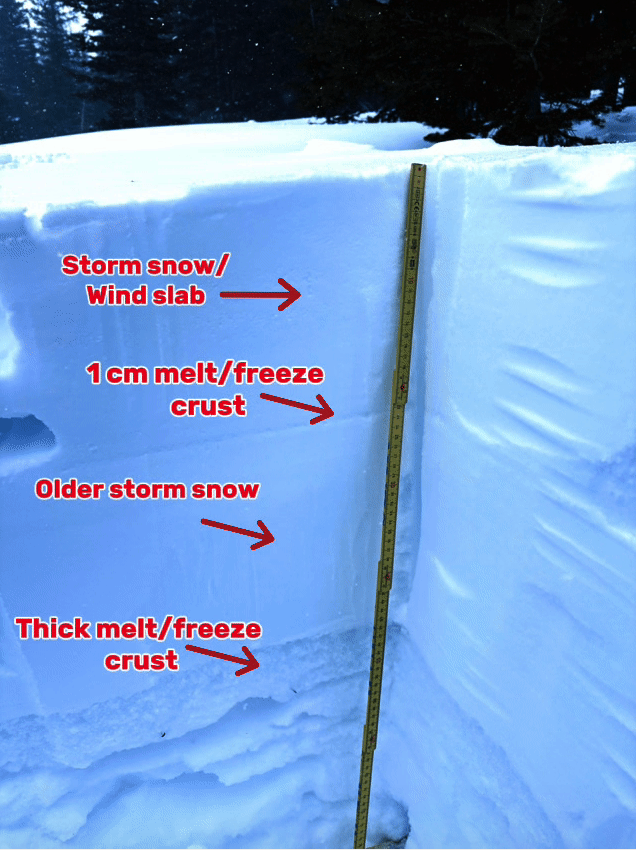
With great visibility throughout the day, we did not see any new avalanche activity in the neighboring backcountry terrain. The upper snowpack was 5 cm of new snow over a supportive to skis, 1 - 2 cm melt-freeze crust up to 1980 m (our top out elevation). At treeline, we did not find wind-affected snow even in open terrain features. Throughout the day the temperatures were cool around - 4 C, with little to no wind that started to increase near the end of the day.
Very Mild day. Very little wind. Mostly cloudy throughout the day.
We were in the Castle Ski tour terrain on Haig for the day with an AST course. We found 5 cm of new snow over a breakable melt-freeze crust from the warm temperatures and precipitation on Friday. Total snow depth 155 cm. The day was warm and there was almost no wind for the whole day. The snowpack is well consolidated, especially in open areas where it is wind pressed. In the sheltered treeline and below treeline we found a softer layer sandwiched between the Dec 26 crust and the most recent crust. There was decent visibility and we saw no recent avalanches.
In general the skiing was better than expected over the past two days. Winds were relatively mild (moderate at times), there was trace new snow and the temperatures were generally below freezing but mild. There was good skiing out there as the wind hasn’t blown particularly hard (averaging moderate, gusting strong) since our last storm (around Boxing Day). Today may change that… We were surprised to see how much soft snow was preserved near ridge tops, though soft snow is limited to lee or protected terrain. Strips of soft snow generally feel unconsolidated on top of the crust (formed during Boxing Day storm). It skis well but at times makes for challenging, slippery skinning. With good visibility we saw 2 naturals, zoomed in photos included.
skied south facing slopes. snowpack was 100cm deep, ct 28, failed 20 cm from ground on facets. avoided areas where windslabs are usually present, saw no evidence of the surface hoar layer under the new snow. First run had deep heavy snow and the second had a 2" crust layer that made it very hard to ski.
Not every day you can say that about the Crowsnest. Surprisingly fluffy snow and good ski quality just south of the highway. When winds pick up again we would expect some new reactive wind slabs might form in open areas. The November drought layer was not reactive in snowpack tests today but our sample size is small and we are still in assessment mode so enjoyed some turns in smaller, lower-angled terrain.
Notice there are no photos of actual riding today!? It wasn’t full on “survival skiing”, but it wasn’t good either…let’s call it “edgeable”. We took advantage of the low avalanche hazard to get into the alpine in the Crowsnest Pass today. We were hoping with a few sunny breaks the south east facing run we chose would soften, but no such luck. It was -3.5 in the alpine, with broken skies and light northwest wind. The snow surface was still FIRM on our decent around 2:30 pm. The views were minty, even if the skiing was marginal.
Beautiful day, absolutely no wind
Warm temperatures and cloudy skies in the morning. Above zero degrees at the resort in the morning, surface snow was soft. As we gained elevation we found variable surfaces ranging from breakable crust to hard wind pressed snow and some not quite as hard wind slabs in sheltered areas. Steep south-facing slopes had the most robust crusts. These wind slabs were bonded well to previous surfaces. The sun peaked out in the afternoon but didn't provide enough heat to get any wet loose avalanches and we saw no evidence of pinwheeling. Skiing was not great but also not terrifying. Sheltered terrain was the best skiing.
Toured up to Haig Bowl area staying at treeline elevations. As we toured up we found very small, isolated pockets of wind slab that were not bonding well to previous surfaces of melt-freeze crust or hard wind pressed snow. It snowed most of the day with a few hours of more intense snowfall. Accumulations were hard to judge due to the strong westerly winds that were present all day. Snow was moving around and likely transporting snow lower down the slope although not increasing avalanche hazard during our field day. Skiing was better than expected and softer snow and wind sift could still be found in sheltered areas.
Surprisingly good skiing on the new snow over a supportive base. Still early season with sharks poking their noses out below 1700m.
Lower elevations below 1700 m we found 30 - 40 cm of new snow over the ground. There was some whumpfing in shallow, low angle areas. Tree line snowpack depths were 90 cm. The snow depths over the rain crust buried on Dec 4 is now down 60 cm in sheltered tree line terrain. We saw a size 1.5 suspect natural avalanche on a SE aspect that was a wind loaded feature. Crown depth 60cm to 20 cm in steep, rocky terrain
recent storm deposited near 20cm at 1950m. human triggered sz 1 Dry point releases observed at 1700m where bed surface was wet and soggy and new snow was heavy. Consistent snowfall all day and temperatures between -5 and 0.
Today we went to the York Creek area of Crowsnest. We had an early start and the access in was still frozen, as we toured up for our first run it was still a solid melt-freeze crust. As we approached the top the strong southwest winds were moving snow around developing soft wind slabs directly lee of the ridge. We avoided these small pockets and decided to ski the southeast-facing slope. The skiing was better than expected as it had softened up just a bit. The second run down the same slope was even softer and getting heavy as we dropped elevation. There were no new avalanches observed in this area just some roller balls and cinnamon buns at lower elevations on steep solar slopes. We left the area by 2:00.
Today we traveled in the Crownest Area, from York Creek to the Mt Coulthard cirque. We saw a range of different aspects and saw an old size 2 slab avalanche triggered by a snowmobile, that was on average 50cm deep but up to 100cm deep where the slope was wind loaded. With mild temps and not much wind transport occurring in the last week we expected to find that both Persistent Weak Layers (PWL's) were healing... We did not find this!!! We found both layers are still reactive and have the potential to cause large avalanches. At 2000m on a N aspect we were able to produce propagating ECT results 70cm deep on the Jan 24 PWL, which is large facets with a stiff wind slab over top. In this area we were also able to produce a propagating ECT result 35cm deep on the Feb 18 PWL, which is size 1 facets with a stiff wind slab on top. These slabs are the most worrisome in isolated areas where wind transported snow has formed a stiff, stubborn slab over both layers of facets. We made some nice turns under the bluebird Alberta skies on sunny South-facing low angle slopes where there is 5cm new snow over last week's melt-freeze crust.
Satoris Summit was warm, sunny, and minimal to no wind. Off in the distance we noticed a slide towards Lynx creek area. Once we got into York Creek Basin the NW wind started blowing and starting to cross-load in areas. Large cornice up top. Be aware of your surroundings.
Very wind affected in open areas with a hard crust forming that was difficult to penetrate. Tree areas and dense trees had more snow with pockets of crust.
Skied a SE aspect starting at 2070m with variable snow conditions. Icy/Breakable crust below 1830m. Very strong wind slab observed in the alpine.
The wind really hammered the York bowl last week. SW facing alpine slopes were stripped bare and where there was snow it was hard slab and sastrugi. Even at the tree line hard slab was present. Below 1800 meters the rain crust that formed after last week's storm is varied in thickness. We spent the day doing our monthly rescue practice and trying out some of our fire-starting gear in our emergency kit while we wait for some new snow.
We spent the day in the Castle area; a place we don’t get too often near Castle Mountain Resort. We toured up through a sheltered treed ridge to avoid the wind, and dug a profile to find the snowpack consolidated and strong around the persistent weak layers. While these layers and the snow around them seem to be gaining strength we are still avoiding steep, rocky shallow snowpack areas where it may still be possible to trigger. The best skiing was in the trees in sheltered areas to avoid the wind affected snow. Snowpack test results - ECTX, CTM (PC) X2 down 17 and 25
Column test gave results about 15 cm down on L12, however this layer was unconsolidated and crumbled on the next load. The next layer to fail was on top of the Dec 8th crust, about 40 cm down, on L25. Recent snowfall is faceted and wind-affected, while this caused no problems today it could create a weak layer when the snow that is forecast for tomorrow arrives. The new snow above 2000m was fairly firm as a result of wind redistribution, however as we skied into denser trees at lower elevation the snow softened and made for excellent skiing.
Today’s skiing brought to you by the Dec 8 crust! Last week's warm temperatures and sunny skies in the Crowsnest, coupled with Wednesday's storm that started warm (rain) have developed a 10 - 15cm knife hard crust. On this crust sits 10 - 15cm of snow that fell after the temperatures dropped below zero. We found variable depth wind slabs at tree line and in the alpine from 5 - 15cm with the deepest wind slab directly lee of ridges and terrain features. We saw a couple of natural wind slab releases out of steep terrain up to size 2. This area still needs more snow, but the few turns we did were surprisingly good.
Skied a few mellow turns on a SE aspect at approximately 1500m. 5 cm new snow overnight becoming moist from solar input, which sits on a mostly supportive 5 cm crust. Snow immediately below the crust is moist for a few cms, otherwise dry below that.
We went to York Creek Mt Couthard area today. The trail grooming there was on point! Thanks, CrowSnow Riders! A good overnight refreeze did not take long to soften up solar aspects. As we toured up the south-facing slope was still a bit crusty, but was already starting to soften. As we approached the ridge there were some light west winds and the recent 5cm of new snow had developed into very small isolated pockets of wind slabs. We observed one machine triggered size one on a small east-facing rollover, no other avalanches were observed. The walk was nice and warm, the skiing was not great - crusty at the upper elevations and mashed potatoes at the bottom.
We spent the day in the Crowsnest Pass. There was evidence of recent wind activity, we found multiple layers from various wind events. As we neared the ridge we tested a small wind lip that provided us some information with shooting cracks that stepped down to a deeper wind slab. There was no natural activity in the area, but we a few test results in the hard range down 25cm on an older wind slab layer with one being a sudden result. We skied a lovely low angle slope where there was no wind effect and had very enjoyable turns. Thanks to the Wolverine who wisely showed us the route to the pass.
A sunny start in the morning turned to windy and snowy throughout the day. Moderate to strong SW winds were moving a lot of snow building a thin new windslab in lees. We saw some cracking and had a size 1 from a ski cut that was 5-15 cms deep and about 20m wide which ran on the Feb 1 melt freeze crust. Photos attached. Pretty decent skiing out of the wind affect! There’s definitely the odd pocket of crust/ice on the surface, but it’s skiing well. PS: Bring ski crampons! Challenging skinning in spots.
Rising temps over the last 4 days. -23C at 1500m on 17/01/20, climbing to 1C by the afternoon of the 19th. Little snowfall since the 17th and strong to extreme winds. Very few local avalanche observations since the 17th. We skied from 1500m to 2300m on predominately west facing aspects. Sunny when we started skiing, by afternoon dark clouds and light precip moved in. Temps above freezing at lowest elevations and around -3C in the alpine. Moderate to strong southwest wind above ~2000m. Moist snow/thin melt freeze crust observed up to 1800m, variable with current sun exposure. Hard, thin wind slab (3-5cm) observed 1900m and above.
The recent Extreme-Strong winds from the southwest have transported the snow (to Newfoundland), leaving the area either scoured or wind loaded on lee sides in the alpine and treeline. In thinner areas, the facet layers at the base of the snowpack or above the early season crust are still present, but was not reacting in our snowpack tests. Recent warmer temperatures must be helping with bonding. We saw tracks pushing into big terrain that did not trigger avalanches.
Cooler temps, overcast skies and moderate to strong south west winds were keeping things just frozen enough for the avalanche hazard to be low…but the crusty conditions meant it was not fun for skiing or sledding either:( I know there are really no bad days in the mountains, but investigating a few different staging areas today was kind of depressing…. #makewintergreatagain
The upslope storm delivered 15-20cm of quality pow to the Crowsnest area. The winds were light out of the south west at our location today and we were able to ski cut some small storm slabs on ridgetop lee slopes. We saw a crown from an old avalanche at treeline, and decided to dig on a similar slope. We were getting test results down 60 cm on a layer of sugary faceted crystals that had a hard slab of snow above it. This layer would likely be difficult to trigger, but hitting a thin spot or trenching with a sled, especially if the weather warms, might just do it on steep unsupported slopes.
Complex snowpack with lots of spatial variability, typical for this southern Alberta region. We chose SW aspect to keep us warm during our ski tour as well as hoping the warmer snowpack will have had some rounding occur during the day time warmth. Obviously lots of Faceting happening overnight when temps are down to -27. Strong bridge in effect keeping us above the basal facets, hard windslab from a few weeks ago. New snow on top of that making the skiing knee to thigh deep with hardly any wind effect on the new snow. Even in the sunniest place we could fund snow still dry and cold on top, felt like chance of avalanche was low but if one were to pop loose it would probably be massive. We did not trigger anything or observe any naturals of whunphs. Unfortunate end to the day when conservation officers were waiting for us at our truck at 7pm to issue us $155 tickets for riding snowmobile without helmet, 2 of us on one sled just rode 4km of road to approach ski touring area. Also fined for lack of insurance on snowmobile, did not realize the new rules now it’s a park hopefully others can learn from this and not get ticketed like we did
Went to York (South Crowsnest) today for the first time this year. We suspected low snowpack but it surprised us how little coverage there was in the bowl. Even with the low snowpack in this area, we observed an avalanche that likely occurred on Saturday with the sun and warm temperatures and confirms a report we had from the weekend. The January 17 weak layer created a sun crust on south-facing slopes and was likely the surface that this avalanche slid on. The riding is hard wind-pressed snow, with little coverage off of the SWEET grooming!