Register for an account and never miss a forecast again!
Register
Dashboard
Regions
Weather Stations
Radar
Alerts
Glossary
Contact
About
Log In
Register for an account and never miss a forecast again!
Register
Regions
United States
Snowy Range
Bookmark
Alerts
Email notifications
Forecast Notifications
An email every time a forecast is published for this region
Weekly Roundup
Every Friday at 6PM you'll get an email with a round up of the weeks' forecasts and observations
Stay informed about Snowy Range
Create a free account to receive email alerts when new forecasts are published for this region, plus weekly roundups of all avalanche activity.
Create Account
Sign In
Alp
Tln
Btl
Observations
Forecasts
Weather
CAIC Observation Report
Published: Apr 4th, 2026
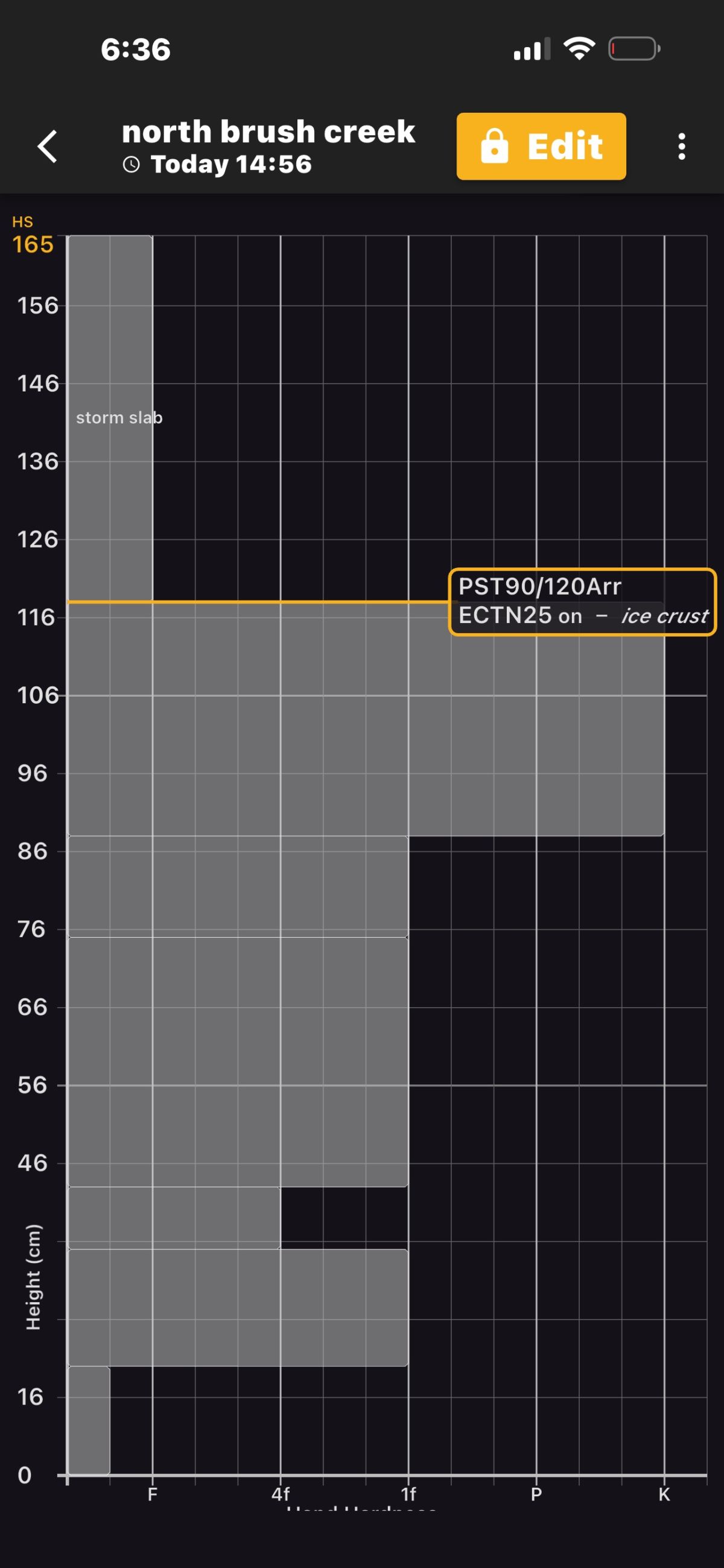
After our recent new snowstorm, we dug a pit on a north aspect around 10,384 feet near North Brush Creek just west of the Quealy warming hut. Snow depth was 165 cm with new storm total of approximately 18 to 20 inches and the slope angle was approximately 25°. Two tests were performed, including an extended column test (ECT) and a propagation saw test (PST) with the following results.: ECTN25 and PST 90/120 END @ 47cm. Both tests revealed some instability that occurred right above a 30 cm ice crust layer that has formed from the previous warm weather patterns and moisture traveling down through the snow pack.
CAIC Observation Report
Published: Mar 26th, 2026
CAIC Observation Report
Published: Mar 28th, 2026
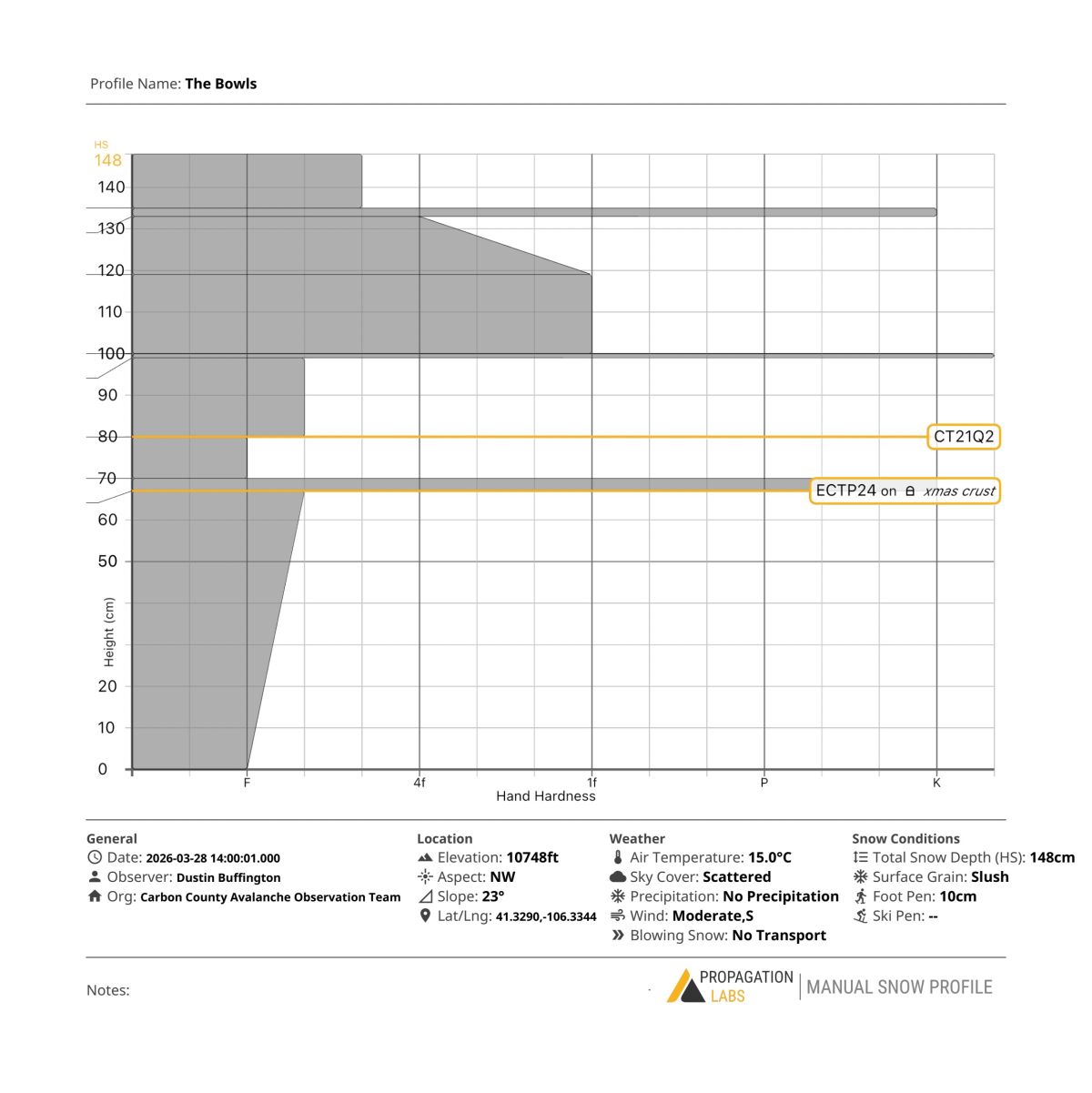
The snowpack in this area was 148cm deep with varying densities throughout. Harder heavy snow in the upper third and softer, weaker snow at the bottom third. Also a very wet snowpack. Our extended column test was stubborn but still got a reaction on the Christmas ice crust. ECTP24@67cm.
CAIC Observation Report
Published: Mar 21st, 2026
Observation pit performed at 10,879 feet, on a wind loaded eastern aspect, on a 28° slope near medicine Bow Peak in the snowy range. An extended column test was performed with no reaction until a final hit after test finalized. Snow pack was one finger hardness throughout the entire depth of pit with the exception of multiple small individual four finger layers.
CAIC Observation Report
Published: Mar 17th, 2026
Sunny, warm, and windy day. air temp (F): 40; cloud cover: clear; wind loading: moderate; recent snowfall (cm): 0; snow avail for transport: small smounts
CAIC Observation Report
Published: Mar 11th, 2026
Our snow pit depth was 110cm this evening on a south to southeast aspect at 9907’ of elevation on a 24 degree slope near the snow survey cabin just east of chains end parking lot. Due to the warm-up we recently had as as well as the south to southeast sun exposure, we observed several layers with a lot of water content moving through them. We still have three persistent layers on this aspect that are reactive. Three tests were performed : compression test on the February 10 layer (CT7 Q3), extend extended column test on the Christmas crust layer, (ECTP21), and propagation saw test (PST 48/100 END @50cm). The February 10 layer, the Christmas crust layer, and sugary facets near the ground are both producing instability results. Foot penetration down to 100 cm due to high water content in snowpack on south to southeast aspects
CAIC Observation Report
Published: Mar 11th, 2026
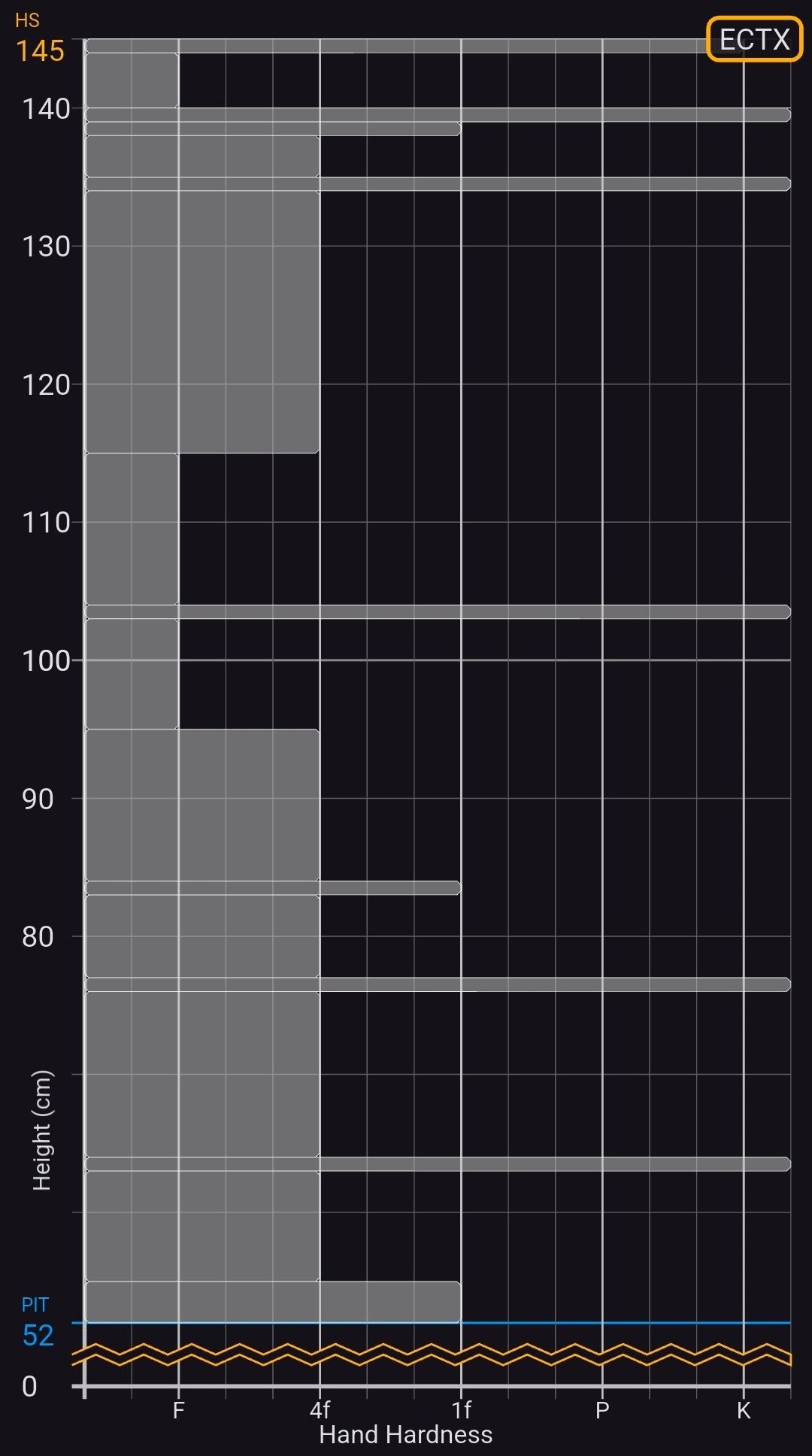
North facing aspect below treeline. HS 145cm. About 6" of new snow. The snowpack has two distinct PWL. The Feb 11th layer (55cm deep) and Xmas crust (85cm deep). The Feb 11th layer is showing to be stubborn, but if triggered is likely to step down into the xmas crust. Heavy winds with the storm last night. I imagine some of the snow was disintegrated from the wind and the rest deposited in weird areas, along with normal wind loading areas. ECTX (with additional taps failure and propagation on the Xmas layer 85cm down) PST48/100end @feb 11th layer.
CAIC Observation Report
Published: Mar 12th, 2026
CAIC Observation Report
Published: Mar 14th, 2026
Snow pit today was west of Silver Lake in the snowy range at 10,404 feet. We were on a south aspect with a pit depth of 117 cm on a 22 degree slope. We performed a couple tests to see if we could eliminate the persistent week layer from our earlier February 10 layer and did get some reactions. Our extended column test results were ECTP22 and our propagation saw test results were PST 60/100 END @79cm.
CAIC Observation Report
Published: Mar 8th, 2026
The snowpack depth in this area is around 195cm. There are multiple layers within the snowpack here but I found 2 of primary concern. The upper layer of concern was a very thin MFcr with buried surface hoar directly on top of it and did react during the ECT. The next layer of concern is our Feb 10 persistent weak layer. There was little reaction on this layer during the ECT but did propagate during the PST. ECTP23@165cm up. PST48/100END@121cm up.
CAIC Observation Report
Published: Feb 25th, 2026
After some high moisture content snow and high winds, we observed three layers in our snow pack. About 10 cm of fresh snow was sitting on top of a 4 cm layer of graupel, which could pose another weak layer in the future. The second layer is our February 10 persistent week layer about 70 cm down in the snowpack. Also still present deep in the snowpack is our Christmas crust at 96 cm from the top. This layer is undergoing changes due to the additional weight and moisture content. We did not observe very much reactivity in our test however it was fairly easy to pull off the upper persistent week layer from the February 10 storm.
CAIC Observation Report
Published: Feb 19th, 2026
The snowpack in this location was 150cm and the pit we dug in this location was 100cm. About 8 to 10 inches of new snow on top of a fairly reactive weak layer 53cm in the snowpack. We performed an ECT test as well as a PST test. We got a ECTN25 on the Tuesday layer and a PST 32/100 on the Tuesday layer.
CAIC Observation Report
Published: Feb 14th, 2026
the snowpack on this specific slope seemed to show good signs of stability with little reactivity from layers lower in the snowpack. the recent storm slab did show some reactivity.
CAIC Observation Report
Published: Feb 11th, 2026
We dug an east facing pit at about 10,500 feet in the Snowy Range near Sucker Lake off Hwy 130. The temperature was about -2c/28F, and a thin layer of fresh graupel littered the fresh powder, which was about 23cm/9" deep. While we noticed light wind loading in the surrounding area. However, our ECT had vertical cracking in the top 23cm of new snow on the first tap with no propagation. We did not observe any additional notable results in the ECT. The Christmas crust remains as a dense, icey layer about 2cm thick at 90cm/3ft deep . We were unable to isolate the column beyond the depth of the Christmas crust due to the dense ice, which may have affected the ECT results at layers deeper than 90cm.
CAIC Observation Report
Published: Feb 12th, 2026
The pit we dug today was on a wind loaded east aspect around 10,700 feet at slope angle of 30°. Two tests were performed, an extended column test (ECT) as well as a propagation saw test (PST). No reaction was seen with the extended column test however we did get a couple of the upper wind loaded layers on the propagation saw test to react. PST 70/150 ARR @87cm was our most reactive layer.
CAIC Observation Report
Published: Feb 6th, 2026
we performed three tests in our snow pit today with some interesting results. Initially a compression test (CT) was performed resulting in failure during isolation (CTV). Next an extended column test (ECT) was performed, yielding no results. (ECTX). Thirdly a propagation saw test (PST) was performed, yielding a stubborn response resulting in PST 60/120SF 82cm down from the top of the snow.
CAIC Observation Report
Published: Feb 6th, 2026
A couple of tests were performed in our snow pit today on a northern aspect near Vagner Lake at 10,650 feet of elevation in the snowies . We observed three distinct layers in the snow pack (January slab, Christmas crust layer, and a non-cohesive snow layer above the frozen depth hoar near the ground). No reactions were seen with the extended column test (ECTX), again showing the stubbornness in the upper third of the snowpack as well as our Christmas crust layer in the middle. The propagation saw test did however show some reaction near the ground level resulting in PST 56/120 END.
CAIC Observation Report
Published: Feb 1st, 2026
Snow pit was Dug on N-N/E aspect at 10922’ with a slope angle of 19 degrees just above Reservoir Lake. Surface hoar was evident on snow surface from overnight and our height of snow was 138cm. We observed several distinct layers, including the surface hoar, a wind slab layer (“JanSlab”), our existing persistent weak layer (“christmas crust”), and depth hoar near the ground. We performed both an extended column test (ECT) as well as a propagation test (PST). The extended column test yielded no results ending in a score of ECTX. We did two propagation saw tests with a small reaction underneath the Christmas crust (PST 60/120 END)and a more reactive result underneath the depth hoar layer near the ground (PST 40/120 END).
CAIC Observation Report
Published: Jan 18th, 2026
Wind loaded slopes greater than 30° that are at or above treeline should be treated with caution. Small to medium sized avalanches could be easily triggered. Cracking observed on wind loaded slopes
CAIC Observation Report
Published: Jan 18th, 2026
Snow pit was dug on a NE aspect at 10400’ on the way down into South French Creek drainage. Slope angle was not that steep at 20 degrees. Three tests were performed: compression test (CT), extended column test (ECT), and a propagation saw test. All three tests were non reactive (example ECTX:PSTnull) possibly warranting another observation in the same area at a steeper slope angle. Top 30cm of snow collapsed above the snow pit when walking on it
CAIC Observation Report
Published: Jan 19th, 2026
2" of fresh snow from night before. We dug our snowpit on a E-SE aspect at 10,950' feet of elevation near widow maker hill on a 30 degree slope. Two tests were performed: Extended Column Test (ECT) and a Propagation Saw Test (PST). ECT test did not show any reaction on our persistent weak layer formed back around Christmas, however we did get a positive reaction on a layer further up in the snowpack around 35 cm from the top which resulted in an ECTP20 at 35cm from the top. Our PST resulted in a small late reaction on both the Persistent weak layer at 65cm as well on our newer layer up higher at 35cm from the top with results of PST 110/120 END@65cm and PST 110/120 END@ 35cm respectively.
CAIC Observation Report
Published: Jan 9th, 2026
The snowpack was 111cm, with two distinct ice layers from freeze/thaw events that occurred before the new year.
CAIC Observation Report
Published: Jan 8th, 2026
Two tests were performed. An extended column test did not result in any reaction ECTX . The propagation saw test PST did not arrest until the very end of the column just underneath the ice layer at 67 cm. PST 115/120 @ 67cm. No instability observed riding into area
CAIC Observation Report
Published: Jan 8th, 2026
A snowpit was excavated to ground at about 10,600’ in elevation SW aspect revealing a persistent ice layer buried at approximately 70 cm from bottom. Extended Column Test results produced an ECTN, indicating that while the ice layer remains a distinct and well-defined weakness, it did not demonstrate the ability to propagate fracture across the column under the applied loading. A Propagation Saw Test resulted in a PST null at 85 cm (PST 85/END), suggesting that despite the presence of a planar, low-friction interface, the slab currently lacks the structural or stress conditions necessary for self-propagating failure. The overlying slab was 1 finger hardness, which likely contributes to bridging and reduced stress transmission to the weak layer. Overall, test results point toward a persistent weak layer that remains dormant at present but could become reactive with additional loading, warming, or changes in slab stiffness. Continued monitoring is recommended, as persistent ice layers can exhibit delayed reactivity and spatial variability despite non-propagating test results.
CAIC Observation Report
Published: Jan 5th, 2026
The extended column test resulted in ECTX. The propagation saw test resulted in pst90/100arr. The pit was 110cm deep on a slope angle of 25 degrees on a south facing aspect below treeline protected from the wind. Two strong slabs separated by a dense ice layer 45 cm below the surface. Weak layers beneath the ice layer and at ground level that did not collapse or propagate upon testing.
CAIC Observation Report
Published: Jan 4th, 2026
No weather stations associated with this region.