
Quick report
- Collapsing
- isolated
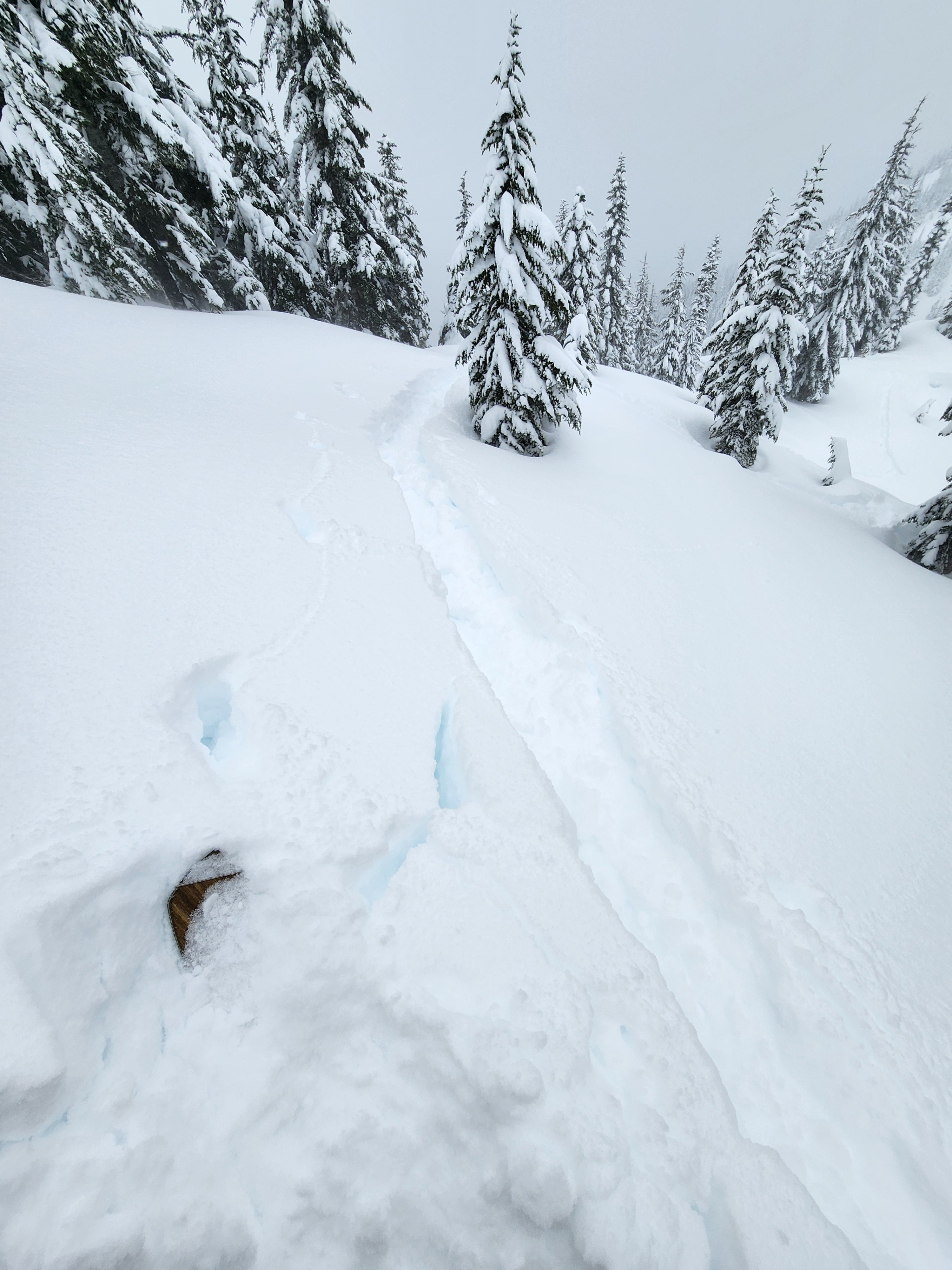
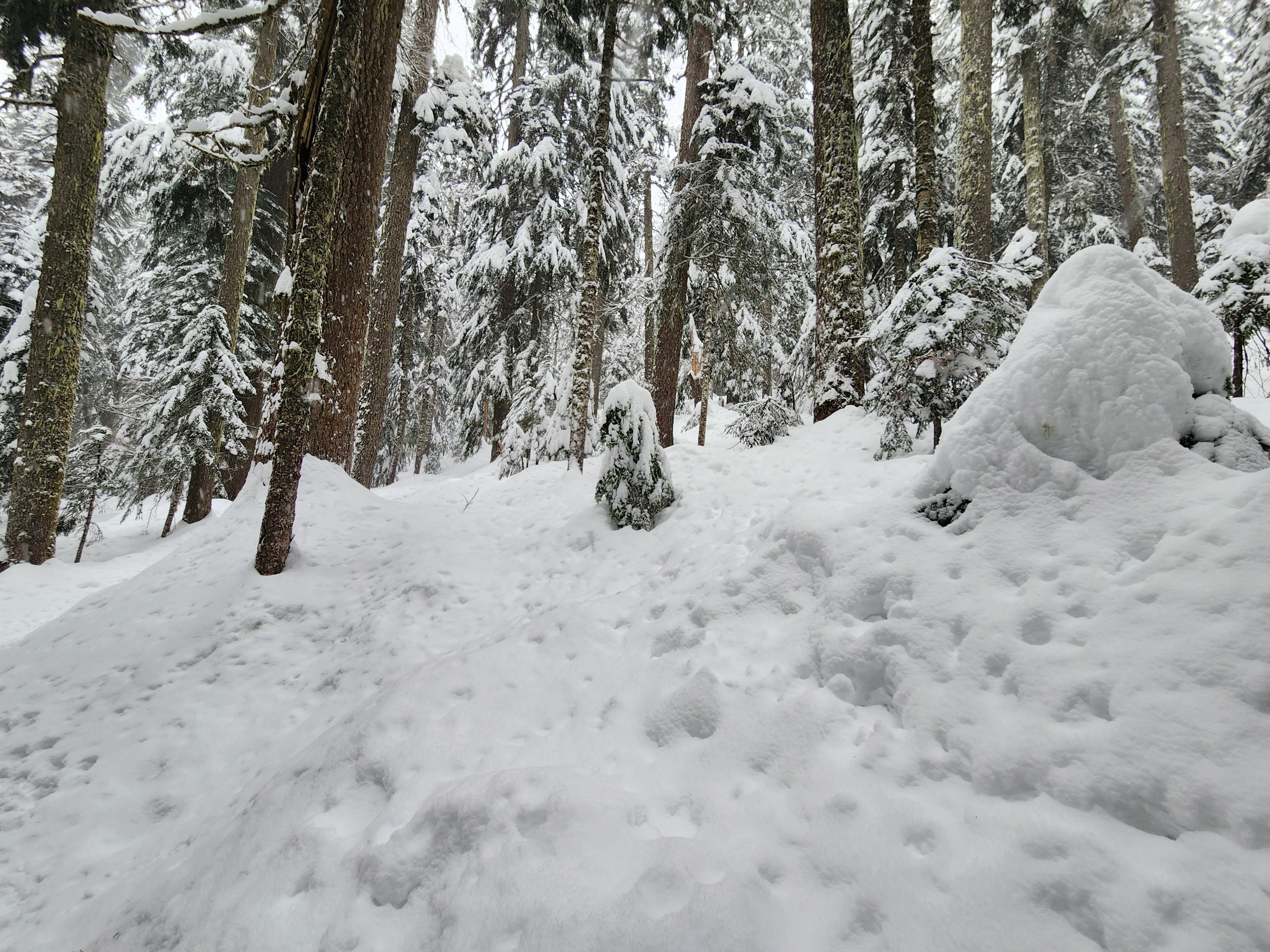
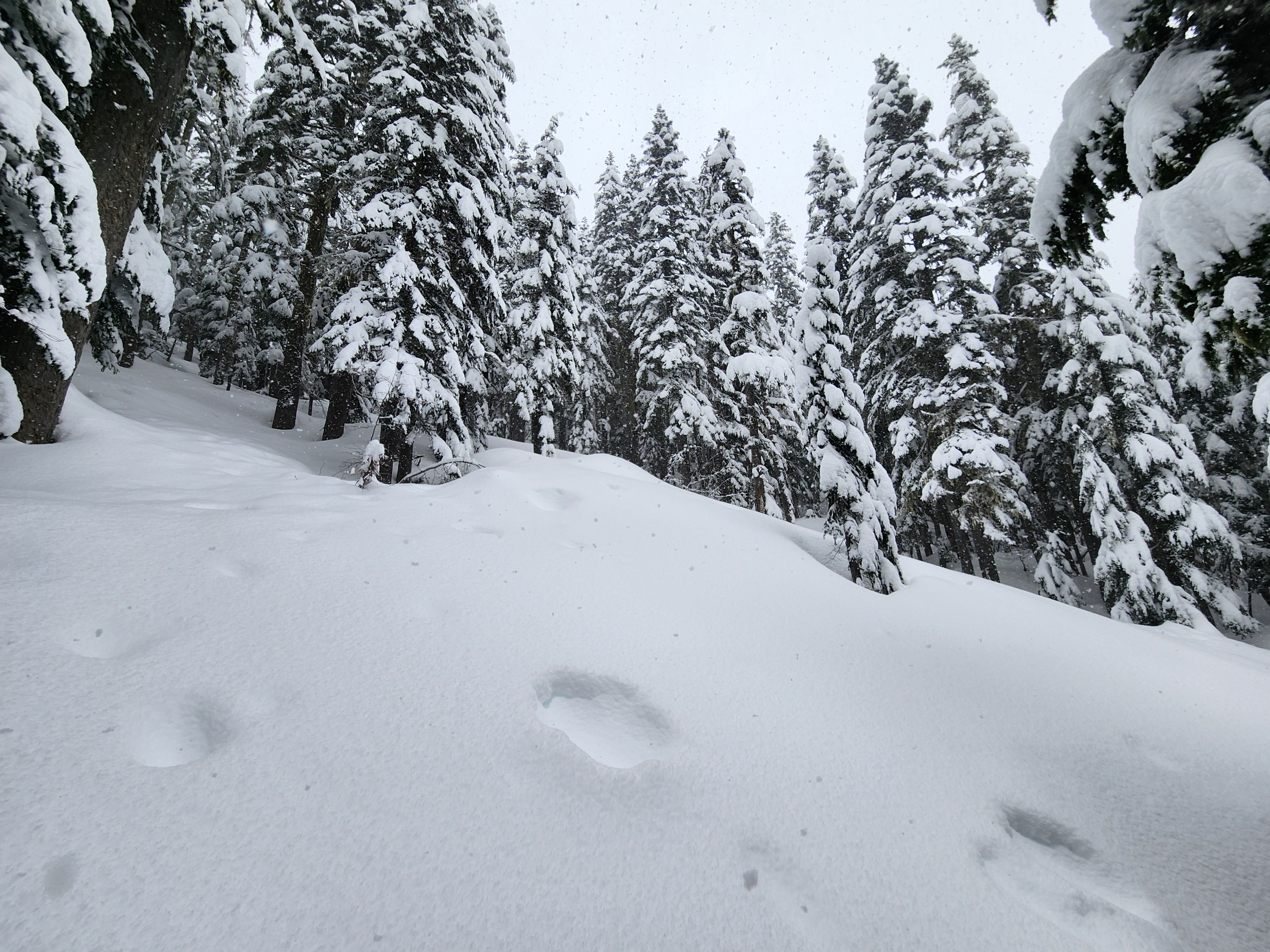
My aim today was to get into the upper reaches of the middle elevation band to seek out instabilities both within the new and old snow. I ascended a generally south-facing slope until about 5000', where I then was able to briefly travel on W-N-SE slopes as well. Winds were transporting snow and filled in my skin track in less than an hour. The new snow did little to improve travel in the trees below about 4500'. Previously frozen coral reef still abounds below that point and the 6-12" of accumulation wasn't enough to fill it in. There was a prominent crust about 2" below the surface and another down about 8" below 4000-4500'. Accumulation, snow quality, and hazard all increased above 4500'.
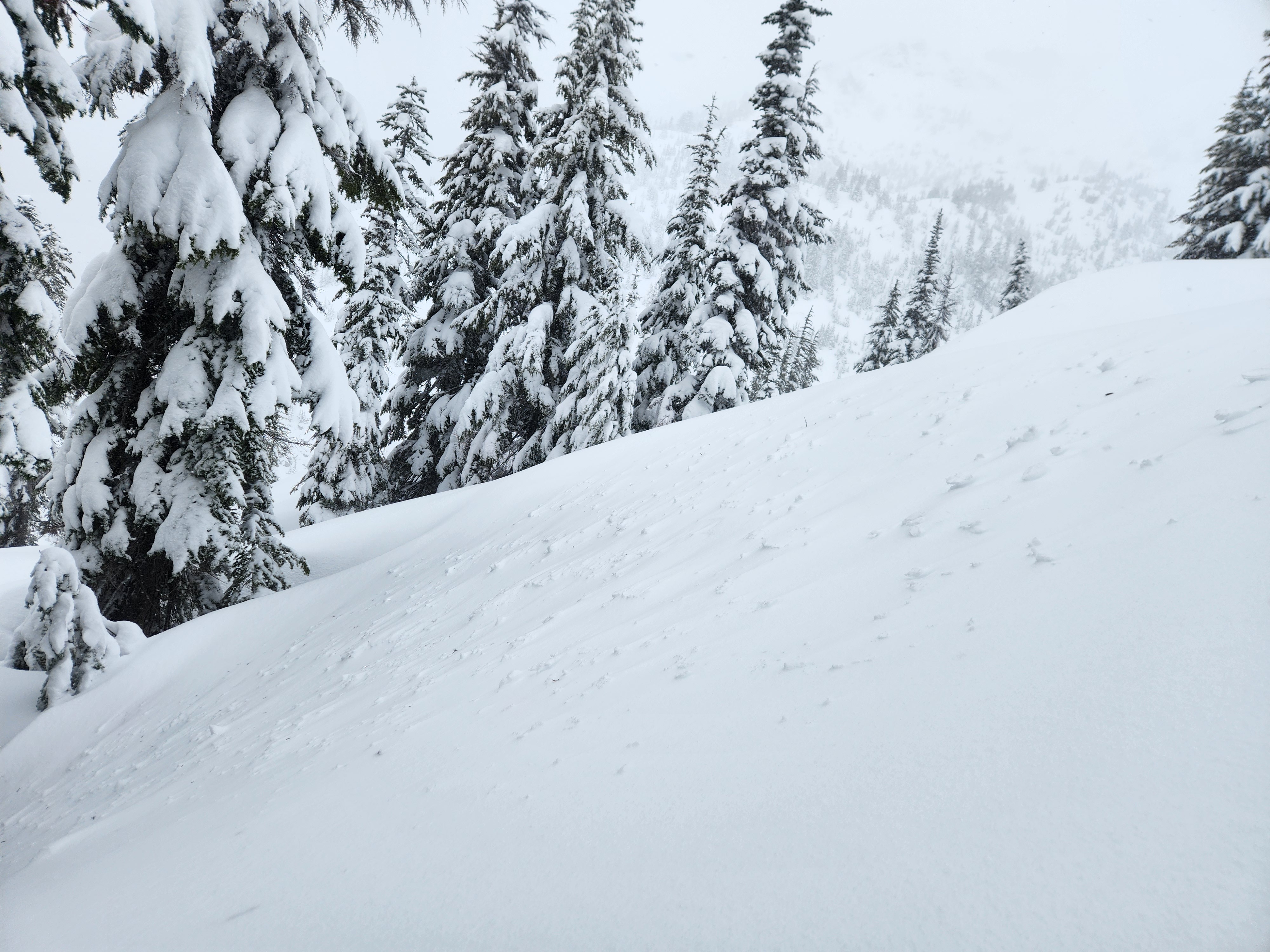
I found about 16" of total storm snow, with an inter-storm crust down about 12" above 4500'. The low-density surface snow sluffed easily, including in the trees. Test slopes were generally non-reactive and uptrack tests yielded some stubborn localized cracking, especially in more wind-loaded terrain. Ski quality was quite good at these elevations. All in all, the storm layers are there and should be investigated, especially in wind-loaded terrain, however, these felt more manageable compared to the persistent weak layer which made its presence known.
We have been tracking both the January Drought Layer (JDL) of facets and surface hoar, as well as facets above and within the 1/10 crust complex. As I crested onto a north aspect at 5200', I felt and heard a resounding whumpf that propagated quite widely. Wanting to dig in an area where I hadn't already collapsed the weak layer, I back tracked about 50' and dug a pit there. To my surprise, I couldn’t find any evidence of the JDL (may have been blown away in this location), but the 1/10 was quite prominent and ominous looking. Below a zipper of crust at the top of the 1/10 interface, two extended column tests propagated fully and with a lot of energy in 1-2 mm well-developed facets overlying more slick crust. They both cash registered into the pit, despite being on a relatively shallow angle. The slab was only F-4F, but was comprised of a significant load of snow water equivalent. I then proceeded to a SE aspect and dug a pit there as well, but the 1/10 was not nearly as mean-looking and 3 ECTs failed to propagate.
A whumpf and multiple propagating test results are enough to make me avoid steep and sustained slopes at the middle and upper elevations moving forward. The combination of poor structure, reactivity, and spotty and inconsistent distribution makes this problem unmanageable for the time being. We need more time to let this play out, and to assess more aspects and elevation bands for the problem. It's unclear how widespread the issue will be and whether we will start to see human-triggered avalanches on either the JDL or the 1/10, but where these layers exist, they are often weak and are now overlayed by a significant slab that will get thicker and eventually harder moving forward.
Observed a rumbling and widely propagating whumpf on a north aspect at 5200'. Other than that, very localized cracking around ski tips in wind loaded areas.Weather
- Cloud Cover
- overcast
- Wind Loading
- moderate
- Recent Snowfall
- HST 40 cm
- Snow Avail For Transport
- large amounts
A cold and stormy day. Light snow (s-1) throughout most of the day, which picked up an intensity in the mid-late afternoon (s-2-). Winds were moderate with strong gusts at the middle and upper elevations with lots of blowing snow. Visibility was quite poor, which limited my ability to observe any recent avalanches in nearby terrain.
Snowpack
Minimal accumulation and thus hazard below about 4500'. Between 4500-5200', I observed total storm accumluations between 12 and 16". There was a crust a few inches below the surface at lower elevations which transitioned to a density break at about 4000' and mostly disapeared above 4500'. Ski penetration was between 10-12" down to the inter-storm crust After observing a rumbling and widely propagating whumpf at 5200' on a north facing aspect, I backtracked about 50' and dug a pit.
HS 262 cm
262 - 235 - F to 4F storm snow
235-232 - 1F+/P inter-storm crust/density break - ECTN 12
232-222 - 4F storm snow
222 - 218 - 1F and friable - top of 1/10 Crust Complex
218 - 216 - 4F 1-2 mm facets - ECTP 21 x2, lots of energy
216 - 209 - Rest of 1/10 complex, crust and facets
Notably, the JDL was not readily observable in this location.
I dug another pit on a SE aspect at the same elevation.
There, the 1/10 was far more benign looking. The area was a bit more loaded and as such, the 1/10 was down 60 cm. CT4 Q2, ECTN down 27 cm at the inter-storm crust, ECTX x3 at the 1/10.