
Quick report
- Collapsing
- Observed
Whenever I stepped off my previous skin track, established before the 12/25 storm cycle, we could hear collapses. The Pioneer Mountains received less snowfall than the Smoky Mountains, with storm totals ranging from 35 to 45 cm at the elevations we traveled. Late in the afternoon, brief breaks in the clouds allowed partial visibility into the alpine, where I identified one natural avalanche. It’s likely that additional avalanches were obscured by the lingering cloud cover.
Weather
- Cloud Cover
- obscured
- Recent Snowfall
- 3 cm
On and off snow through day with max rates of S1.
Snowpack
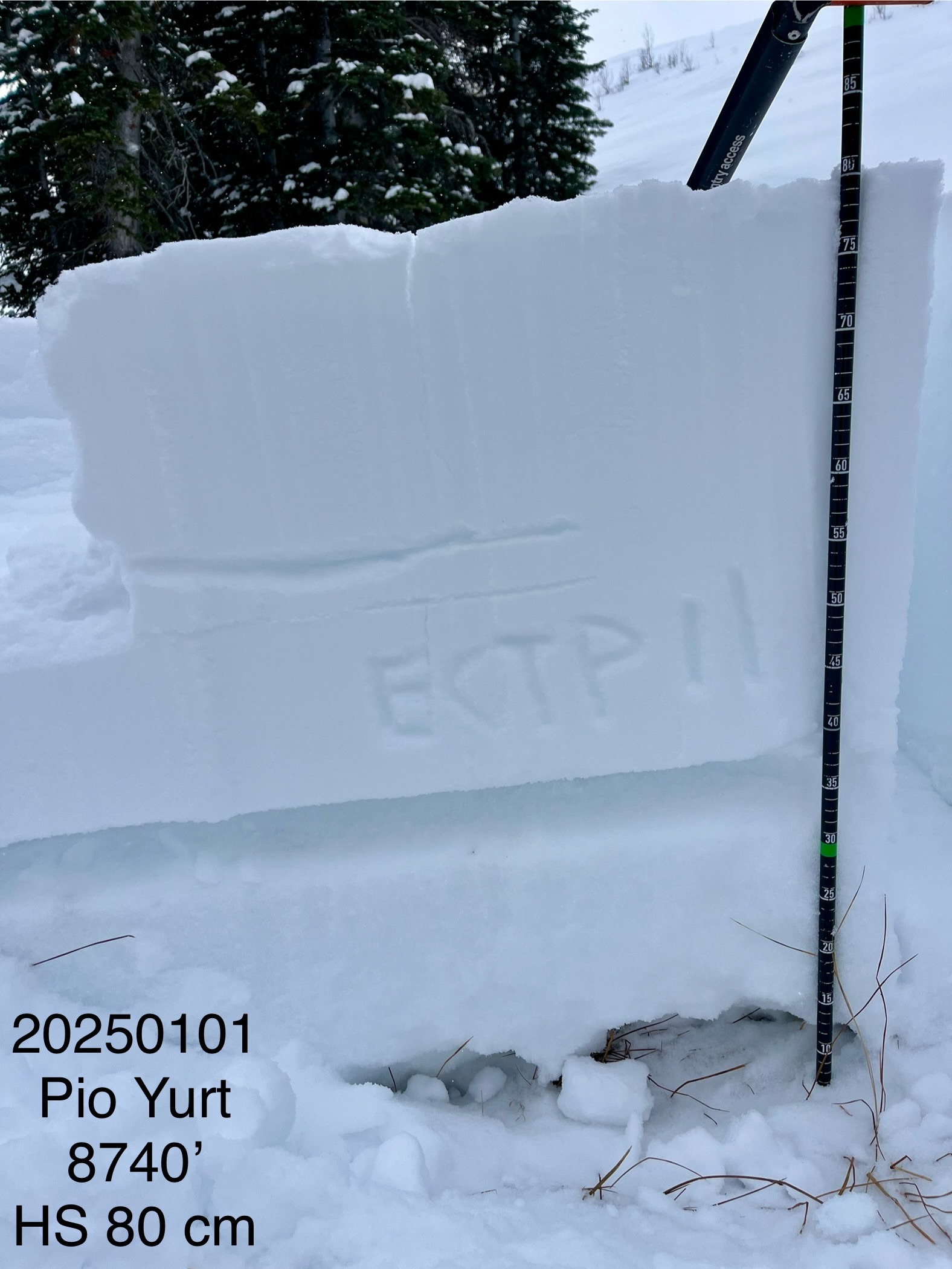
I conducted a snowpit near the yurt in a shaded meadow. While approaching the site, we observed collapses propagating approximately 15 meters (50 feet). The storm snow from the December 25 cycle measured 43 cm (17 inches) in thickness and ranged from Fist to 4F+ hardness. A thin melt-freeze crust separated the new snow from the underlying facets, which were about 7 cm thick and 1–2 mm in size. Two large column tests yielded propagating results on this layer with 10–11 taps.
Avalanche
- Size
- D2.5
- Type
- SS
- Aspect
- N
- Trigger
- N
- Elevation
- 9100 ft
This large avalanche failed 1–2 feet deep on a persistent weak layer, with the crown extending approximately 1,000 feet around a subtle terrain feature. Observations suggest the failure likely occurred near the end of the storm cycle on December 25.