
Quick report
- Cracking
- specific
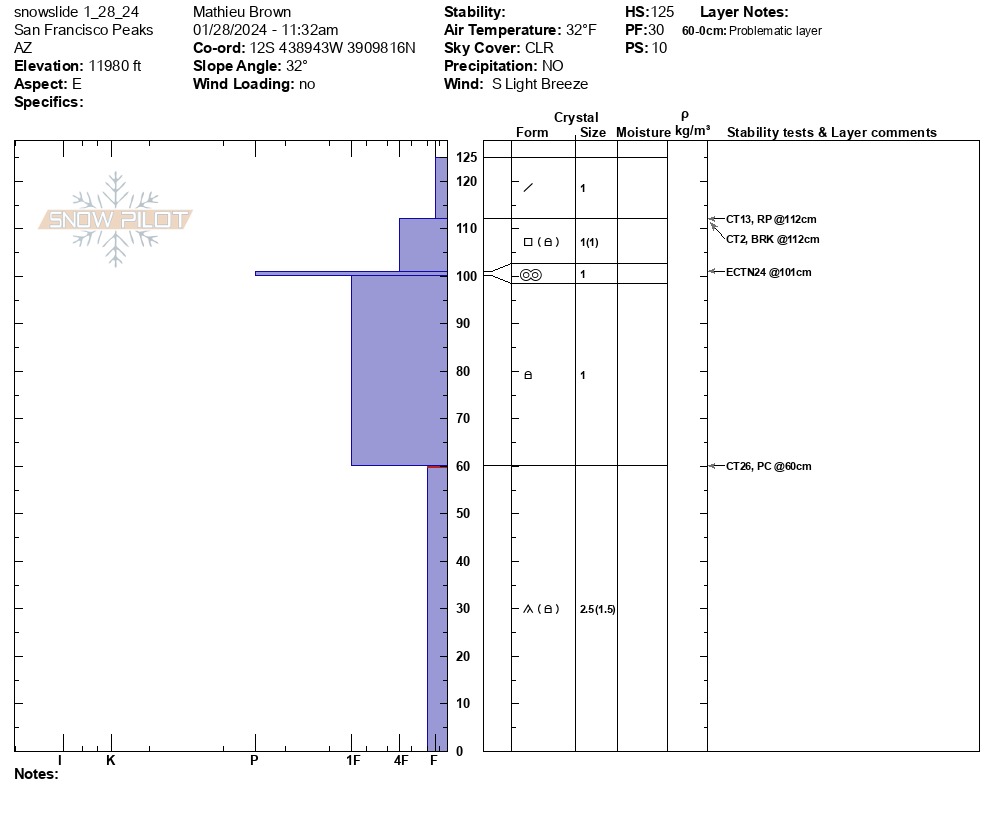
Snow depths are highly variable across the inner basin, snowslide, north core, and Humphrey's cirque. Some lines are skiable with minor obstacles and depths range from 30 cms across ridgelines to approximately 100 cms in gullies, to as much as 120-220 cms in catchment zones. In general, the structure remains poor, strength is medium to high, and propagation propensity is low to moderate. Loaded steep slopes represent the greatest reactivity. Depth hoar has demonstrated reactivity at CT 20-30 in both ECT and CTs.
The upper 10 cm of crust showed signs of instability in shearing when skinning and descending slopes greater than 33. They broke in sections and were not continuously reactive.Weather
- Air Temp
- 33
- Cloud Cover
- clear
The clear skies and fair weather on Saturday did not significantly impact the Eastern aspects. Temperatures today climbed just above freezing and may develop into a melt/freeze crust this evening.
Snowpack
Upper elevation east-facing steep slopes have been affected by wind and minor melt/freeze cycles. In the mid-slope terrain, these cycles are less evident. Numerous pits have revealed facets on most every elevation and aspect, but their reactivity varies from unreactive to stubborn. With enough loading this layer of concern could become reactive. Slopes are showing a high amount of spatial variability and varying continuity. On all aspects there is an additional persistent slab problem in the upper layer of the snowpack. Thus far, column tests, extended column tests, and ski cuts reveal that this layer does not have the propagation propensity to release on a slope-wide scale and, instead, is typically unstable in isolated pockets. Nonetheless, this will also be a layer to track if the snowpack is loaded with more than an inch of SWE.