
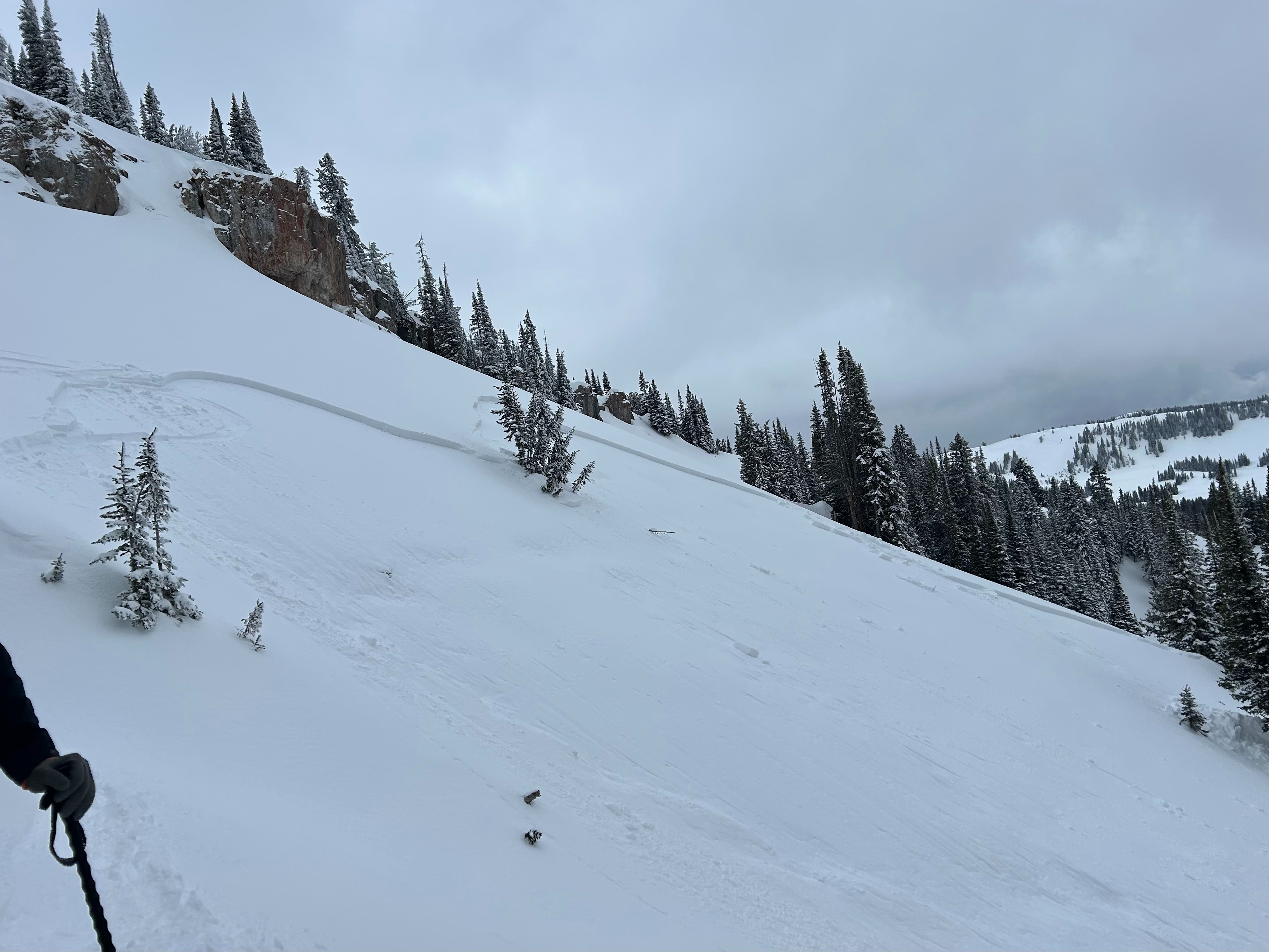
Quick report
See avalanche description. We noticed several other R1D1 avalanches near ridgelines on N/NE aspects above 8,500 feet while traveling from Chicken Knob to Treasure Mountain. Average new snow depth was 8-10 inches. Weather was cloudy and in the mid-twenties. No wind or precip. Snow had a light zipper crust but skied generally well on E/N/W aspects. Impression of stability is very spatially variable. Before the avalanche our slope gave us no indications of instability. A hand pit 30 feet away from the trigger point indicated no instability. And after the avalanche we noticed no further instabilities for the ensuing 2,000 feet of skiing in and around avalanche terrain on the same aspect.
Avalanche
- Size
- D2 R2
- Type
- SS
- Aspect
- W
- Trigger
- AS
- Elevation
- 9300 ft
About 50' below the initial cliffband/rollover leading to the large west facing avalanche path above the Painted Lady Couloir (south of the southernmost "Eddington Chute") the first skier triggered a R2D2 soft slab on a 35 degree WNW aspect, while transitioning to the skier's left wall of the main west facing avalanche path. We encountered some wind drifted snow just off the ridge line, about 100 feet higher (west facing, similar slope angle), but it was unreactive, short lived, and bypassed via trees. Once into the main avalanche path, hand pits revealed about 8 inches of low density snow with no slab formation. About 30 feet below the hand pit the avalanche was triggered, while skiing from the main west facing gut to the skier's left wall, which faces gently WNW. Just before the avalanche propagated the skier noticed a density change indicative of wind drifted snow. The avalanche "point released", with a 12" crown, 150 feet wide, and ran approximately 300 feet. The slab lacked energy and propagated slowly, composed of moderate density snow, and appeared to fail on the faceted surface buried after the January high pressure. I listed this as a storm slab, however, the abrupt density and depth change relative to the main path, and location near a ridgeline, is consistent with a wind slab. After the avalanche we transitioned to the trees and traveled north into the main Eddington Chutes area with no instabilities observed.