
Quick report
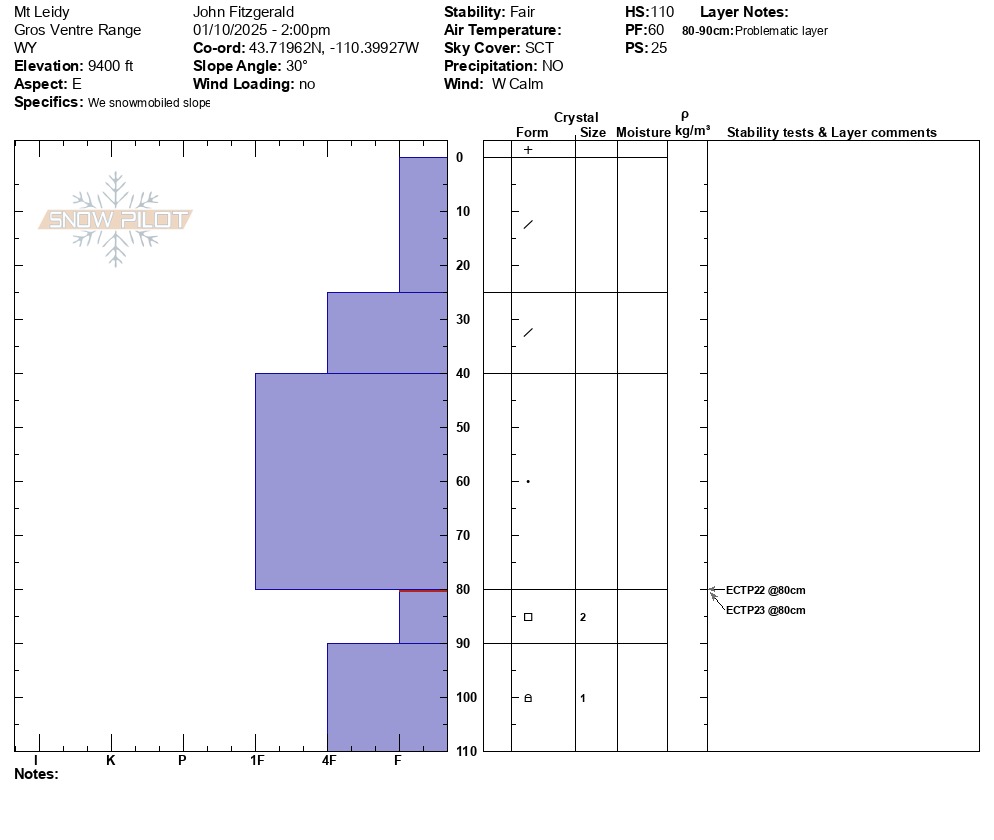
Snowpack depth varied greatly depending on elevation. At lower elevations (below 9000') snowpack depth was generally less than 3 feet, averaging 1 to 2 feet through elevations below 8000'. Above 9000' the average depth significantly increased. In areas unaffected by the wind, we found an average depth of 4.5 feet. Weak snow is buried ~4 feet deep in the Leidy area. Our snowpit tests yielded an ECTP22 and ECTP24 failing on the facets near the bottom of the snowpack. The weak layers in this area are becoming more difficult to trigger. If triggered, the buried weak layer may still propagate across the slope or upslope causing a large avalanche on slopes over 30 degrees.
Recent winds from varying directions have created wind-loaded pockets along ridgelines and stripped the snowpack in other locations. We found areas in the upper elevations where thick snowpack existed near terrain stripped to the ground. This means there are shallow areas in the snowpack where it's easier to trigger buried persistent weak layers.
We noted recent avalanches that are likely 3-5 days old. We observed no other signs of instability.Weather
- Cloud Cover
- overcast
- Wind Loading
- previous
- Snow Avail For Transport
- small smounts
Cold temperatures today with a temperature inversion. The morning temperature at the Ranger Station was 11 F. Climbing up to the higher elevations, temperatures increased to the upper teens by mid-day. Winds were generally light from the north. Sky was covered the entire day, no precipiation was noted.
Avalanche
- Size
- D1 R1
- Type
- SS
- Aspect
- E
- Trigger
- N
- Elevation
- 7800 ft
We observed multiple avalanches on all aspects below 9000'. These avalanches occurred around 7800' where the snowpack ranges from 1-2 feet deep and failed on buried weak layers. It's hard to know exactly what triggered these avalanches. Our best guess is the sunny weather caused a temperature increase on Tuesday (1/7) and buried weak layers failed during this period. All of these avalanches were small (no larger than D1.5) and were approximately 1 foot deep.