
Quick report
- Collapsing
- specific
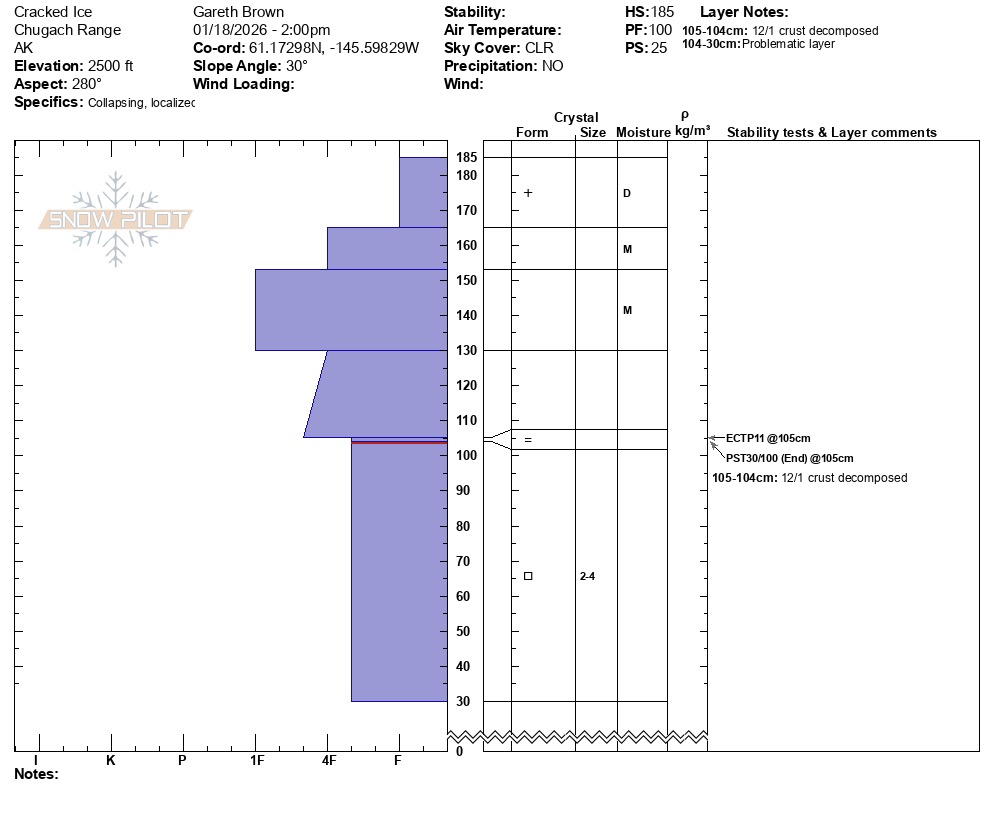
Rain crust down low was found to be supportable creating a strong upper snowpack with avalanche unlikely where it exists. At elevations just above the rain crust (>2500') found a thick slab (2.5-3 feet) above reactive facets (weak snow). Easy to moderate propagation was observed in ECT and PST stability tests indicating that dangerous avalanche conditions exist in the mid elevations on slopes that are steeper than 30° and have not already naturally avalanched. A very important observation was that we found significant signs of instabilities here a week ago. Today we only received one piece of feedback, but it was significant. After we had dug our pit and excavated some of the facets, josh climbed out of the pit to grab a piece of gear and got a significant collapse. This combination of observations concludes that weak snow exists at the base of the snowpack that is overloaded by a heavy slab. Areas that have not avalanched and are steep enough to do so may not give signs of instability while travelling despite dangerous conditions existing. Another point users should be aware of is that the overlying slab has gained significant mass and is far more dangerous than it was a week ago.
Above 3000' weak snow was less prominent. We probed a lot of areas and continue to find the snowpack structure to be variable, however weak snow generally exists at the base of the snowpack, but is less developed compared to the mid elevations. No significant stability tests were observed, however caution is advised.
Widespread natural avalanche activity was observed in the mid elevation band, coinciding with the failure of the 12/1 rain crust. There were also many naturals above this elevation band (above 3k). Activity appeared to be mostly mid-storm as many crowns were filled in to some point.Weather
- Cloud Cover
- clear
- Wind Loading
- previous
- Rain Elevation
- 2500
- Snow Avail For Transport
- moderate amounts
Snowpack
Found a supportable rain crust at the road level with 1 cm of snow on top. Snow overlying the rain crust quickly increased to 10 cms, and the crust disappeared at 2500'.
Dug a pit at 2500' in close proximity to a pit we dug a week earlier (prior to last big storm) where the 12/1 PWL was showing clear signs of instability. Structure is poor and stability test yielded very concerning results at this elevation band.
Above 3000' the snowpack changes and structure improves but is highly variable. Weak snow exists near the base of the snowpack, but is less developed and consistent.