
Quick report
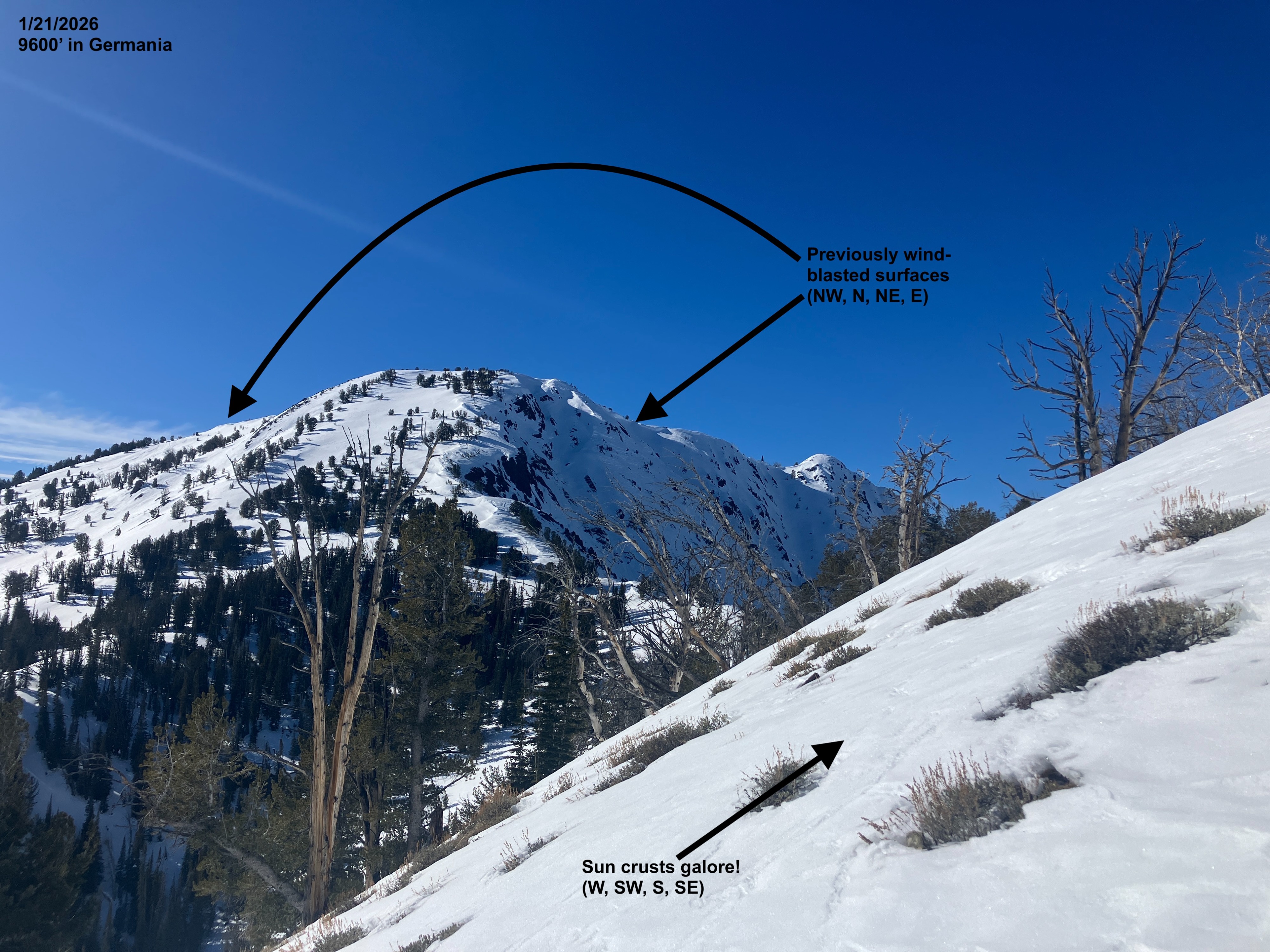
Today, we went out to survey surface conditions near Germania. We generally found either well-developed crusts or soft, sugary surface snow depending on a given slope's exposure to the sun. A few additional things stood out to us:
- It was WARM, yet the surface snow seemed too "beaten up" from recent warm/cold temperatures to moisten to the point of instability
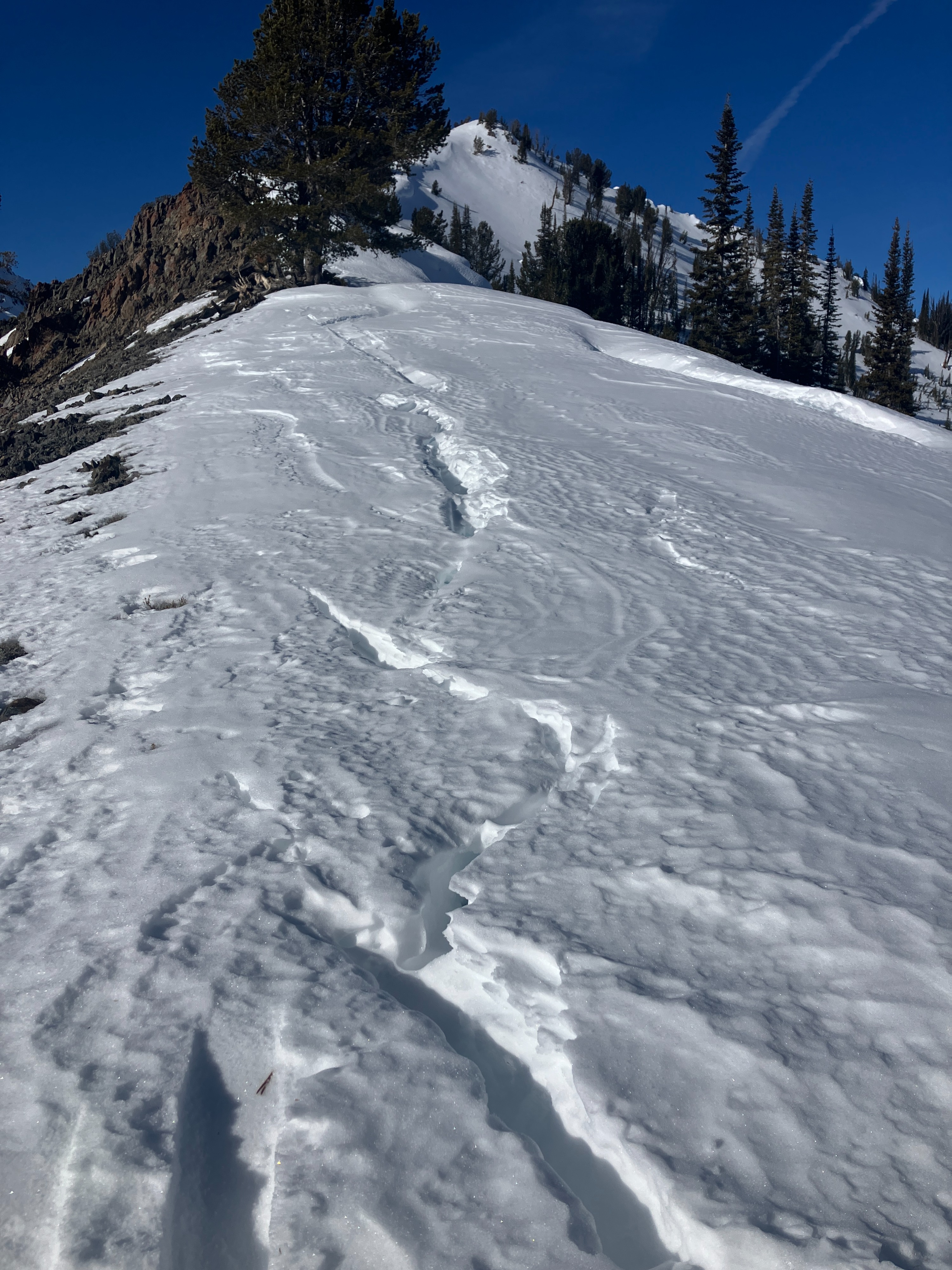
- Cornice crevasses are widespread and surprisingly deep. As these behemoths creep away from their roots during the prolonged warm weather, be aware of the hazards of falling through these shallowly bridged holes.
- The snowpack is quite deep in middle and upper elevations in the Germania area
Weather
- Air Temp
- 40+
- Cloud Cover
- clear
- Wind Loading
- previous
- Recent Snowfall
- 0
- Snow Avail For Transport
- none
Clear and warm today with mostly calm to light NE winds.
Snowpack
Slopes facing the sun: Widespread sun and melt-freeze crusts were found anywhere the sun touched. On steep slopes, these crusts were mostly supportable and even developed a bit of corn on S and SW aspects by the end of the day. On lower-angle and/or SE facing slopes, the crusts were mostly breakable and 1-2 inches (2-4cm) thick.
Sheltered slopes: During this high-pressure period, widespread surface faceting is occurring on all slopes not affected by the sun or scoured down by wind. The "sugar" snow is primarily found in the upper 4-8 inches (10-20cm). This includes previously very firm wind slabs that are actively softening through faceting.
We dug a quick pit on a NE aspect at 9500' that was previously wind loaded and found a right-side-up snowpack with pronounced near-surface facets making up the upper 20cm. These facets failed in testing (ECTN11@20cm↓) but did not propagate due to the lack of a cohesive slab above. 1/1 did not present as a crust, but as a hard-to-discern density change. 12/5 was buried approximately 170cm down. Total snow depth was 195cm.