
Quick report
- Collapsing
- Observed
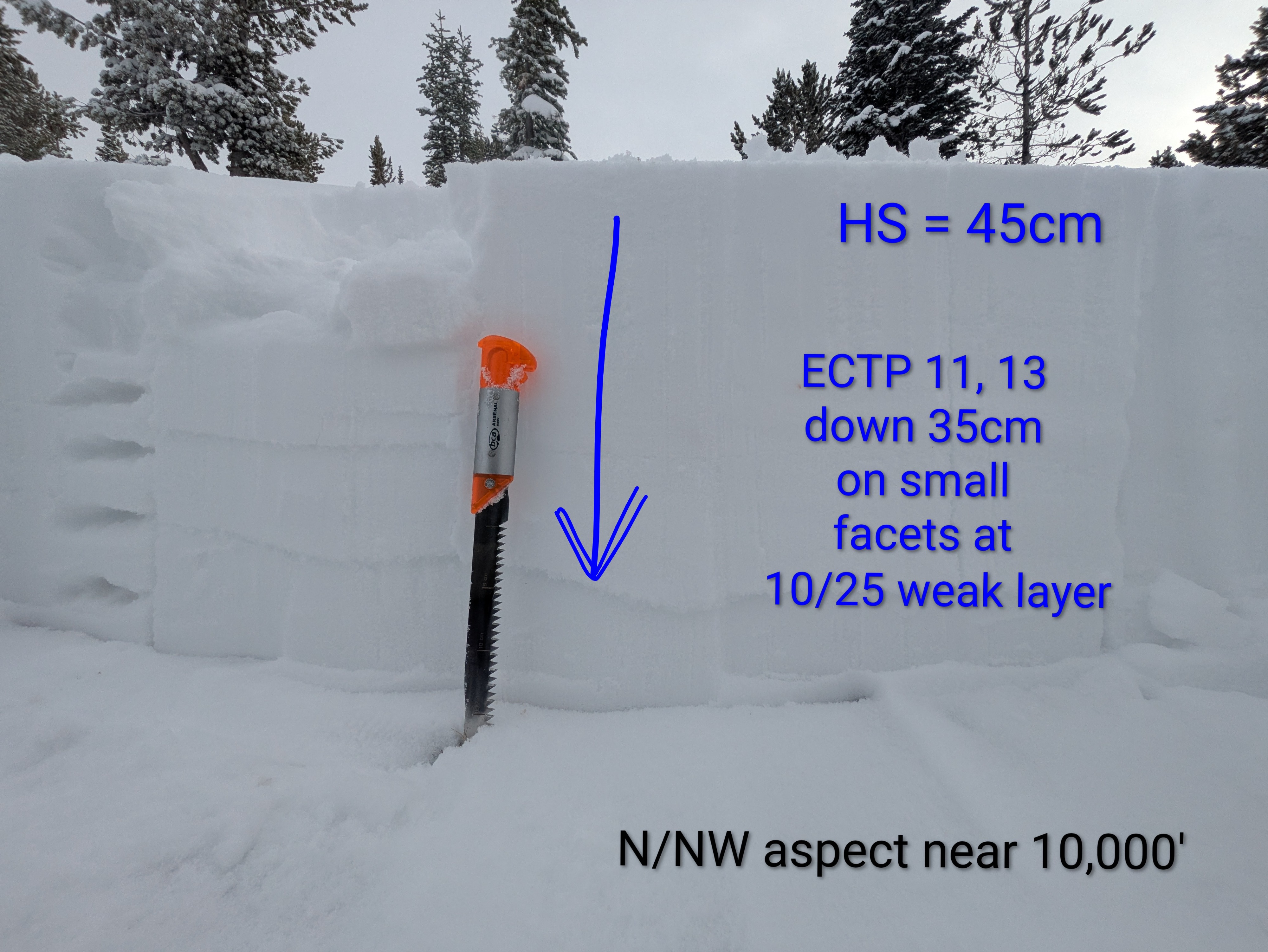
<8cm new snow along valley bottom (6,500-7,000), 20-25cm new snow by 8,500'. Density changes in the new snow produced rough shears. I dug a pit near a ridgeline around 10,000' on a N/NW aspect, where HS=40-50cm. As I approached my pit I triggered a small collapse involving a wind drift. The collapse occurred at the weak layer that we began to bury on Saturday, the "10/25". Snowpack tests produced ECTP 11 and 13 on this layer. I found it down 30-35cm in the wind-loaded location where I dug, and down 20-25cm in non-winded terrain. There was no crust at the 10/25 where I dug, just some small facets, and the layer was quite irregular. The overlying slab was still soft, grading from F to 4F. More exposed alpine terrain in the range took a beating from the wind. The 10/25 weak layer poses the greatest snow-related hazard in the backcountry. Finding this layer with a fresh slab on top is most common in upper elevation terrain on shaded slopes, but I'm paying attention to it wherever I find old snow underneath this weekend's storm snow. General early-season hazards (rocks/stumps/etc) are widespread , which draws travelers towards areas with more snow...the same areas where encountering an unstable slab is most likely. Single collapse in wind-loaded, upper elevation terrain near ridgeline.
Avalanche
Small dry loose sluff on SE face at 10,000 (tail end of storm, running on crust). I could see a lot of terrain did not see any slab avalanches.