
Quick report
- Cracking
- specific
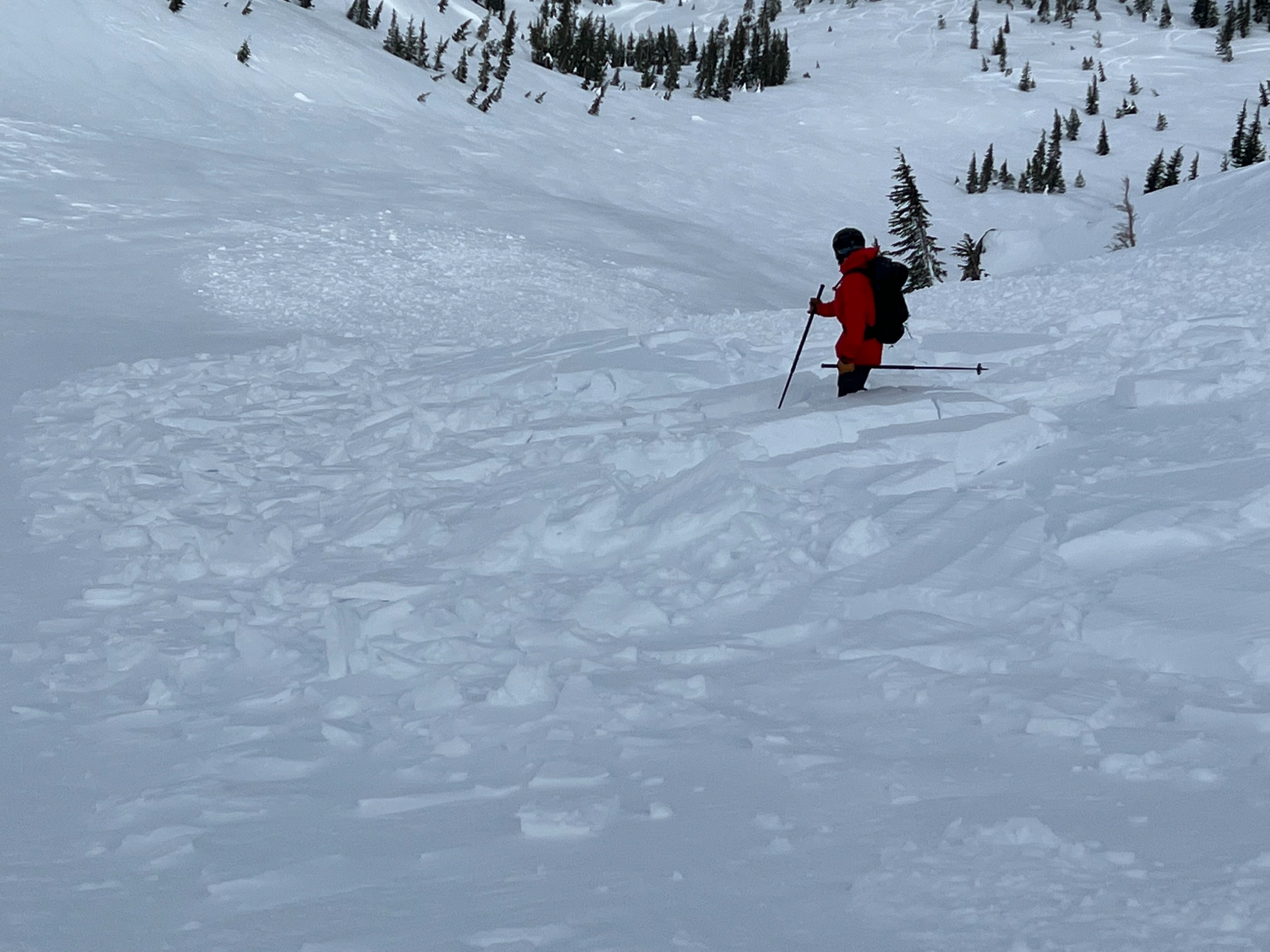
We went for a tour today in the Chief Creek zone. The NE winds were already cranking by mid morning and tossing plumes off of exposed ridges. With obvious wind effect observed, I was curious about the extent of fresh wind loading. A stiff kick to a small cornice was able to trigger a predictably small wind slab (4-6", ~25' wide), that ended up running full track down into the bowl below. What was interesting was that this small avalanche ended up triggering a second, much larger slab avalanche on the lower angle apron below. This second slide had a crown up to 2' deep, approx. 200' wide, and ran approx. 600' vertical. Elevation at the first, smaller crown was ~8900', elevation at the secondary, larger crown was ~8600'. Aspect was due North, slope angle was ~38* (at second, larger slide). We did not access or investigate the crown, only the debris below (photo). My best guess is that the lower apron experienced cross loading with the NE wind and the significant loading from the first slide was enough of a trigger to get things moving. We then skied lower angle terrain and saw no further signs of instability.
Avalanche
- Size
- D2
- Aspect
- NW
- Trigger
- AS
- Elevation
- 8600 ft
We went for a tour today in the Chief Creek zone. The NE winds were already cranking by mid morning and tossing plumes off of exposed ridges. With obvious wind effect observed, I was curious about the extent of fresh wind loading. A stiff kick to a small cornice was able to trigger a predictably small wind slab (4-6", ~25' wide), that ended up running full track down into the bowl below. What was interesting was that this small avalanche ended up triggering a second, much larger slab avalanche on the lower angle apron below. This second slide had a crown up to 2' deep, approx. 200' wide, and ran approx. 600' vertical. Elevation at the first, smaller crown was ~8900', elevation at the secondary, larger crown was ~8600'. Aspect was due North, slope angle was ~38* (at second, larger slide). We did not access or investigate the crown, only the debris below (photo). My best guess is that the lower apron experienced cross loading with the NE wind and the significant loading from the first slide was enough of a trigger to get things moving. We then skied lower angle terrain and saw no further signs of instability.