
Quick report
- Cracking
- Observed
- Collapsing
- Observed
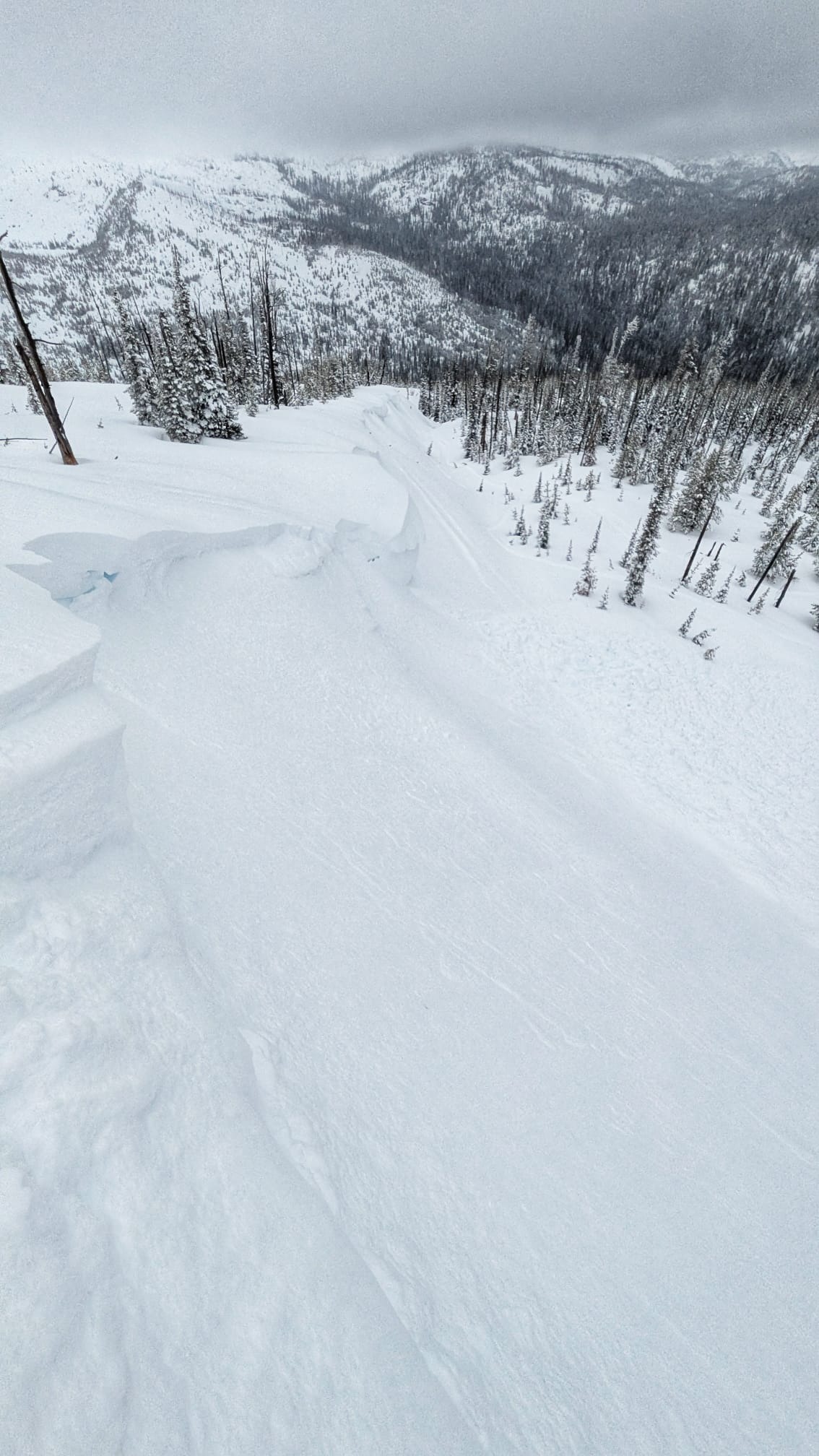
We headed to the crest of the Bitterroot to see how much more snow had accumulated here, and how sensitive recent wind slabs were. We found up to a foot of new snow in upper elevation terrain at the back of the drainage. The wind had moved snow around in the most exposed terrain, where we found generally soft slabs 1-2 feet thick. These produced some minor cracking and one small avalanche on a test slope on a NE aspect at 7,600'.
Our main focus remains on the persistent weak layers buried in the upper snowpack. These two layers are pretty close together in the snowpack (6-8 inches apart), and are buried 2-3 feet below the snow surface. We experienced no signs of instability with these layers, but our nonstandard snowpack tests produced unstable results and last week's widespread natural avalanche cycle is hard to ignore. These layers are not improving quickly, and the potential for triggering a large avalanche involving these layers continues to be our primary concern, and continues to drive our terrain selection.
We intentionally triggered a small wind slab avalanche in safe terrain from the ridgeline above. It took some effort, stomping around in wind-loaded snow. The slide broke about 50 feet wide, 1-2 feet down, tapering quickly away from the ridge. Other similar pockets that we pushed on did not move. Wind slabs produced short cracks, and occasional muffled collapsing.Weather
- Wind Loading
- previous
- Recent Snowfall
- 25
- Snow Avail For Transport
- moderate amounts
A mix of clouds and sun in the valley, with cloud cover increasing as we rode deeper into the drainage. By the time we got to the head of the drainage, a cloud deck was hovering around 7,500-8,000'. We climbed into this cloud deck, where significant rime was accumulating on the trees and on us. Light flurries of graupel and rimed stellars through the day produced less than an inch of new snow. 1 inch of wet new snow at 4,500', increasing to 4-6 inches by 5,500', and 8-10 inches by 6,500'. Winds were light and occasionally gusty, it did not seem like there was much constructive loading going on.
Snowpack
At the truck, we found an inch of new wet snow sitting on dirt, rocks, pine needles and packed ice. This increased to a few inches by 5,000'. 5-6 inches by 5,500' and 8-10 inches by 6,000'. At lower elevations, the days of heat followed by rain had wetted the entire snowpack. A 1-inch-thick, partly frozen crust sat on top of the wet snow and under the new snow. It appeared that heavy rain had fallen up to above 6,000' before temperatures cooled and precipitation switched to snow.
- A snowpit at 6,200' on a WNW aspect revealed an upper snowpack that had seen a significant amount of water down to and past the January drought surface (buried around 2' deep here). There were small amounts of liquid water hanging at crusts. Snowpack tests did not produce unstable results here, it felt like our columns were just progressively squishing into wet snow.
- By 6,800', most of the precipitation had fallen as snow. There was a bit of moisture in the upper snowpack, but no visible liquid water. The slab above our main layer of concern (the January drought surface, and the Valentine's Day surface hoar). Standard loading steps in ECTs did not produce fractures on these layers, but continued hits from the shoulder eventually produced dramatic, propagating results. A non-standard Deep ECT (upper soft snow removed, test starts with hits from the shoulder) failed after 4 shoulder hits. This layer presented as partially laid-over surface hoar and facets resting on a crust.
Continuing up, we focused mainly on wind slab issues. We found and traveled through slabs in much of the terrain we saw between 7,000 and 8,000'. These ranged from F+ to 4F+ in hardness, and were 1-2 feet thick. Some produced minor cracking extending just a foot or two from our skis. We intentionally triggered a small wind slab avalanche in safe terrain from the ridgeline above. It took some effort, stomping around in wind-loaded snow. The slide broke about 50 feet wide, 1-2 feet down, tapering quickly away from the ridge. Other similar pockets that we pushed on did not move.
There is a lot of light snow sitting around waiting to be transported. With a forecasted wind event on Sunday and Monday, we could see a lot of this snow put into play and drifted into stiff, hard slabs.
Avalanche
We intentionally triggered a small wind slab avalanche in safe terrain from the ridgeline above. It took some effort, stomping around in wind-loaded snow. The slide broke about 50 feet wide, 1-2 feet down, tapering quickly away from the ridge. Other similar pockets that we pushed on did not move. We didn't have great visibilty, but we could see a number of suspect pieces of terrain that had not produced recent natural avalanche activity.