
Quick report
- Aspect
- North
- Red Flags
- Poor Snowpack Structure
- Elevation
- 2835 m
- Slope Angle
- 30°
- Red Flags Comment
- <p>This drainage had the weakest snowpack structure I have observed this season - weaker than upper LCC, Millcreek, as well as a few other drainages in BCC. Did get one collapse on NE aspect at 9000'</p>
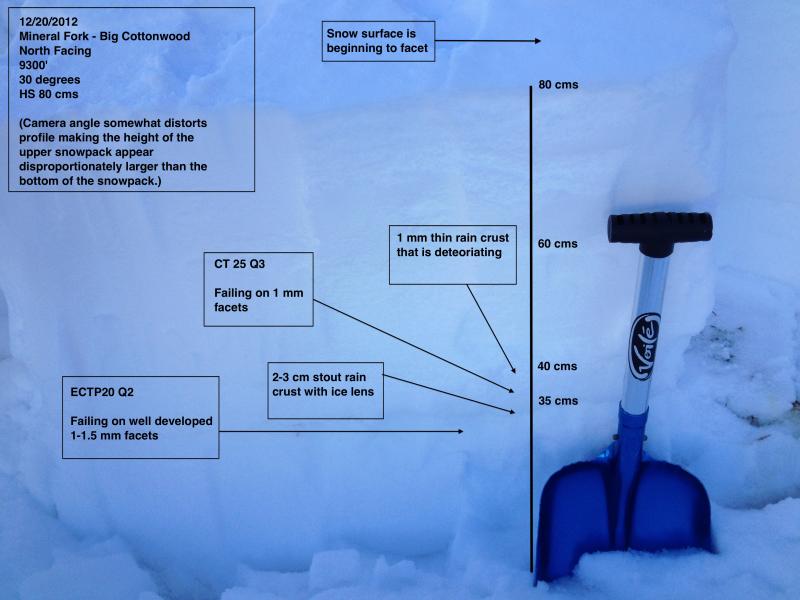
Quite a bit of spatial variability observed today. For the most part, was finding a generally thin snowpack up to 9500' with snow totals roughly between 60-90 cms (1.5-3'), although quite often on the lower end. On one ridgeline running east-west there was little evidence of much wind affect, on an adjacent ridgeline was finding the snow surface scoured down to late November rain crust. Was finding a very stout 2-3 cm rain crust with ice lens up to about 9300'. I have not observed this stout crust at these elevations in the tri-canyon area this season. First video shows results of ECT failing below lower rain crust.
This video shows the weak, faceted snow where the ECT fractured.
Excellent skiing/riding/travel conditions in this beautiful low light at the Solstice. This slope was unskied, but with poor snowpack structure, am not seeing a reason to stick my neck out on steeper slopes.
Snowpack
- Instability Comment
- <p>Was finding 2 rain crusts buried anywhere from 15 cms (6") to 45 cms (18"). Top crust is very thin & brittle - often difficult to identify. Bottom crust is stout and 2-3 cms thick with an ice lens. Facets below lower crust appear weaker than faceted layer between crusts, likely because the lower crust forms a vapor barrier and upper crust does allow some vapor transfer. (Keith Stebbings identified something similar I believe near Brighton.) ECTP20 down 40 cms (below lower crust.)</p>
Some faceting as well as surface hoar noted in the top few cms of snow. A few thin old windboards were also noted. In some places, the wind scoured all the new snow down to the 2-3 cm thick rain crust leaving total snow depths at about 30 cms (12"). For the most part, observed snow depths ranged from 60-90 cms (2-3')