
Quick report
- Cracking
- specific
- Collapsing
- isolated
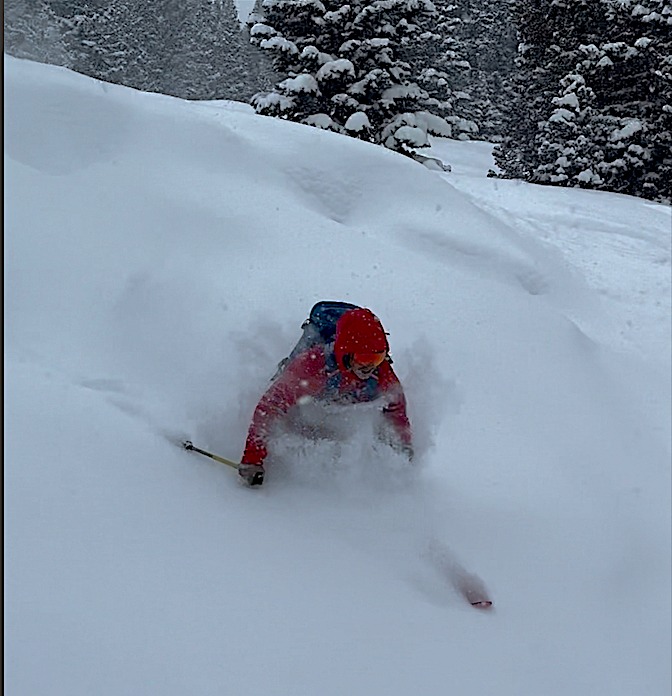
The goal of today's fieldwork was to gauge the sensitivity and size of avalanche problems in sheltered areas on the north half of the compass by selecting small, low-consequence test slopes. Avalanches were easy to trigger on small test slopes on north and easterly aspects. Even though slabs were only a foot thick, the entrainment of the old snow below made for larger-than-expected debris piles. We did not travel near any wind-drifted slopes, but natural activity on Schuylkill Ridge suggested that more cohesive slabs were forming in wind-affected areas. Riding conditions were very nice on modest slope angles around 30 degrees.
We experienced a few quiet collapses and cracking on steep terrain features. We skied several small, low-consequence slopes, looking for feedback on avalanche conditions. We triggered 3 small avalanches breaking on the weak facets below this weeks snow.Weather
- Cloud Cover
- overcast
- Recent Snowfall
- 30
- Snow Avail For Transport
- moderate amounts
Light snowfall during our tour. About 2 inches accumulated during the 5 hours in the field. Winds remained light at our below treeline elevation with minimal transport near valley bottom.
Snowpack
At 230 pm, around 14 inches of recent snow sat above a faceted snowpack. Collapsing was quiet and relatively infrequent, and cracking traveled up to 20 feet. Traveling above and skiing a few small test slopes, it was easy to trigger slab avalanches. Avalanches entrained lots of old snow as they ran and would have easily reached a large size on longer slopes.
Precip rates were relatively slow while we were in the field, and it felt like the snowpack in sheltered areas was near but short of natural avalanche activity. I suspect a brief period of strong snowfall would have tipped the snowpack over the edge in sheltered areas on the north half of the compass.
Avalanche
- Size
- D1
- Type
- SS
- Count
- 5
- Aspect
- NE
- Trigger
- AS
- Elevation
- 10100 ft
Visibility was poor, but we could see two natural avalanches immediately below Schuylkill Ridge. There was enough propagation in these wind-drifted avalanches to make them difficult to manage, and it would best to avoid drifted terrain. We intentionally sought out small test slopes in sheltered terrain to get feedback on the developing Persistent Slab problem on northerly slopes and were able to find sensitive avalanche conditions. The entrainment of old snow created debris piles bigger than one might expect from foot-thick, soft slabs.