
Quick report
- Cracking
- specific
- Collapsing
- specific
The snowpack continues to be screaming instability below 3000', where the 12/1 faceted rain crust exists. Human triggered avalanches are likely on slopes free of brush that are steeper than 30° below 3000'.
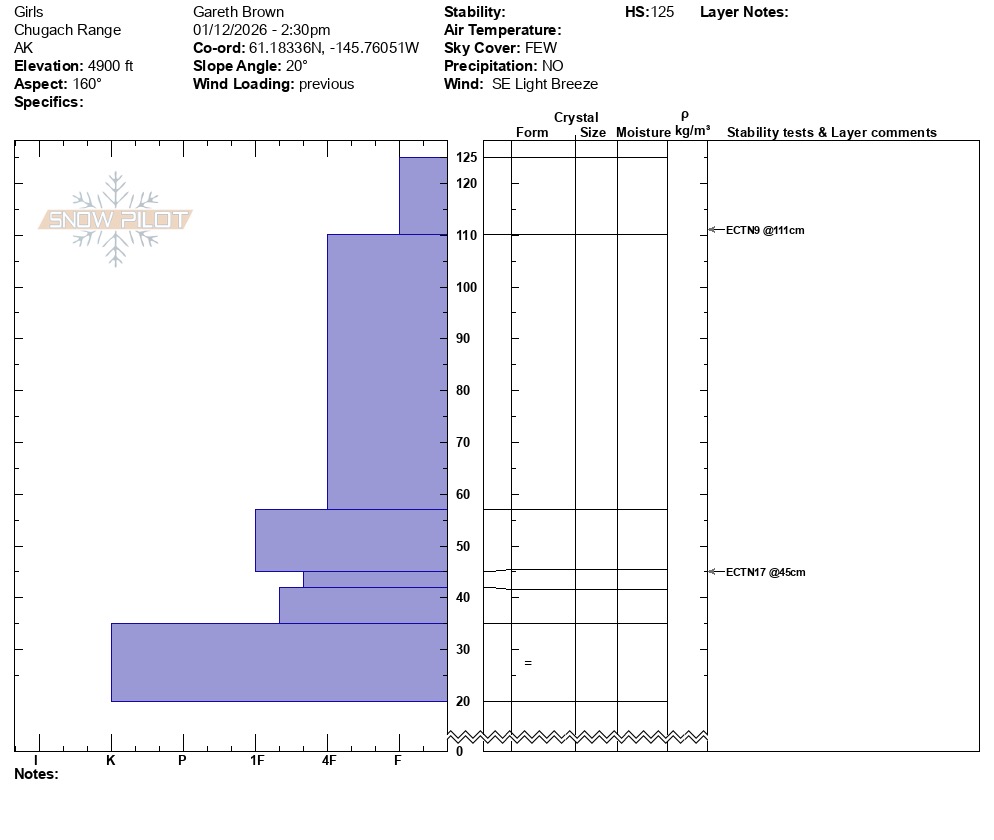
Above 3000', bonding of the new snow at the interaface of the old wind slabs was found to be good in the area we travelled. The snowpack still has weak snow at the base, but is bridged over by extremely hard wind slabs. The depth and strength of wind slabs was found to be variable, but the current load makes it unlikely for deep slab avalanches to be triggered except for potentially isolated areas. As the load increases, the chances for avalanches will become higher. There is a lot of uncertainty about how much load it will take to make weak snow at the ground above 3000' reactive.
Probably had near 100 collapses some being large and involving shooting cracks. All signs of instability were below 3000'.Weather
- Cloud Cover
- few
- Wind Loading
- light
- Recent Snowfall
- 30
- Snow Avail For Transport
- moderate amounts
Mild temperatures and mostly clear skies. wind was moderate to strong out of the South during the first half of our tour.
Snowpack
Below 3000' the surface snow had consolidated from rising temperatures and was slightly top heavy. There continues to be signs of a reactive weak layer (12/1 rain crust), with collapses and shooting cracks that were common. Avoided slopes steeper than 30° below 3000'.
Above 3000', the surface snow remained slightly top heavy with a slight rime crust at the surface. Most notable was the disappearance of the 12/1 rain crust and the coinciding abscence of signs of instability. Snow from the last week and a half was showing signs of bonding with the December wind slab with hand pits producing moderate to hard results with no clean shears. This old December wind slab was found on average 1 meter below the surface, was knife hard and ranged from 6 inches to 3 feet thick and had poor structure (hard snow over soft snow) beneath.
Pit results at 4900' produced no propagation or other notable results,