
North side of Northcore Ridge, Middle Section
Quick report
High temperatures and some wind throughout the week have affected the surface of the snowpack. On Wednesday, temperatures, in combination with sun exposure, caused two wet loose avalanches in Humphrey's Cirque. South facing slopes were corning up by 1:00 PM, but were not warm enough to show signs of instability. Some surfaces had new widespread wind deposition. These conditions will change with the incoming high winds and new snowfall expected overnight.
Weather
- Air Temp
- 33
- Cloud Cover
- clear
- Wind Loading
- moderate
- Recent Snowfall
- 0
- Snow Avail For Transport
- small smounts
Clear but moderate winds. Some solar aspects were showing signs of wet loose avalanche potential, but the only events were from the day before.
Snowpack
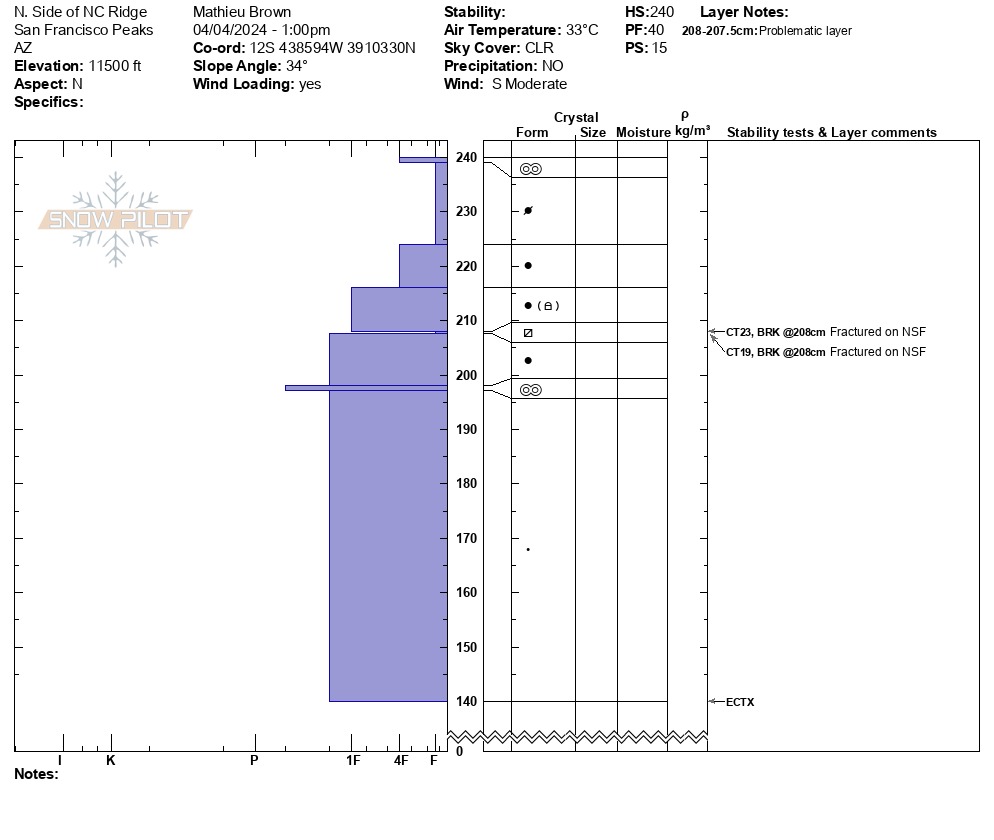
The purpose of this tour was to determine overall surface conditions and to assess for areas of instability. West and southwest slopes were either stiff smooth windslab or frozen crust. At 11:00 AM some of the SW slopes had started to melt on the upper 1cm of the snowpack. Ski or splitboard crampons are recommended as conditions were slick and a fall may have resulted in a long slide on the hard and smooth surface. Snowslide provided quality skiing as a layer of 5-10 cm of drifted snow had covered the otherwise hard conditions. On SE aspects the snow was soft and offered prime corn conditions. Depths of snow in the inner basin near treeline varied between 180-220 cms. Conditions on northcore offered even softer snow as the wind had deposited 20-30 cm of fist hard snow in the catchment zones of the north facing northcore chutes. Wind drifts were hardened and unreactive. In catchment zones on the north side of northcore ridge snow depths ranged from 180-240 cms. Overall stability was good. Snowpack showed moderate to high strength, fair structure, and low propagation propensity. The only reactive layer in the pits was a thin layer of near surface facets on a density break approximately 30 cms below the snowpack. This layer is likely isolated and showed no signs of propogation on tests, but did produce fracture plains on 2 CT tests with broken fracture character. If the slab above was stiffer, this layer would possibly be more reactive. These chutes will likely be affected by winds associated with the incoming storm and conditions in this area will be subject to rapid change.