
Quick report
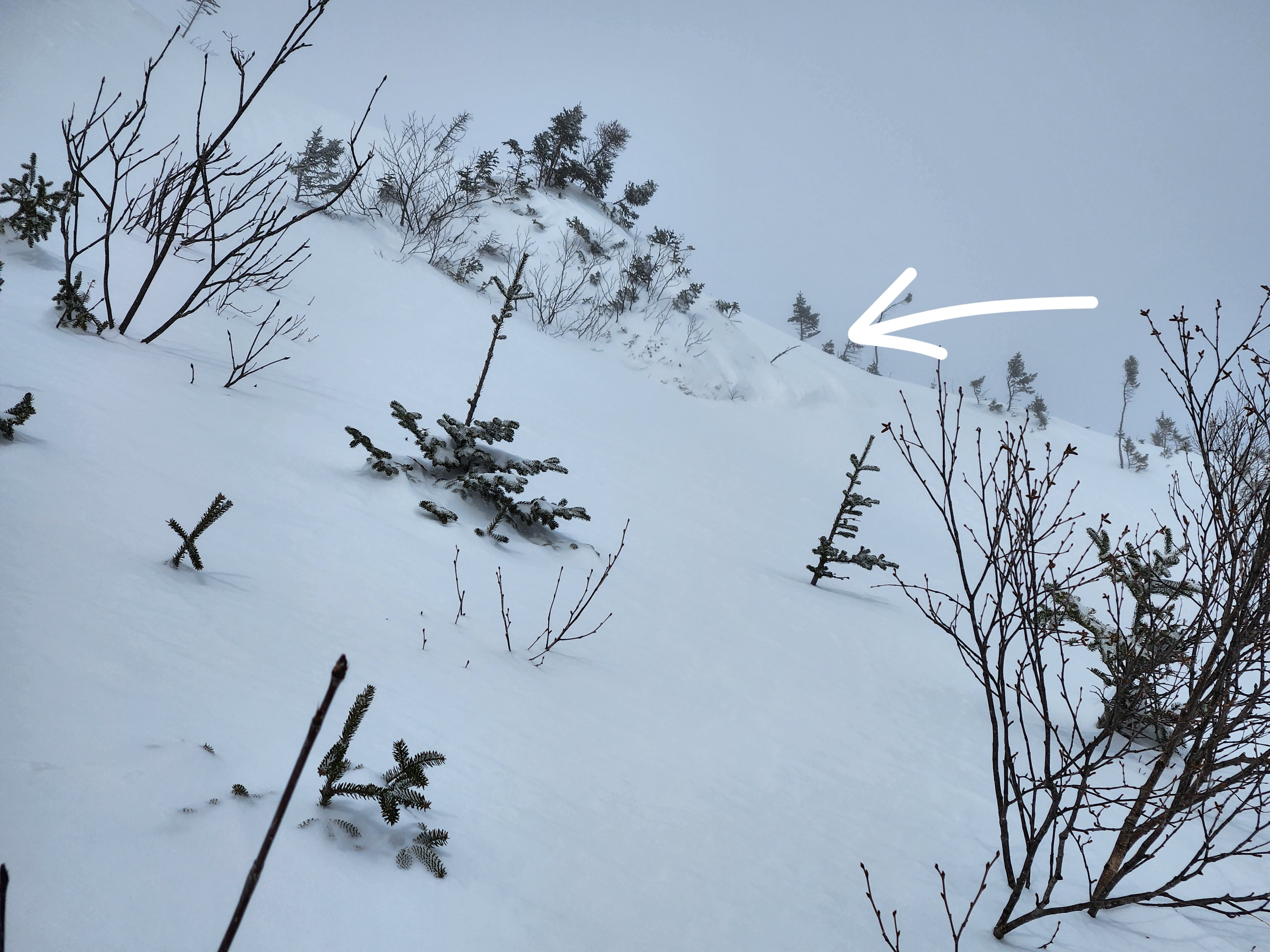
Today we were on the hunt for visibility. Tuckerman Ravine was socked in when we arrived at Hermit Lake around 10am so we hiked the Summer Lion Head Trail to the traverse of the slide path. We were curious if we could still see the crown from the natural avalanche reported on Friday. Although almost completely filled in from wind deposited snow over the last 4 days, the crown line was still visible in a few locations. We dug two pits, the second was about 100ft upslope of the first. Pit depths down to the 1/10 MF crust varied significantly in these two locations and the higher (second pit) was just under the crown line of Friday’s slide and the lower location likely had debris adding to the depth to crust from the new snow on the surface.
In the hour or so we were in this location, soft slabs of new snow had just begun to form from westerly winds blowing snow and obscuring visibility. The top several inches of soft snow was on pencil hard older wind slabs varying in depth down to the 1/10 MF Crust. While we saw some compression in the new surface snow, our snowpack tests yielded no results on the weaker snow surrounding the crust despite the two different snowpack depths.
Weather
- Air Temp
- -9 (summit)
- Cloud Cover
- obscured
- Wind Loading
- moderate
- Recent Snowfall
- 2cm at Hermit Lake
- Snow Avail For Transport
- moderate amounts
Cold! Limited visibility. Light Snow. Moderate wind. Gusts visibly transporting snow.
Snowpack
Before arriving at the traverse section on Summer Lions Head we observed 2-3 inches of fresh snow evenly blanketing the trail. The snow became a little deeper the closer we got to the traverse.
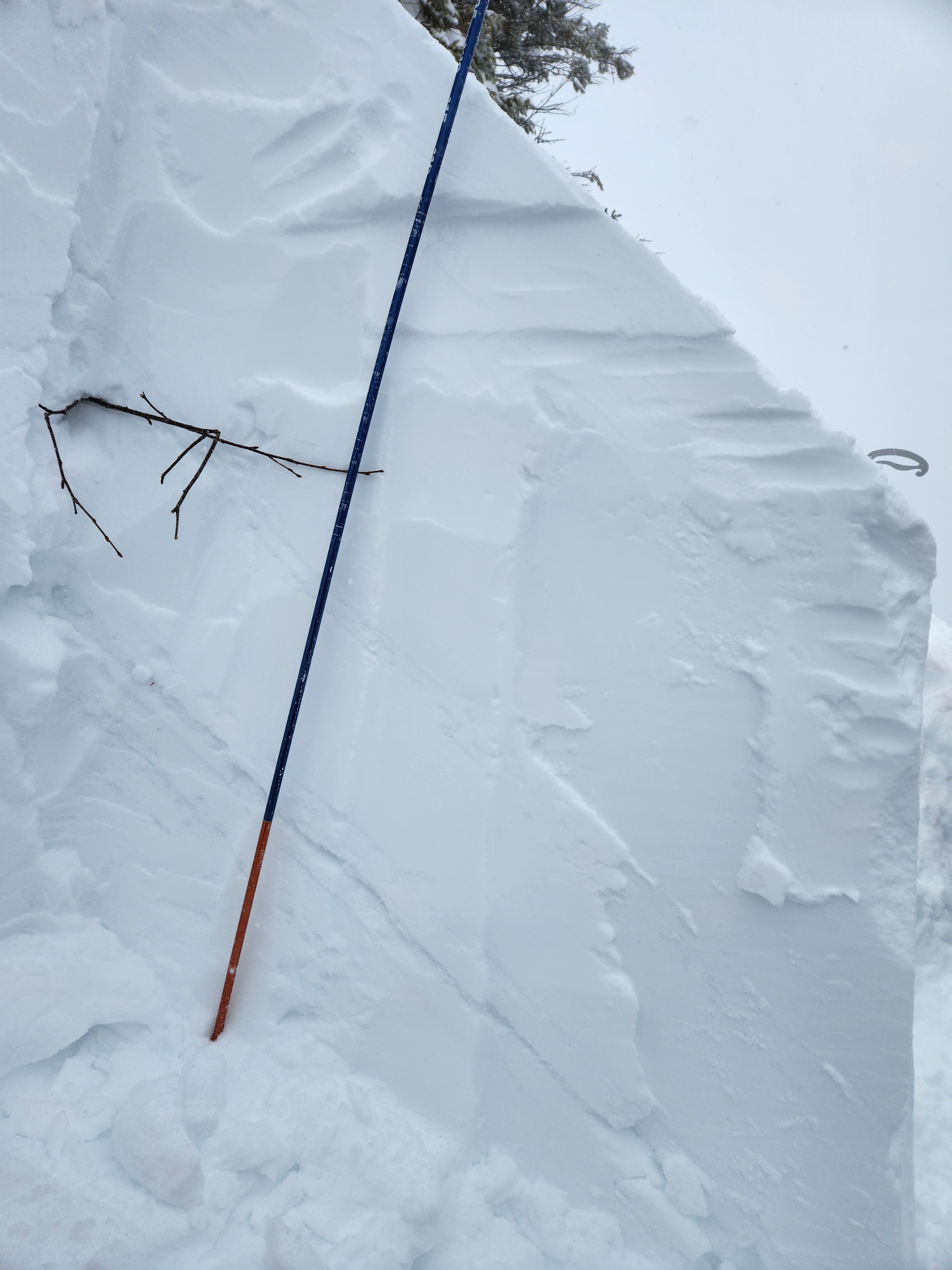
Our first pit was on a SE slope at 4280 ft. New wind slabs (1F over F) were beginning to form on top of old slabs (P). We found a thin layer of perfectly formed snowflakes (stellar dendrites) about 10cm down within the new slabs forming about 10 cm down where the old and new interfaces meet. This snow likely fell when wind speeds were calm, or non-existent. We performed an ECT test and noted the top 10cm compressed after the first round of 10 taps, but no propagation, or collapse. (ECTX). Using a shovel sheer to remove the column, it slid with moderate force off of the 1/10 crust, with a smooth planar surface.
Our second pit location was also on a SE slope but at 4320 ft in a less wind protected area. This area had recently avalanched on 1/16. We performed an ECT test here as well and got similar results to the first. The height of the old slab on top of the 1/10 melt-freeze crust was much compression of the new softer snow, with no collapse, or propagation (ECTX).
Both of our pit locations were in wind-sheltered terrain.