
Quick report
- Collapsing
- isolated
This was an off-duty sunset tour on my way back to Stanley from Ketchum. Mostly trying to get up to a different vantage to see any new avalanche activity, see what surfaces were doing, and see what the presence/reactivity of 2/1 was on multiple aspects. 2/1 presented as everything from a sun crust, to a rain crust, to not present on varying slopes. This layer had inconsistent test results as expected from propagation with moderate force to no fracture at all.
Only experienced 2 collapses in sheltered, easterly terrain near 8000'. This collapse only radiated out 1-2' from my skis.Weather
- Cloud Cover
- scattered
- Wind Loading
- previous
- Snow Avail For Transport
- small smounts
Leaving the truck at 15:40, skies were SCT with the sun going in and out of the cloud cover. Winds were light and variable, with small amounts of snow being transported.
Snowpack
On a quick off-duty ski tour on my way back to Stanley from Ketchum, quickly moved through lower elevation and the lower half of middle elevation terrain without stopping to take too many observations. While there was a lot of traffic in areas I traveled at these elevations, undisturbed surfaces had an ambient temperature MFcr that did not have any water pooled at its center / ice layer from that would indicate rain. Climbing up a ridgeline, there was a large difference between the presence and the thickness of this crust as I wrapped from the SW to the SE side of the ridge. Climbing at 16:00 near 8500', surfaces were primarily soft and moist, having melted in the sunshine and warm temperatures during the day. In more shaded and sheltered terrain, I observed small FC growing on surfaces.
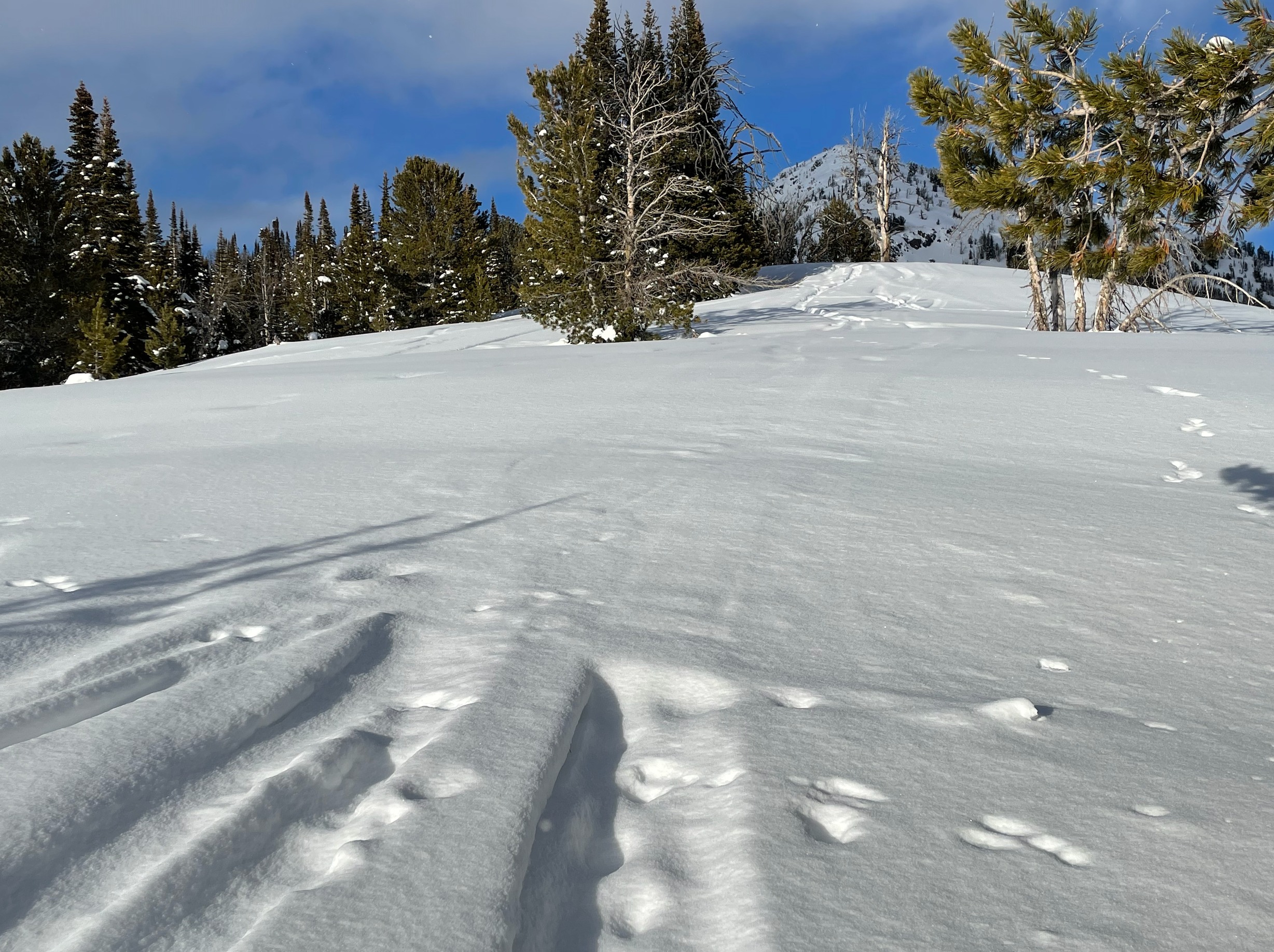
Ascending above 9000', I saw evidence of recent wind transport and plenty of soft snow available for transport despite the warmer temperatures. Skin and ski tracks on ridgeline were blown in at low points with light, drier snow (see photo). Digging several pits on both E, SE, and SW aspects between 9300-9500', I observed the 2/1 down 55-65cm beneath a F+ >4F > 1F dense slab. This crust presented as both a sun crust, rain crust, and facets in different locations, with more predominant sun crusts on steeper solars as you would imagine. The 1/6 was down 130-160cm under an even denser (1F > 1F+) slab. Test results produced inconsistent test results on the 2/1 as expected, from propagation with moderate force to no fracture at all. Results on the 1/6 consistentlyindicated that the overlying slab is dense enough to make it difficult to trigger this layer, however if force reached it it still has the possibility to propagate (ECTP 27 x2, 29, 26, 28).
My overall impression is that the 2/1 is definitely something to keep an eye on going into this next storm as we load it further, however, due to its inconsistent distribution, character, and reactivity the 1/6 will remain our primary concern. The 2/1 is currently difficult to gather data and information on given its inconsistency across terrain. Snowpits on low-angle slopes out of avalanche terrain may not have developed the same crusts as steeper portions of the same slope as the 2/1, creating the likelihood of having false stable test results if you were trying to gather info on this layer.
Avalanche
No new or recent avalanches observed while moving through terrain.