
Quick report
- Cracking
- specific
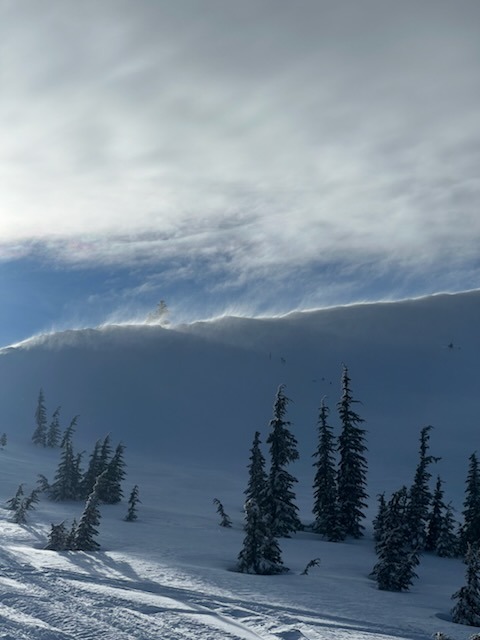
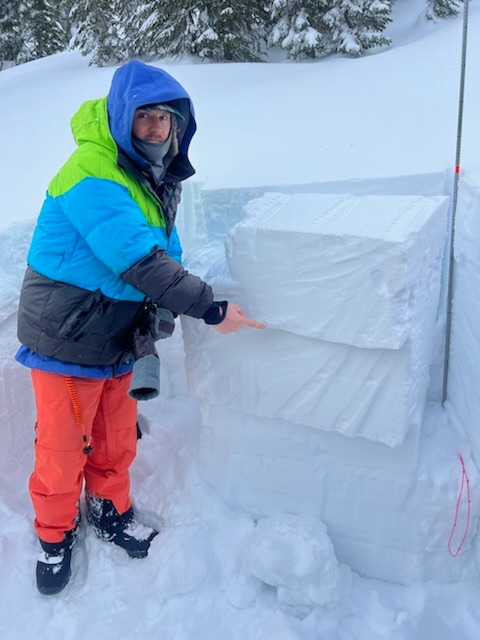
Today was the first day of a Sierra Avalanche Center Motorized Level 2 course and we headed above the area know as "The Grills" to observe 2 remotely triggered avalanches from the day before. Conditions remained mainly unchanged through the day with broken to overcast skies, cool temps and moderate WSW winds with visible wind transport along ridge lines. As we gained elevation snowpack depth increased rapidly and it was evident where snow had not existed before these last series of storms. Once at our objective we chose a slope within close proximity to the recent avalanches to take observations. Our snowpits revealed a complex structure comprised mostly of new precipitation particles, facets, crusts and buried surface hoar with a total HS of 165. We could easily identify the Jan 2 buried surface hoar and the Dec facets within the mid depth of the snowpack. Our students performed multiple tests on these layers and we got moderate scores on the Jan 2 buried surface hoar with sudden collapse results on compressions test's, but no propagation on extended column tests. We did find reactivity on the new/old interface from the Jan 10 storm with consistent failures and propagation among CT's and ECT's in multiple pits. All of these tests produced results at the same depth (110cm from ground) on what appeared to be small near surface faceted grains. Although we did not get results on propagation test's on the Jan 2 BSH/Dec facets, we determined these to most likely be the culprit of the remotely triggered avalanches from 1/11 dues the depth of the crowns and smoothness of the bed surface.
Weather
- Air Temp
- 22
- Cloud Cover
- broken
- Wind Loading
- moderate
- Recent Snowfall
- 40
- Snow Avail For Transport
- moderate amounts