
Quick report
- Cracking
- specific
- Collapsing
- specific
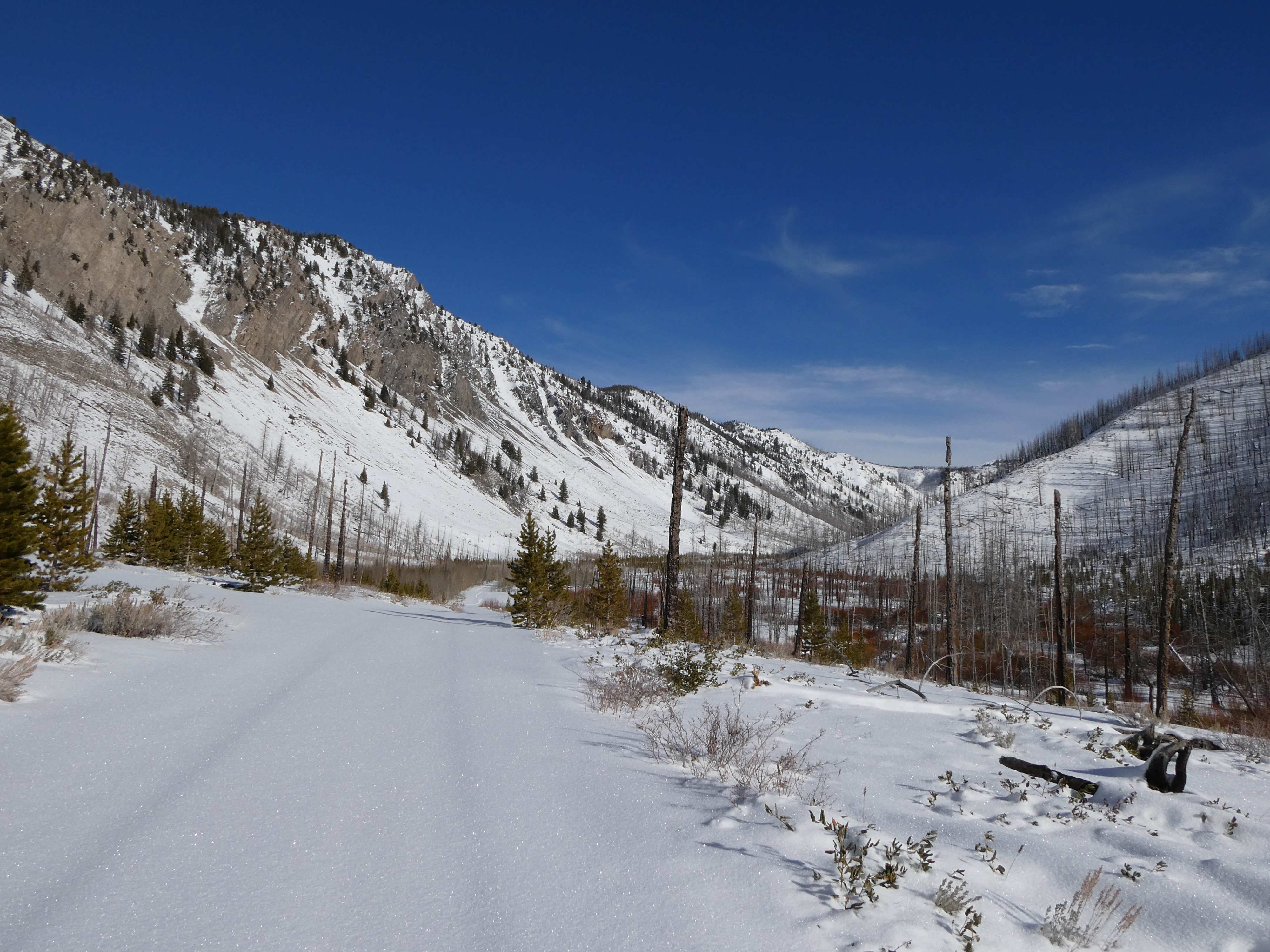
There is quite a bit of snow in this area relative to the alpine portions of the rest of this zone (Bolders and Pioneers). The coverage on most slopes was sufficient for preserving future weak layers.
Cracking and collapsing were specific to slopes where early-season snow exists at the base of the snowpack. We collapsed many slopes, most of which faced SE-S-SW-W (these were the aspects we traveled on). Most collapses extended at least a few ski lengths, some collapses involved starting-zone sized pieces of terrain.Weather
- Cloud Cover
- few
- Snow Avail For Transport
- small smounts
Morning clear skies gradually gave way to some thin, high clouds in the afternoon. These hung on the western horizon, parked over the Sawtooth/W Smokys. Winds were calm through the day, with just a hint of westerly winds blowing around sunset.
Snowpack
Our primary goal was to paint a picture of the snowpack in an area that we hadn't been to yet this season. We found a snowpack that shares many characteristics with other snowpacks that we've observed in the region. A slab overlies a layer of very weak snow that developed during November. The slab we observed was 30-45cm thick and graded from F- at the top to 1F at the base on shaded slopes, and 4F to 1F+ on sunny slopes.
SE-S-SW: 40-45cm of settled snow here. 11/30 was present at the base of the snowpack by 8,500', and presented as a thin layer of facets on top of an icy crust. There was enough of this snow where we dug on a 9,200' S aspect to produce repeated unstable snowpack test scores (ECTPV & ECTP7). We experienced many collapses on these aspects, which increased in frequency and size as we climbed. These were occurring on slopes less than 30 degrees, we did not travel on steeper slopes.
W: 65-70 cm of settled snow here. 11/30 package (made up of two distinct snow pulses which subsequently faceted) is down 30-45cm on a 9,700' W aspect where we dug. It is composed of very weak (F-), 2-4mm facets that are cupped and striated. This looked like depth hoar prior to burial (the sun valley special, "DHsf"). It looks no better now. The slab overlying this layer has undergone a good bit of faceting and has lost some strength. We received mixed results in our ECTs, and relatively short cut lengths with propagation to end in CPSTs.
In both pits, the 12/6 interface presented as a thin, icy lens with snow that appeared to be well bonded on top and bottom.
Surfaces: the snow in the upper 15cm of the snowpack has lost much of its strength. There was a widespread layer of 5-8mm surface hoar on the approach and in shaded terrain while skiing. The weak snow developing at the surface will present a significant problem when loading resumes.
Avalanche
Evidence of previous avalanche activity was difficult to pick out. There were a few debris piles without visible crowns, and a few features that may have been either crowns or wind lips, but we did not observe evidence of recent, large avalanches. We did not observe any evidence that warm days and direct sunshine had produced any loose snow avalanches. I suspect that there were at least a few slides that occurred in the terrain we could see, but with thin snow coverage and snow redistribution due to wind these weren't apparent.