
Quick report
Incremental snowfall since the end of January and more steadily throughout the last 6 days has built slabs about 45 to 75 cm deep (1.5 to 2.5 feet) over surface hoar and crusts. The snowpack structure observed in our location today is similar to other recent observations in nearby zones: weak snowpack structure consisting of buried surface hoar and faceted crusts. The weak structure produced test results, some surprisingly easy, showing poor snowpack stability. A lack of natural avalanches and obvious signs of instability - such as cracking or collapsing - is due to incremental snowfall not overloading the snowpack at once yet leaving the weak layers primed for a trigger.
The snowpack remains eerily quiet while walking around, but tests results suggest otherwise.Weather
- Cloud Cover
- overcast
- Wind Loading
- previous
- Recent Snowfall
- 45 to 75
- Snow Avail For Transport
- large amounts
Broken cloud cover and brief sun transitioned at mid-day to overcast skies and intermittent snow flurries. Winds were light from the southwest at ridgetop. Around 3 pm, light snowfall increased in intensity to S2.
Snowpack
New snow amounts steadily increase from valley bottoms to ridgetops. The most recent snow gets drier, and lower density, while traveling up in elevation.
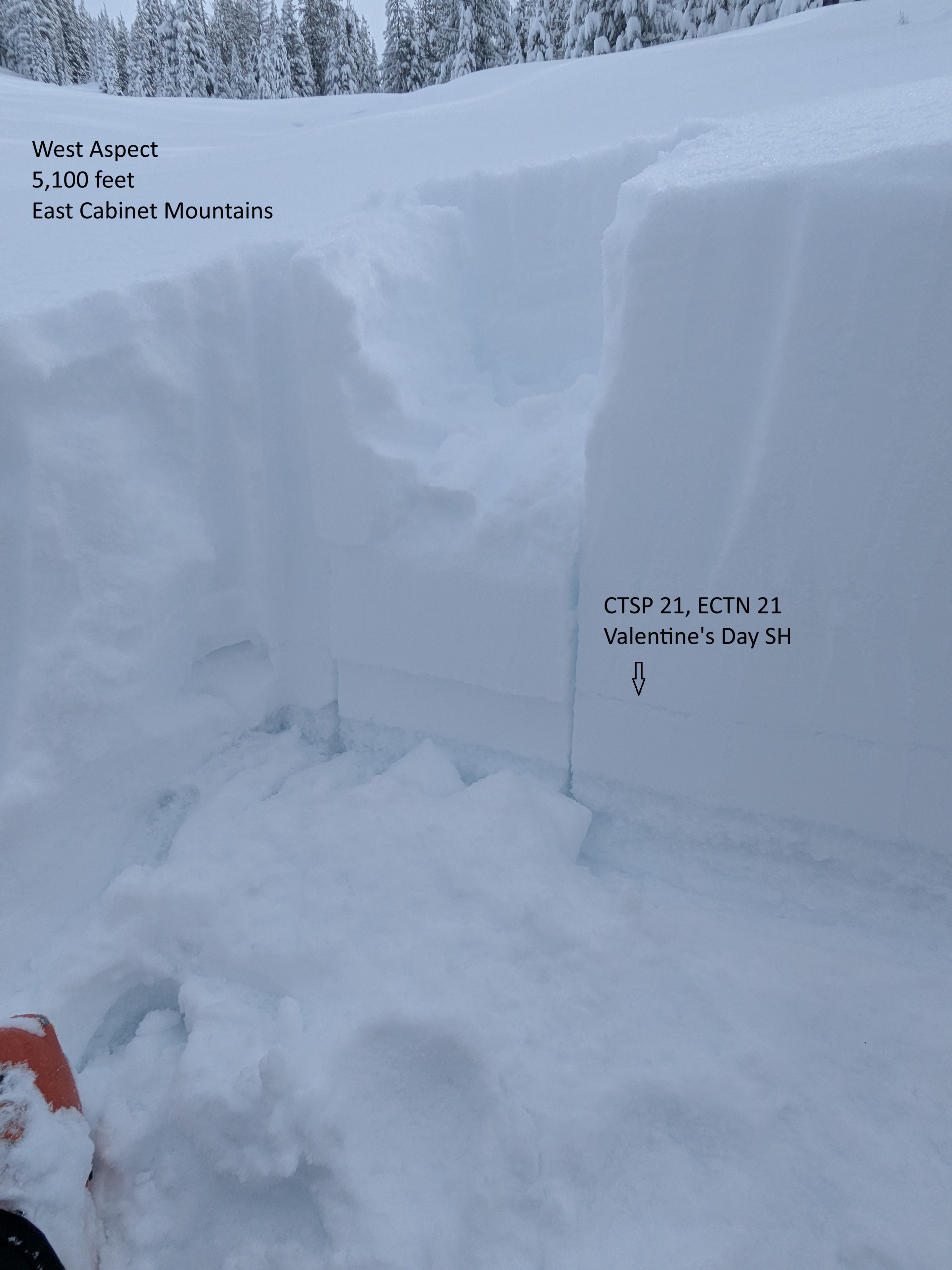
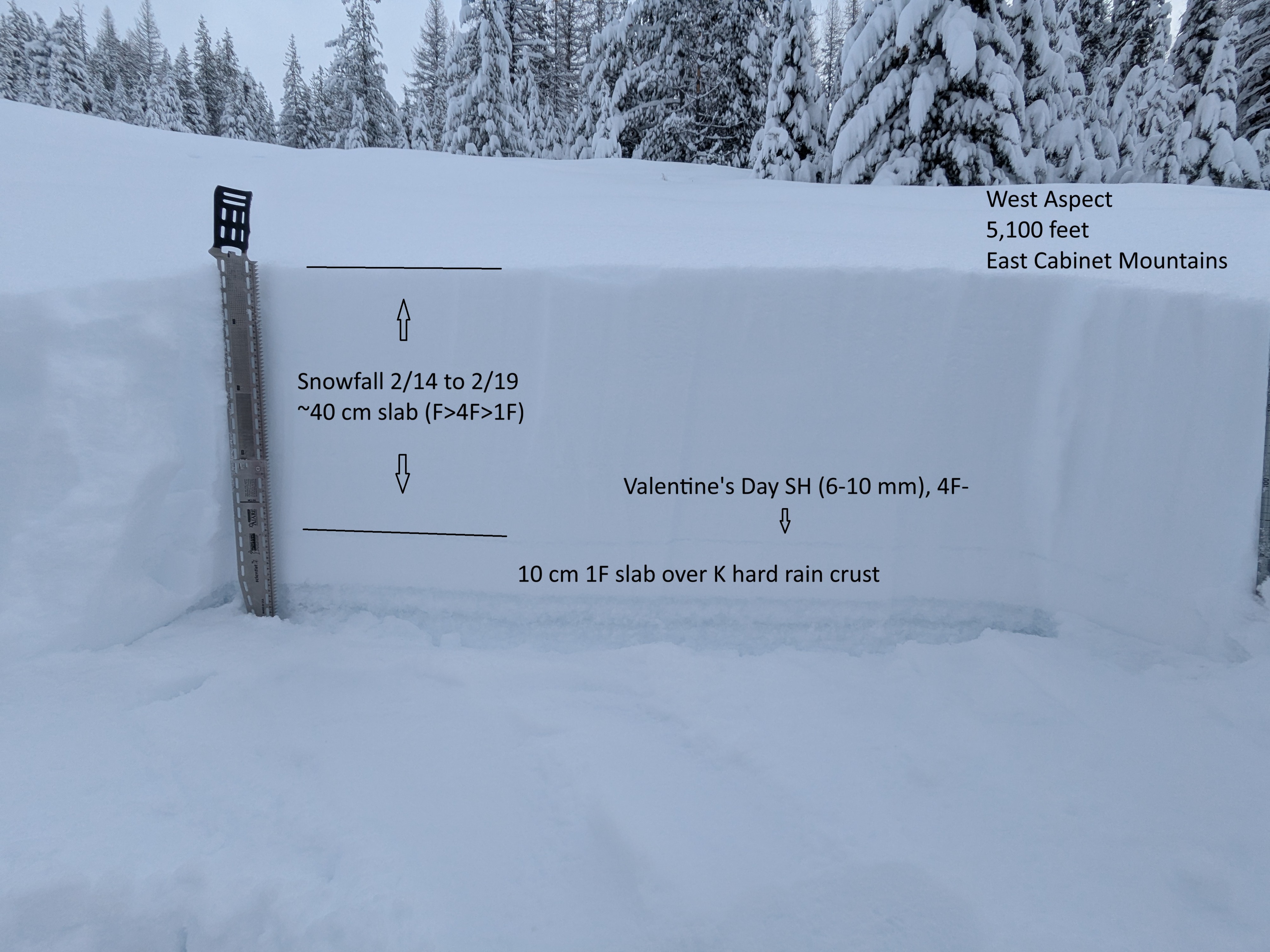
At 5100 feet on a northwest aspect we observed a snowpack height of 106 cm (~3ft). We observed a right side up snowpack, softer new snow over firmer snow below. We observed ECTN 18 and CT7 PC results in the new snow interface down 20cm. A Knife hard 4 cm thick crust, January 28 interface, was down 50 cm. The February 14 surface hoar (V-Day SH), size 6 - 10 mm, was observed down 44 cm. This layer produced test results: CT 21 SP and ECTN 21.
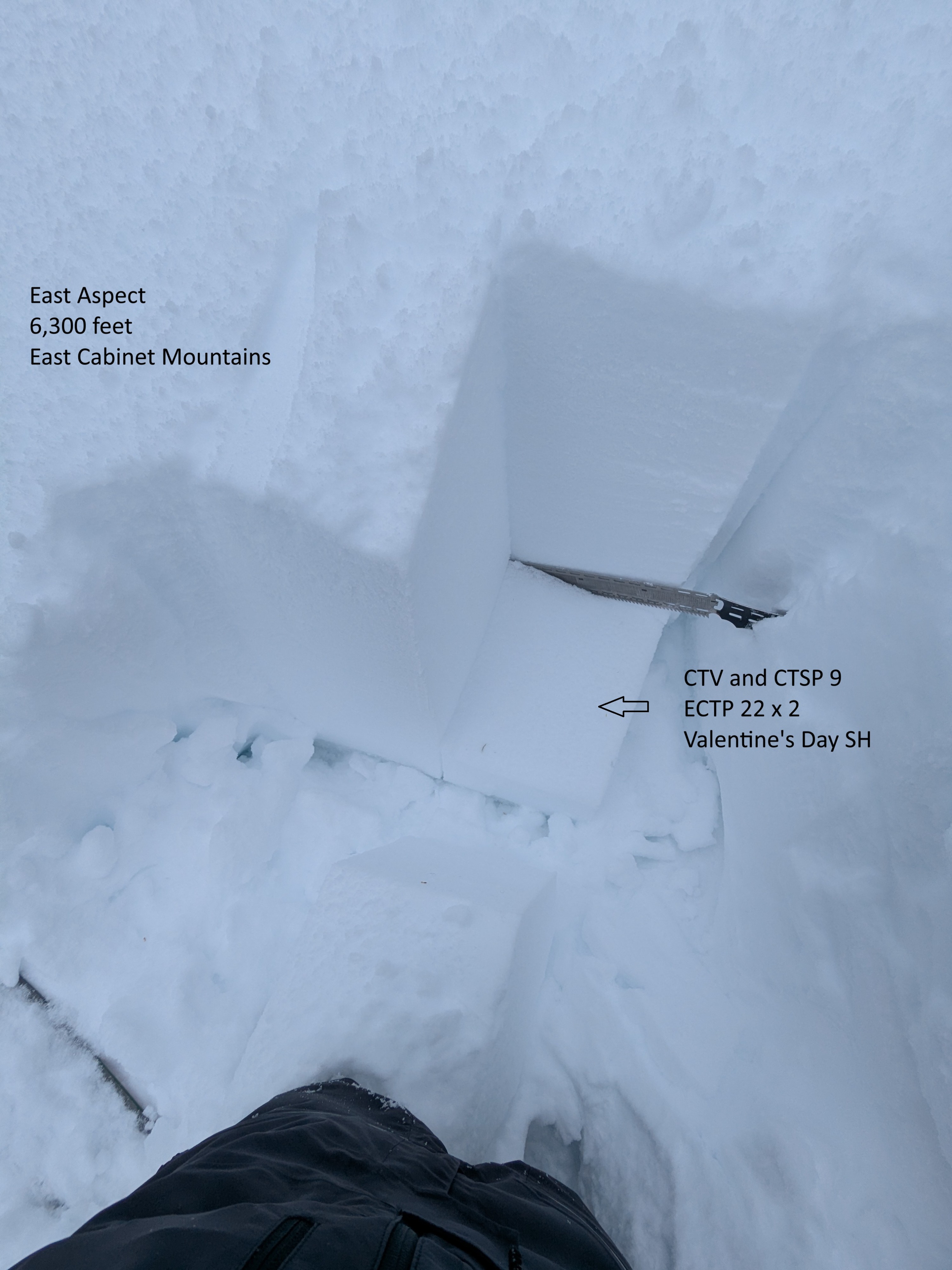
At 6300 feet on a East aspect we observed similar easy CT PC and easy ECTN results on a new recent snow interface down 18 cm. The February 14 surfae hoar (V-Day SH), size 4 - 6 mm, was down 55 cm from the surface and sitting on a 1 cm thick 1F hard decomposing crust. On the V-Day SH at this location we observed: CT V (fractured and slid on isolation), CT9 SP, and ECTP 22 (this ECTP was in a location that may not be representative with the snow potentially artificially disturbed). At this location, the January 28 interface was down 75 cm from the surface - the mid-January crust was P hard, 4 cm thick. This crust had small (1 - 2mm) faceted grains above it.
Avalanche
None observed