
Quick report
- Cracking
- isolated
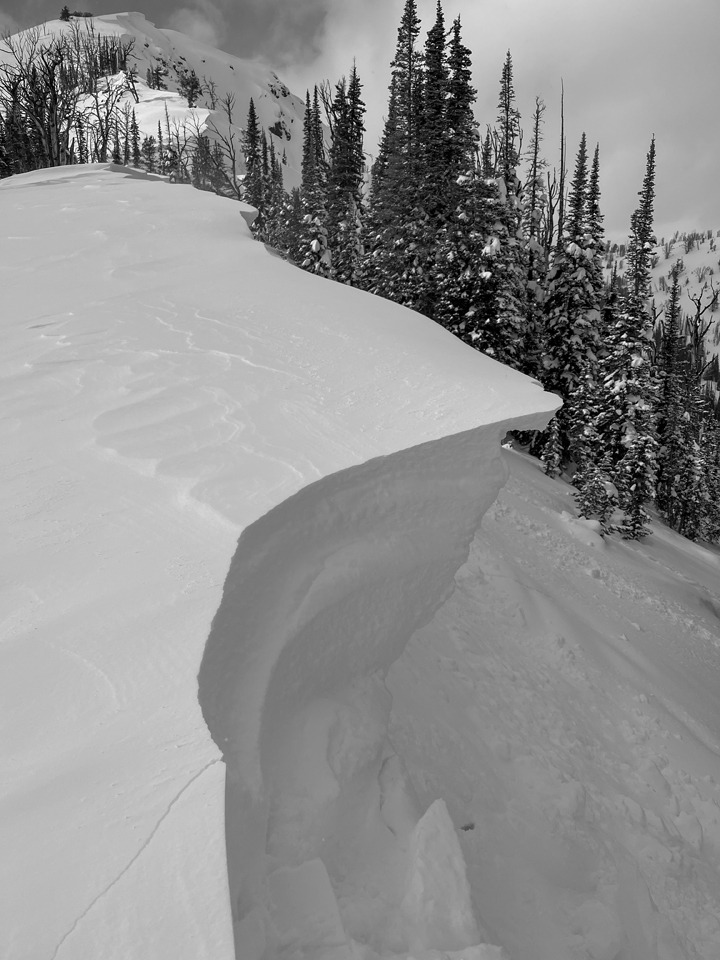
Cracking isolated to freshly formed/growing cornices. Sensitive slabs did not extend far below the ridge.
Weather
- Cloud Cover
- broken
- Wind Loading
- moderate
- Snow Avail For Transport
- moderate amounts
It was snowing S1 to S2 from Hailey to Galena Lodge. The cloud layer was thin, and the sun was bright behind the clouds. Climbing to the Pass, clouds broke up, precipitation sputtered, and some blue skies were visible. Overall, clouds decreased throughout the day. It was mostly cloudy in Headwaters until about noon when it became broken. There was a good bit of sunshine on the Southern Sawtooths and portions of the W. Smokys as I exited around 3:30 PM. Snow during the day came in waves, occasionally heavily rimed or small graupel, with no real accumulation. It was windy, blowing steady moderate from the SW.
Snowpack
(2/14):
This layer, about halfway through the (2/1) slab, looked very poor on sunnier slopes where it was a melt-freeze crust with associated facets. The facets around this crust were worse than around (2/1) where I looked. This would certainly be on my radar where wind-loaded and may inhabit more directly sunny slopes than (2/1) as the warmup/sunshine that formed this was much less intense. On shadier slopes this layer produced ECTNs on near surface facets.
(2/1):
I circled from E->S->WNW on a mid to upper-elevation ridge through untracked terrain. I did not observe any obvious signs of instability. The layer presented as a thin rain/melt-freeze crust on the margins (~1 cm on E and ESE) that thickened on sunnier slopes (~5 cm on SE, S, SW, W) before thinning again (~1 cm on WNW, NW). I observed small facets both above and below the crust. On sunnier slopes, the slab above this layer is thin (~20-40 cm) and contains 1-2 additional crust layers. On a WNW at 9,300' it produced a clean shear above the crust down 70 cm after toppling a column into the pit following two ECTXs.
(1/6):
Triggering a slide on this layer seems unlikely here due to the thickness and strength of the slab above. On a ENE @ 7,800' I observed this layer down 90 cm as rounding 4F moist facets. The slab above the layer was very hard (P+). The depth of this layer increased as I climbed, thinning only on sunnier slopes. These slopes had thicker crusts, which added an additional layer of armor above the layer. ECTX (x2)