
Quick report
- Cracking
- Observed
- Collapsing
- Observed
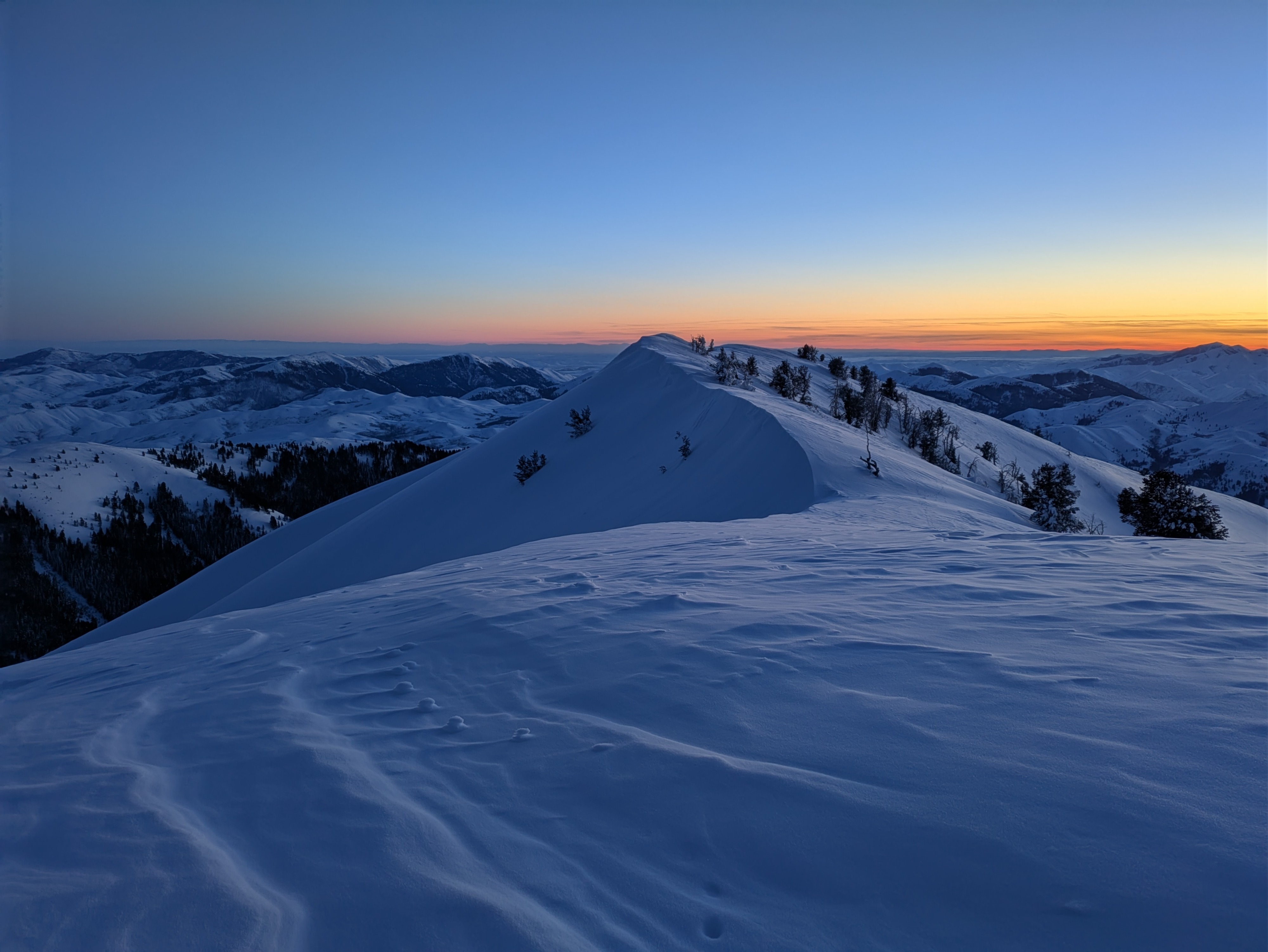
This was a nice walk on a beautiful, cold day. I also found some very nice skiing and excellent views. The story of the snowpack has two main focuses right now: the 1/31 weak layer (buried by early Feb storms), and the new weak layer forming at the surface that will be begin to be buried on 2/13. Slabs over the 1/31 weak layer have found a semi-comfortable conformation and the likelihood of triggering these has decreased significantly since the main avalanche cycles on 2/4, 2/5, and 2/7... remembering that decreasing significantly and going away are two very different things!! The presence of the 1/31 weak layer has been driving my terrain selection since its burial; basically I'm avoiding it everywhere it exists. The budding Valentine's day weak layer (current snow surface) doesn't pose a hazard yet, but it is about to. This is described in more detail in the snowpack summary. We will be dealing with this new weak layer, in addition to the 1/31 weak layer, for the foreseeable future. I triggered a few collapses as I traveled through miles of untouched terrain. The largest of these collapses occurred on wind loaded SW-W facing slopes at middle elevation. I did not see any avalanches from the previous 48 hours, but plenty of signs of avalanche activity from the cycles in the first week of Feb. I reported some of these below.
Weather
Cold, clear, calm. Soft snow in the sun. Doesn't get a lot better than that.
Snowpack
The current surface (future Valentine's Day weak layer) looks like it will make some avalanches with a loading event. Cold, clear weather have been the name of the game during weak layer formation over the past week. This is a "great" time of year to build crust+facet combinations on solar slopes, and thats exactly what has been happening here. Temperatures have been cold enough to prevent crust formation on low angle solars, but as soon as the slope is tilted up into the 30s these crusts and facets are present, but not baked into submission. Radiation recrystallization crusts have formed and evolved over multiple days, resulting in a multi crust + facet matrix. These exist on roughly ESE - SE - S - SW slopes. On shaded slopes, the upper snowpack has undergone a good bit of faceting and will also be able to make some avalanches. There is also a multi-phase layer of small surface hoar on shaded slopes that existed all the way up to the local summits, and seemed to be more pronounced as you climbed in elevation. Adding a bit of complexity to this picture, is the 2/4 rain crust, which exists up to around 7,200' or so. There is a decent bit of faceting immediately adjacent to this crust, particularly down lower where more precip fell as rain. There is also a dusty layer associated with this crust that also exists above where it rained. This dust was likely sourced from somewhere in the Great Basin. I observed this layer ( there are actually two, one from 2/3 and one from 2/4) when it was initially deposited in a few places across the area, I think it is pretty widespread, but fairly subtle. This layer has also been reported in many areas in Utah as well as in SW Montana.
Avalanche
- Size
- D2
- Count
- 4
- Aspect
- E
- Trigger
- N
- Elevation
- 9400 ft
Was surprised that this wasn't larger... Lots of slab hanging in that starting zone still...