
Quick report
Average height of snow ranged 60 to 100 cm between 4,000 and 6,500 feet. Above that, height of snow is pushing north of a meter and we found isolated drifts around 150 cm. Overall, the snowpack lacks widespread discernable weak snow layers. At upper elevations, facets are forming above the November 12 rain crust, and this is likely due to slightly cooler temperatures. While triggering a slide in those weak grains seems confined to thin areas of the slope or margins of the slab, an ensuing slide at that depth would be large and difficult to escape. The most widespread avalanche concern at present lies in two mid-storm interfaces in the top one to two feet of the snowpack.
Weather
- Cloud Cover
- scattered
- Wind Loading
- none
- Recent Snowfall
- 35 cm or 14 inches
- Snow Avail For Transport
- moderate amounts
Light winds, mix of sun and clouds, and the occassional passing fog. Visibility offered abundant views into neighboring terrain and the east side of the West Cabinet Mountains.
Snowpack
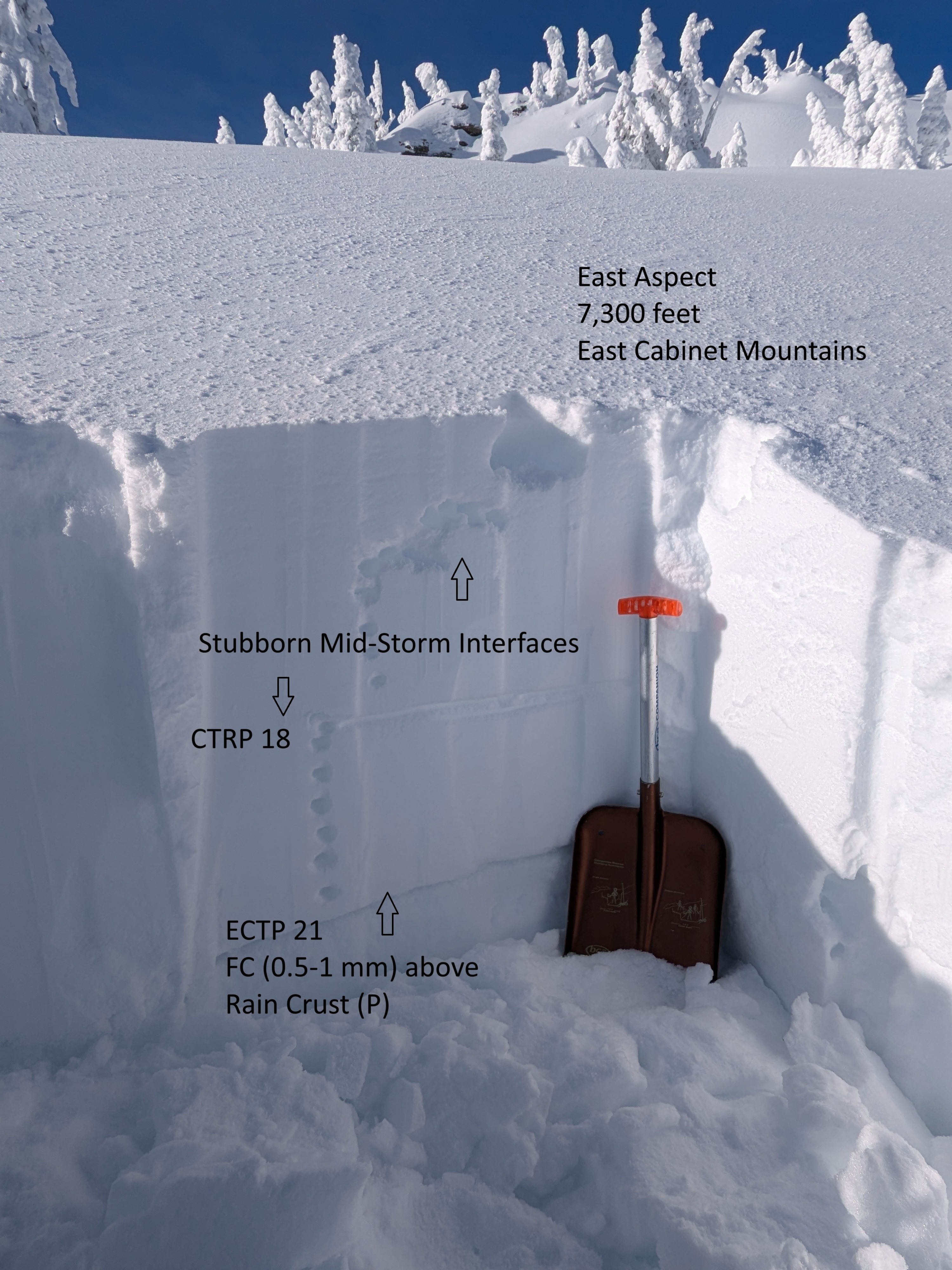
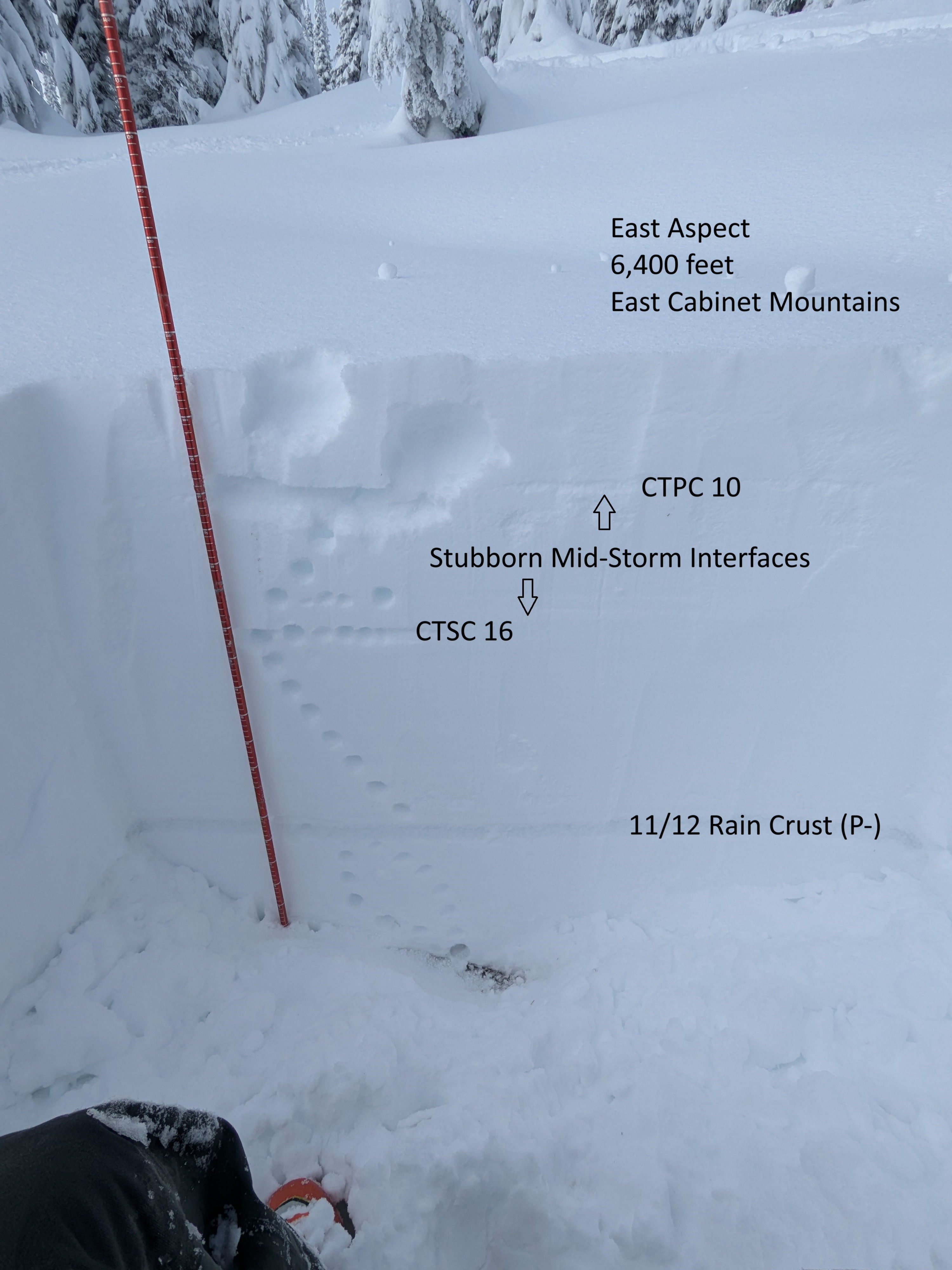
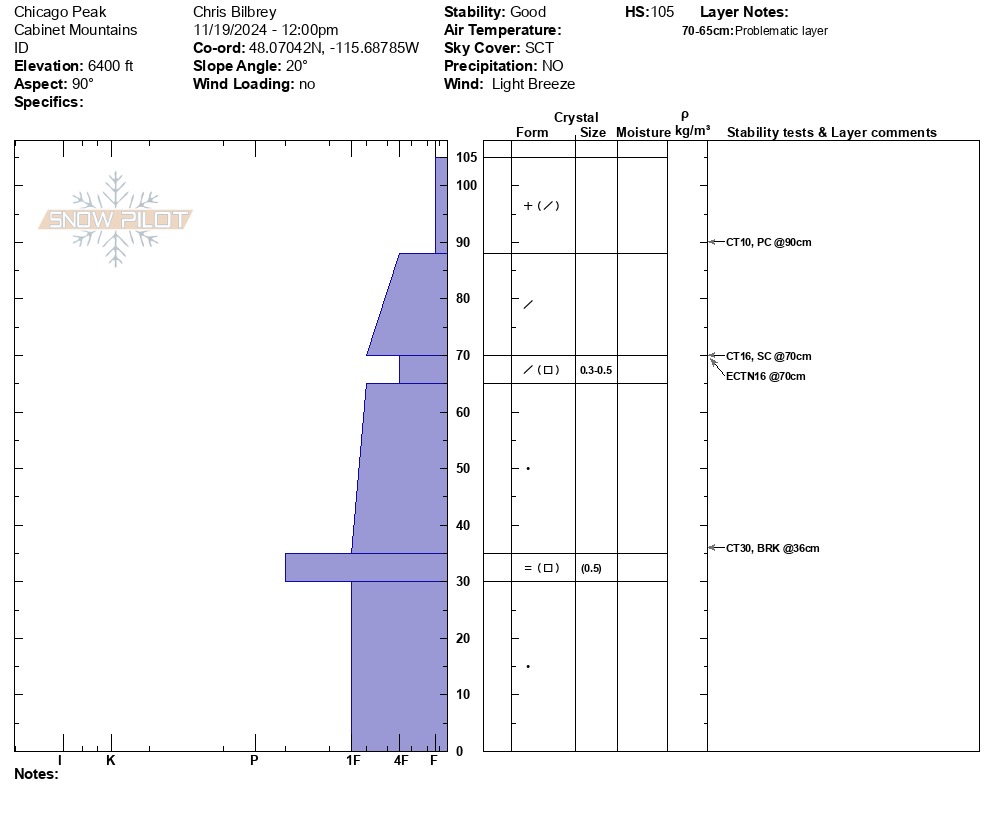
We found around a foot of snow at the trailhead around 3,500 feet. This made for smooth snowmobile travel up the road, but there's not enough coverage to boondock through the woods. Snow depths increase dramatically above 4,500 feet broadening the scope of off road snowmobile travel - still, numerous natural obstacles lurk below the snow surface. Digging on an east-facing slope at 6,400 feet, we found the November 12 rain crust (P- hardness) sitting in the lower third of the snowpack around 70 cm deep. This layer is mostly refrozen and intact, and we observed limited faceting both above and below the crust. Compression Tests produced progressive and sudden collapse failures in the top 12 to 18 inches breaking at mid-storm interfaces - below a mostly F to 4F (top to bottom) slab. The lower of the two storm layers is starting to form small faceted grains. We did observe a break failure in CTs with 30 taps above the crust, and the snow below was 1F to the ground and very consolidated. Our second pit was dug on the same aspect, but at 7,300 feet. In that pit, we found the same stubborn stom interfaces but we observed resistant planar failures with moderate force (CT 18). Additionally, Extended Column Tests produced propagating failures with 21 taps on 0.5-1 mm FC above the crusts. These grains currently sit around 80 cm deep. The crust higher up is thicker and slightly harder (P hardness). Like our lower elevation snowpit, the snow below the crust is very consolidated to the ground.
Avalanche
- Size
- D1
- Type
- SS
- Count
- 2
- Aspect
- SE
- Trigger
- N
- Elevation
- 7200 ft
Spotted several small loose snow avalanches on east and southeast-facing slopes that likely ran during the last round of snow, and all size 1.