
Quick report
- Cracking
- isolated
- Collapsing
- isolated
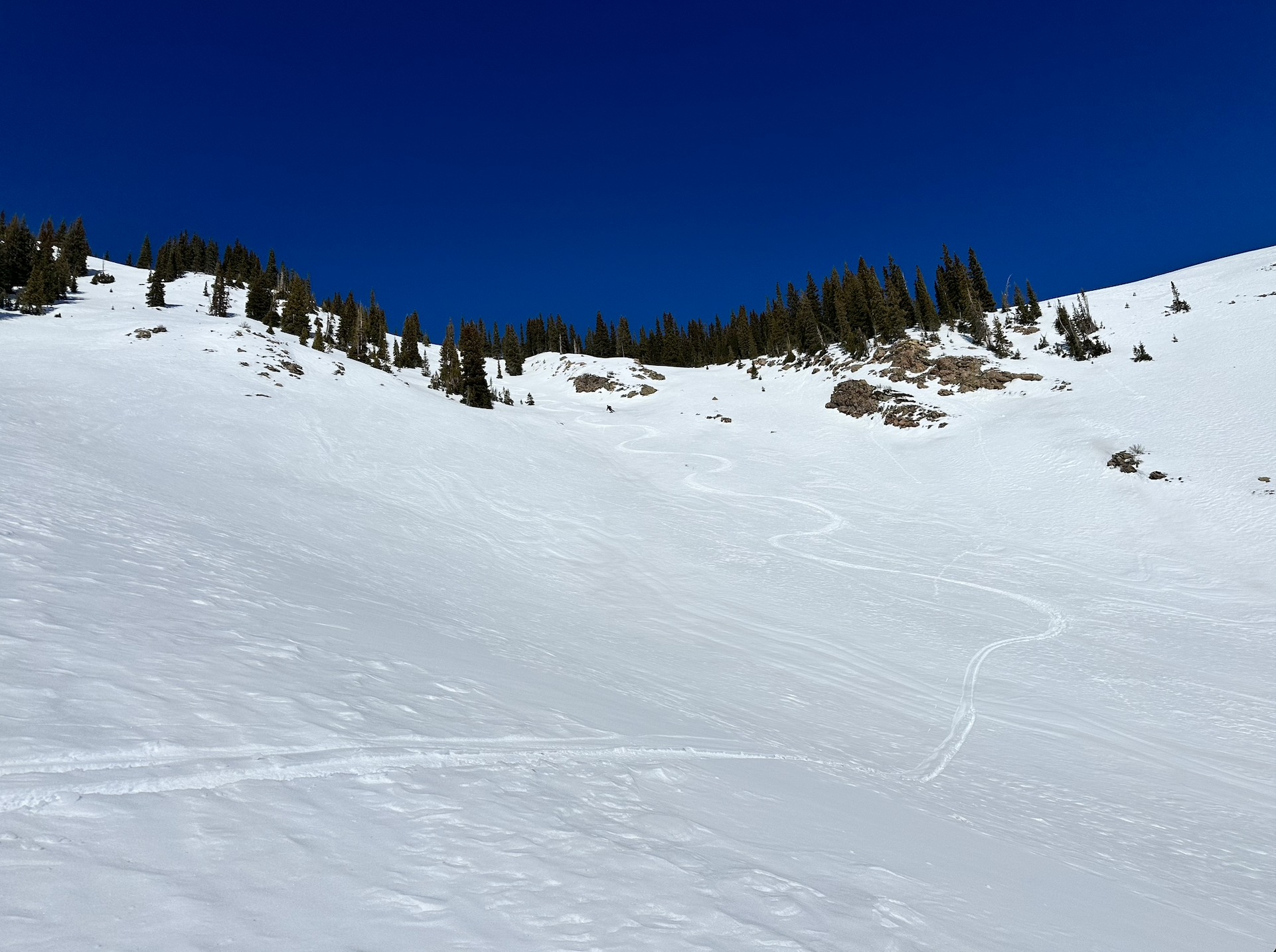
It was a nice day to travel around with warm temps and soft snow on southerly aspects out of the wind. Surface crusts broke down by the afternoon on many near and below treeline sunny slopes, but loose avalanche problems remained in check. The bit of higher-elevation terrain we traveled on remained mostly frozen due to moderate southwest winds. The snowpack became punchy and unsupportive below 10,000 feet in the afternoon and made for difficult travel conditions. In this area, southeast through south through southwest slopes up to 11,800 feet had largely seen meltwater move through the entire snowpack (an exception could be a heavily drifted terrain feature with an abnormally deeper snowpack).
We experienced a handful of small to moderate-sized collapses on low-angle southerly slopes. The snowpack was very wet and unsupportive to boots in these spots. I suspect a thin crust at the bottom of the snowpack was collapsing due to softening from meltwater. We did not experience this on steeper slopes.Weather
- Cloud Cover
- clear
- Wind Loading
- previous
- Snow Avail For Transport
- none
Clear skies and warm temperatures. Moderate southwest winds kept temps feeling cool near the summit.
Snowpack
We traveled mostly on the south half of the compass up to 11,800 feet with a few easterly slopes near treeline. By noon, many surface crusts had broken down, and the ski pen was around 6 inches deep. Steep east and southeast slopes have 2 to 5 inches of wet surface snow, sometimes more. I tried to initiate a few loose avalanches in the wettest places, but the moving snow often stayed at the surface and failed to entrain significant amounts of snow. All loose avalanches remain very small and did not gouge. I dug a profile on a southeast feature at 11,500 feet and found a moist snowpack top to bottom with 6 inches of wet snow at the surface. Ice columns connected several crusts in the snowpack down to the late December crust with thick ice columns to the ground (see images). Although punchy, this structure didn't produce loose avalanches where we skied down.
In the early afternoon, below 10,000 feet, the snowpack became trapdoor and was a weak, wet mess that was sometimes unsupportive to skis.
Gazing into the northerly-facing start zones of Green Lake Bowl, the terrain often looked scoured, with a few areas that appeared to have slabs intact, but overall, it was relatively shallow for these typically well-drifted slopes. There is often a large cornice above this bowl, but it was blown back in many places and very small.
Avalanche
- Size
- D1
- Type
- WL
- Count
- 3
- Aspect
- W
- Trigger
- N
- Elevation
- 11800 ft
A handful of Wet Loose avalanches from Monday's initial warm-up were visible near and below treeline slopes on the sunny side of the compass. A few loose avalanches appeared to run today on westerly slopes of Red Ridge above the East River (observed on a bino tour after my field day).