
Quick report
- Aspect
- Northwest
- Red Flags
- Wind Loading, Poor Snowpack Structure
- Elevation
- 2896 m
- Slope Angle
- 41°
- Red Flags Comment
- <p>Wind loading on ridge lines and cross loading off the ridge lines (ie the gullies down the Emma's). Poor snowpack structure - Dug a full pit to further investigate. </p>
picture of large facets from the 15cm-70cm weak snow layer. Picture taken on 3mm grid.
Picture of rounded snow in the slab from 105-155cms. Picture taken on 1mm grid.
Snowpack
- Instability Comment
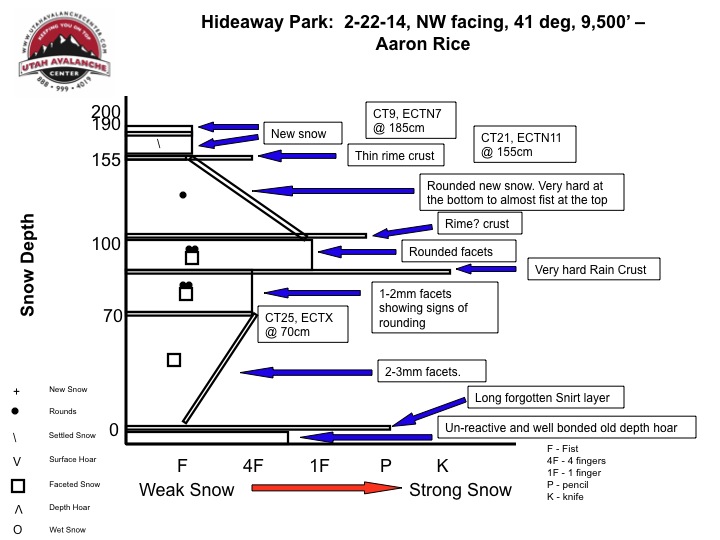
- <p>lots of small and soft, but touchy wind slab around. I did not find any harder slabs. Wind was blowing hard and the snow was very light, which may have just sent the snow for a ride, rather than created big slabs. With more wind tonight the danger of wind slab could become more pronounced. </p> <p>I have been diligently reading the obs and advisories regarding the deep slab danger and wanted to see for myself and validate the results that others have been getting. I wanted to dig a pit in a poor location while not putting myself on a dangerous slope. I ended up finding a small test slope near the bottom of hideaway park. The slope was facing 330degrees (NW) and was very steep (41deg). It was also sheltered in the trees and tucked away enough that not too many people would have skied it. The only issue was it was a bit lower elevation than would have been perfect (9500ft). I Dug a pit to the ground and performed CT and ECT tests down to the weak layer that was buried 120cms deep (70cms from the ground). </p> <p>The pit was 190cms deep and all numbers following will be the height of the snow. The CT showed some instabilities in the top foot. CT4 @ 185cm - This was just the sluffing in the new snow CT21 @ 155 - This was the most recent shot of snow running on a combination of grauple and rime. The CT also showed deep slab instability CT25 @ 70cm. The fracture was planar on the slab side but the rest of the snowpack below just disintegrated under the weight of the slab. </p> <p>The ECT is where it gets interesting. ECTN7@185 ECTN11@155 This shows that while there is surface instability there is low propagation power. Though a wind loaded slope may have behaved differently. </p> <p>For the rest of the column the result was ECTX. This perfectly describes the issue that everybody is talking about. The is a buried weak layer and there is a well defined slab on top of it, however it is getting harder and harder to trigger that weak layer. After the test I tugged on the column and the whole the popped out of the wall and into the pit. It is hard to trigger an avalanche but if you can find the right trigger it will run big. </p>
Very top layer of new snow was very low density and sluffed easily. The top foot or so was also relatively new snow that skied very well.