
Quick report
- Aspect
- East
- Elevation
- 2713 m
- Slope Angle
- 25°
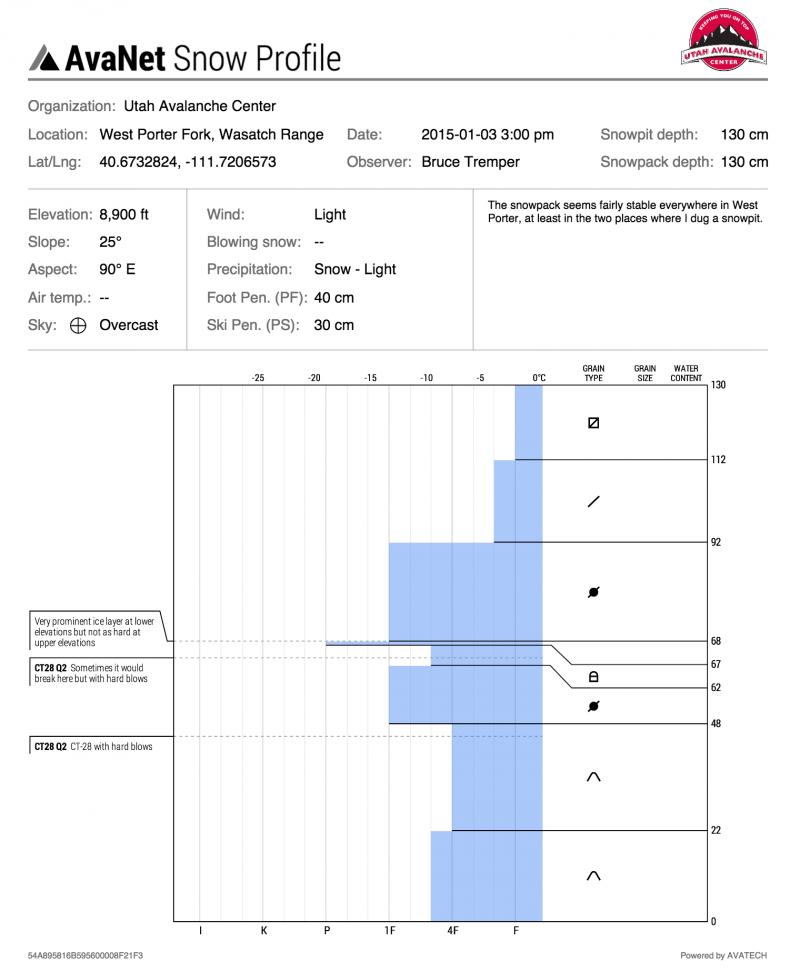
The snow profile above seemed pretty typical from poking my pole in dozens of places and digging another quick pit slightly lower. The snowpack in there seems fairly stable right now but I don't quite trust the steep, rocky areas where the snowpack may be quite a bit different. The weakest layer of the snowpack is the surface snow, so any future loading will slide there first. The surface snow is faceting so it might be tricky with the next storm.
Snowpack
- Instability Comment
- <p>I'll bet there is still some potential for persistent slabs in there but everything was fairly stable in the main, lower angled terrain. I did not quite trust the steeper, rocky areas, which I almost always avoid anyway. You can still see evidence of avalanche activity from the Solstice storm with buried chunks and piles above trees, which came off the main West Porter headwall. It was a fairly large and destructive avalanche. I thought I could also see some old scars in main Porter Fork headwall but visibility was not very good.</p> <p>The northwest wind was blowing up high but not any lower. Most of West Porter Fork has escaped the wind but I would guess there is a fair amount of wind damage on Gobblers and Raymond at high elevations. All of West Porter had great powder.</p>
Although there was a skiff of new snow that fell today, most of the snow was the older snow from the past two low density storms. Much of the surface snow is faceting so it's slightly loud powder but It rode very well. Fairly many tracks in West Porter but there's room for a lot more. The access from lower West Porter is mighty gnarly with lots of brushy and thick, small aspens but it's probably better to access it from main Porter and use that as the exit route as well. The snowpack is still quite thin at lower elevations.