
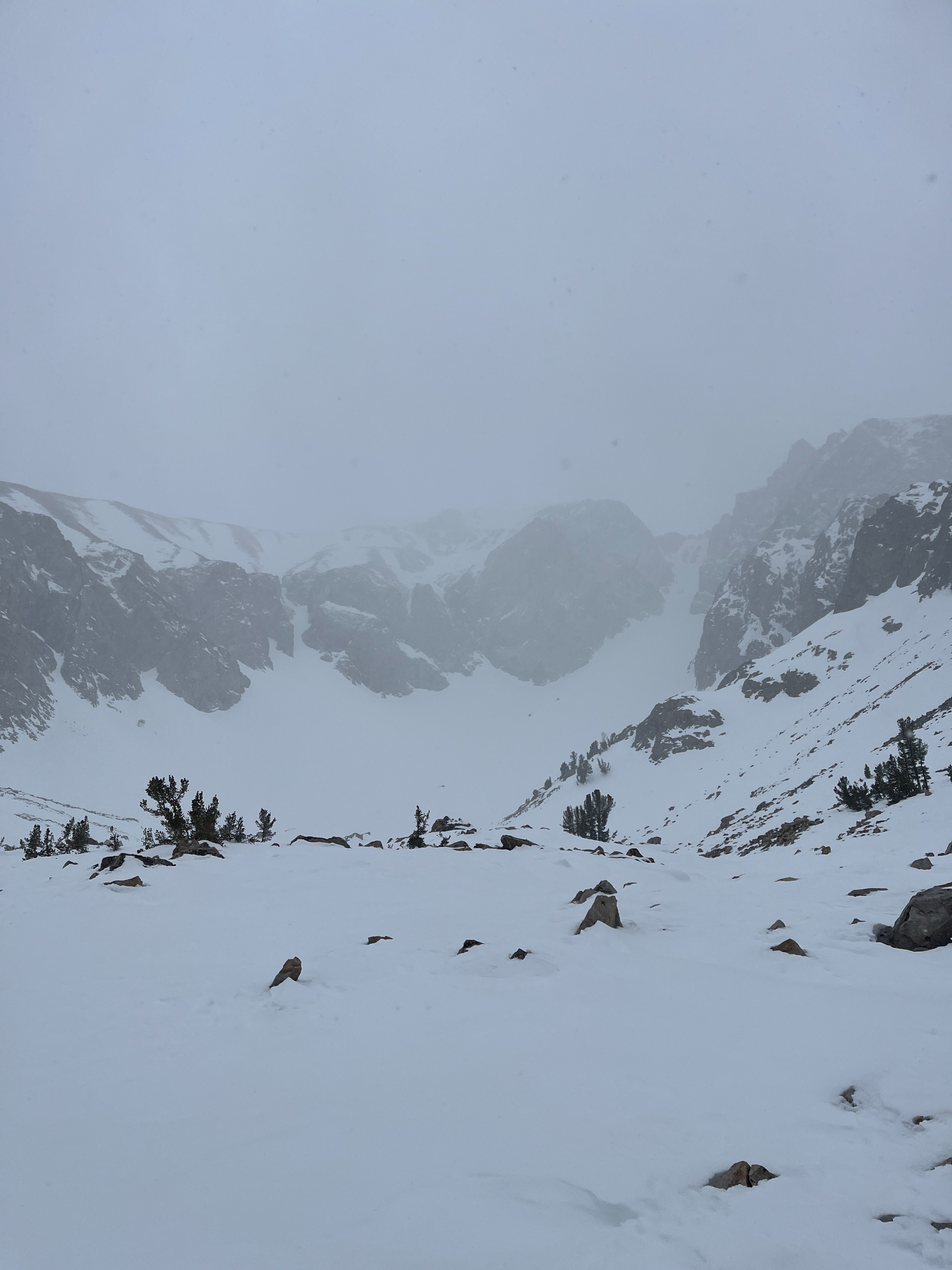
Quick report
My goals for today were to track the distribution of near-surface facets and see what's going on with the New Year's crust. I also wanted to watch the new snow as it fell and see if the wind was moving any around.
Dense clouds and warm temps were making all surface snow wet and sticky. By the time I reached 8500 feet, light snow was falling and temps had cooled, seemingly slowing the greenhouse effect.
I went as high as the moraines below the plateau at 9600 feet or so, and dug in on a N facing aspect. Near-surface facets here are the most developed and widespread that I've observed anywhere. When skiing steep N facing trees on the way out, I was able to push loose facet sloughs downhill, which then entrained more as they went.
I did not observe enough new snow for any sort of loose dry problem.
Below 8500 feet, the snow turned to isothermal mush, and I mostly kick turned my way back to the truck.
Weather
- Air Temp
- 32-40
- Cloud Cover
- obscured
- Wind Loading
- none
- Rain Elevation
- Below 7500 feet
- Recent Snowfall
- Trace
- Snow Avail For Transport
- small smounts
Skies became obscured throughout the morning, and light snow began to fall around 1200 pm. Winds were calm to light, and temperatures were right around the freezing mark. By the time I ripped skins at 1:30 pm, there was a trace of new snow on the ground.
Snowpack
Below 8500 feet: snowpack is mostly shallow and made up of melt forms, regardless of aspect.
Between 8500 and 9500 feet: solar aspects are melt-freeze, and polar aspects are well developed near surface facets.
Above 9500 feet: mix of wind board, NSF and MF.
I dug at 9500 feet on a protected N aspect. I found 30cm of fist hard, 3mm facets on top of the New Years rain crust. My extended column test produced no results (ECTX), due to a lack of any slab.
The structure here in the mid-elevation band will be concerning if and when we get new snow next week.