
Quick report
- Cracking
- isolated
It's hard to believe that exactly one-month ago, the snowpack in the West Cabinet Mountains was experiencing an almost full reset as an historic Atmospheric River unleashed significant rainfall in short order. Now, the mountains look and feel squarly in winter. Through the up's and down's of this winter, there are several parts of our snowpack that still offer more questions than answers. Whether the slab or weak layers win the stability battle remains the main question, but conditions likely need more time before poking too steep.
Minor cracking on leeward wind deposited areas.Weather
- Air Temp
- 25
- Cloud Cover
- overcast
- Wind Loading
- moderate
- Rain Elevation
- n/a
- Recent Snowfall
- Tr
- Snow Avail For Transport
- moderate amounts
Light snow on and off all day, Light winds >10mph
Snowpack
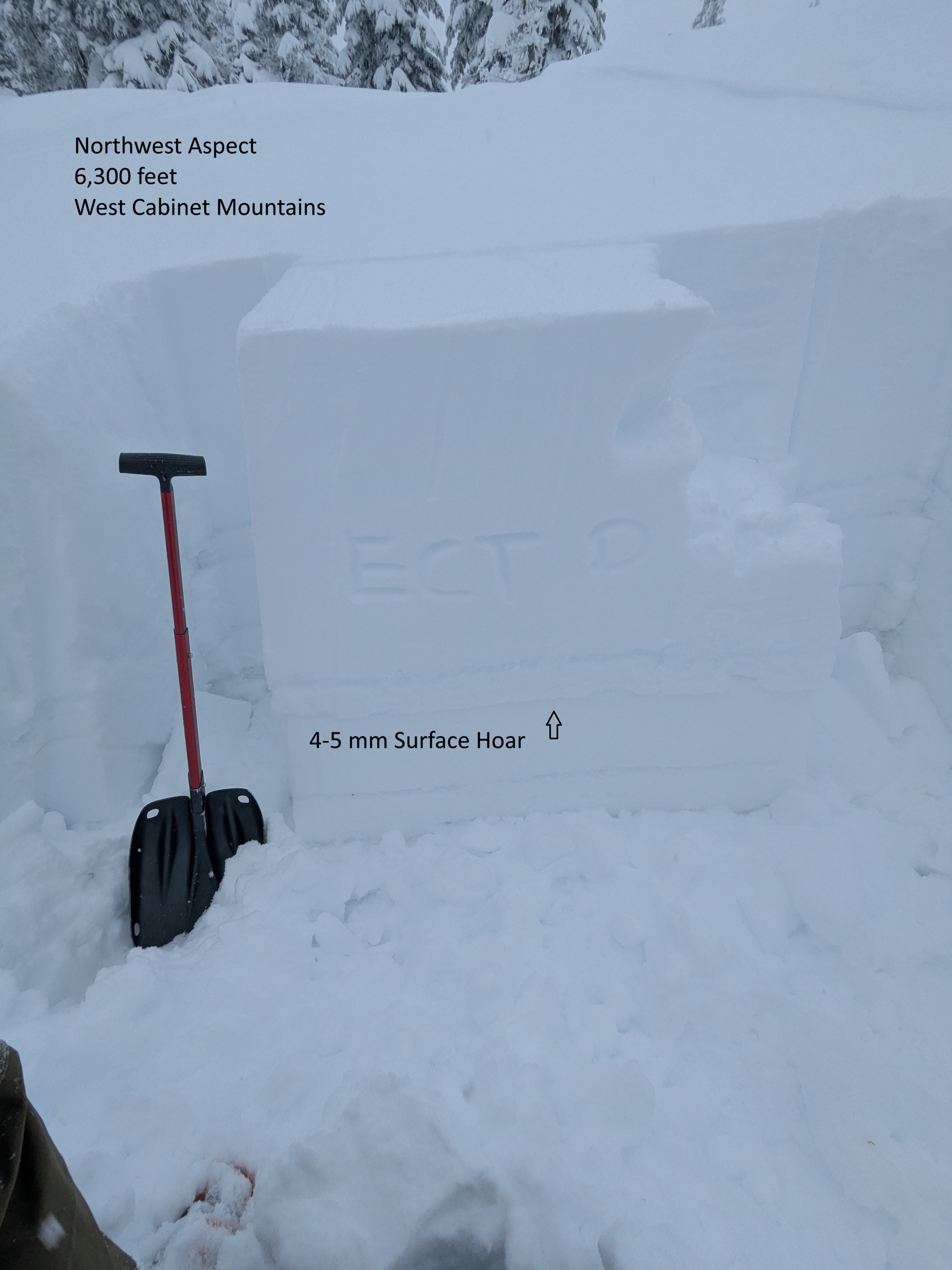
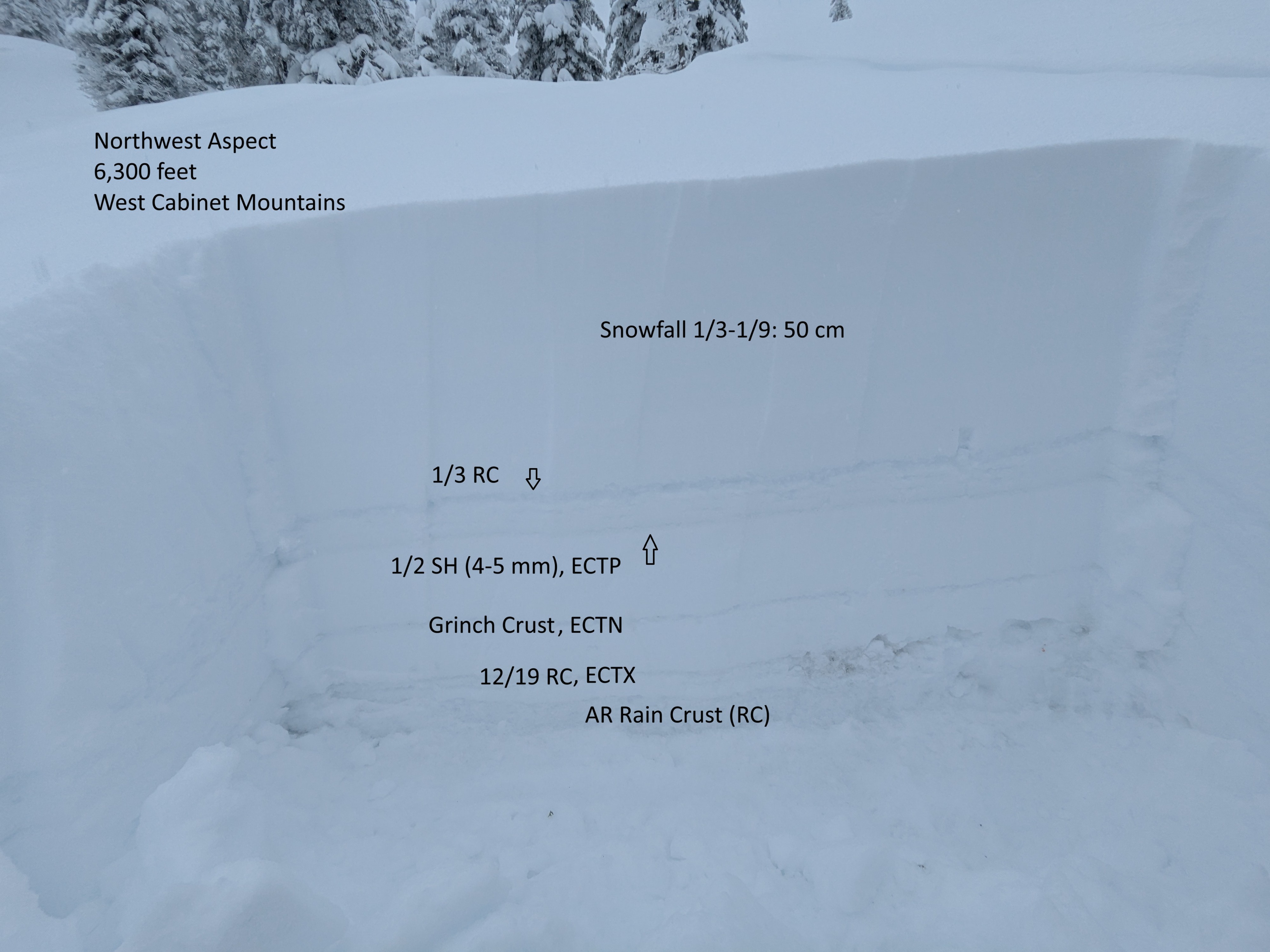
The snowpack is beginning to resemble a more typical mid-winter structure. The lower portion of the snowpack is becoming less of a concern as ongoing compression is turning it into a dense, consolidated base. Multiple rain crusts are still present, but the spacing between them has decreased and the snow in between is significantly firmer, limiting their current reactivity. In the mid-pack, roughly 70 cm below the surface, we continue to find a prominent rain crust commonly referred to as the Grinch crust. Faceted snow exists both above and below this crust, making it a more concerning layer. If a failure initiates in the upper snowpack, there is potential for the avalanche to step down to this deeper weak layer. About 54 cm down, a buried surface hoar layer was observed that could act as an effective sliding surface. While stability tests did not yield consistent results, the character of this layer combined with the cohesive slab above suggests that propagation remains a concern on slopes where the slab is intact and well connected. The upper portion of the snowpack consists of several rounds of new snow from the past week. Overall, the new snow is right-side-up, with density gradually increasing with depth, which is generally favorable. However, this slab continues to sit over multiple persistent weak layers, meaning careful terrain selection remains important.
Avalanche
None observed