
Quick report
- Cracking
- isolated
Spring-like day in the mountains in January. Wet and damp at lower elevations and more winter-like the higher we climbed. Fresh slabs are slowly forming over a variety of old snow surfaces. Regardless of the grain type or interface below the new snow, plenty of weaker snow shallowly buried only lacks a thick enough slab or trigger to round out the avalanche recipe. Drifted slopes are the most worrisome and where slabs are slightly thicker and stiffer over the same softer layers.
Weather
- Cloud Cover
- overcast
- Wind Loading
- moderate
- Rain Elevation
- 4,200
- Recent Snowfall
- 15 to 25
- Snow Avail For Transport
- moderate amounts
Overcast skies and fog to start the day. Around 1 pm, clouds lowered along with moderate snowfall. Winds ramped up too contributing to moments of lower visibility from drifting snow.
Snowpack
Below approximately 3,800 feet, the upper 20 cm of the snowpack was moist as a result of recent warm temperatures and rainfall, though it still contained roughly 10–15 cm (4–6 inches) of new snow. A distinct transition was observed near 3,800 feet, where the influence of rain diminished and snow conditions became progressively drier with increasing elevation. The next transition was around 5,500 feet when the snow glopped less to our skis. From there up to our top elevation around 7,200 feet, the new snow showed little to no evidence of rain effect and remained cold and unconsolidated. From about 6,000 feet and higher, wind effects became increasingly apparent. Moderate to occasionally gusty winds redistributed the new snow, forming localized wind slabs on leeward aspects and in cross-loaded terrain features.
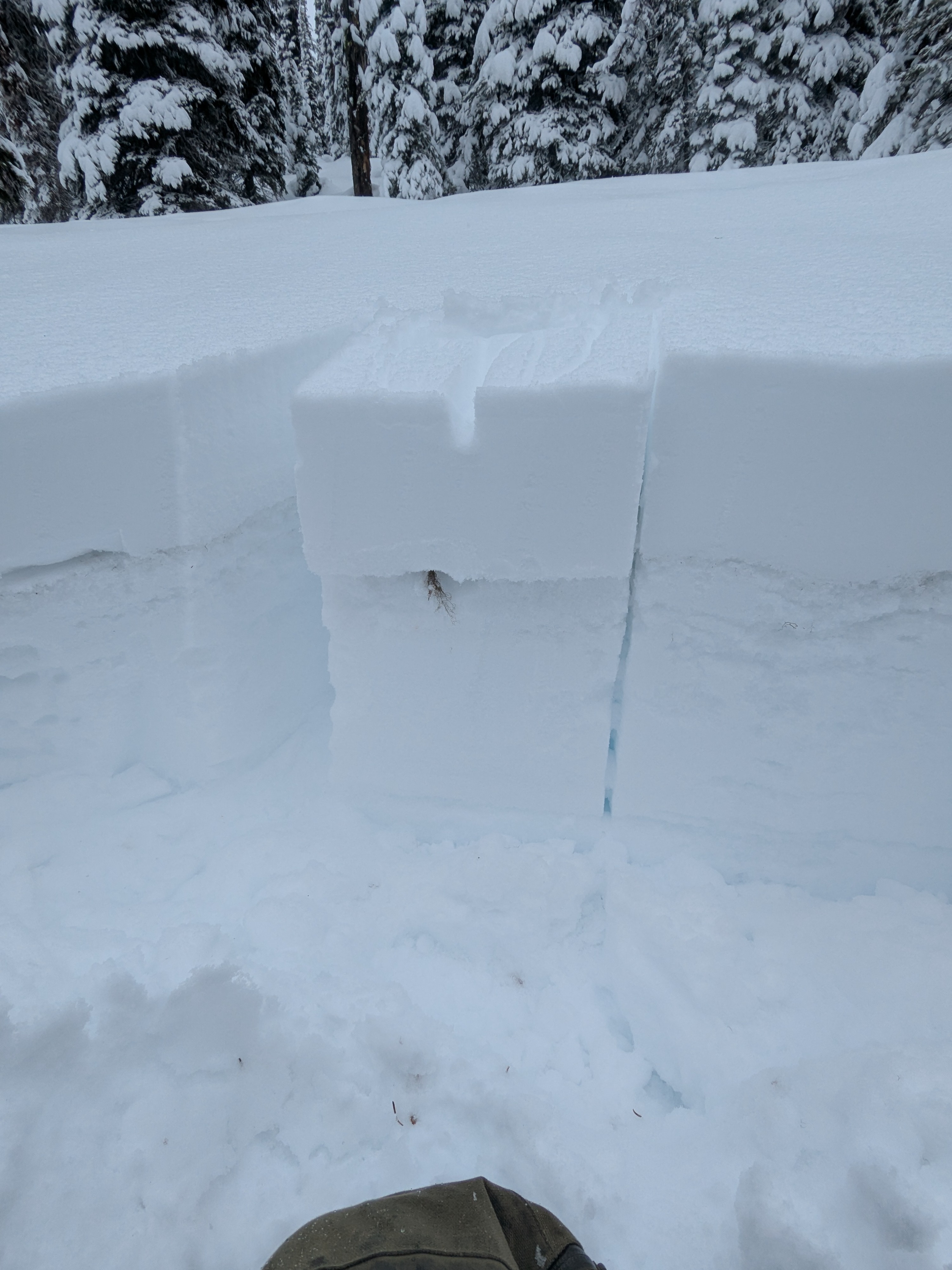
The primary snowpack concern is a buried surface hoar layer located approximately 20–30 cm below the snow surface and now capped by the recent storm snow. During snowpack test, this layer exhibited minimal signs of crack propagation (ECTNs) but the slab failed in compression with easy force (CT SC). This surface hoar layer rests on top of a thin but breakable crust, which in turn overlies 20–30 cm of weak, sugary faceted snow. This structure represents a classic persistent slab problem, and any failure initiating on the buried surface hoar would be very likely to step down into the underlying faceted layer, resulting in a deeper and more destructive avalanche. The January 13 crust is currently buried roughly 50-60 cm deep and appears to possess sufficient strength to act as a bridging layer, effectively isolating the lower portion of the snowpack for the time being. As the storm snow continues to settle and stiffen over the coming days, particularly where wind loading has occurred, the slab may gain the cohesion necessary to become more reactive. This would increase the chances of human-triggered avalanches.
Avalanche
- Size
- D2
- Type
- SS
- Count
- 2
- Aspect
- E
- Trigger
- N
- Elevation
- 6400 ft
A couple older crowns likely from the January 12 to 13 warmup.