
Quick report
- Cracking
- Observed
- Collapsing
- Observed
See entries in avalanche database and weather and snowpack summaries below. On untraveled flat terrain I triggered some impressively long-lasting collapses, which were easy to hear thanks to the rain crust down low. A few of these lasted 3-5 seconds, one lasted 6 seconds, and one continued for 8 seconds (all estimates). As I climbed off the flats, the frequency of collapses decreased drastically; I only heard one deep, rumbling collapse throughout the rest of the day. This occurred on low angle SE-facing slope at 8,400'.
Weather
Beautiful winter day in the mountains. -9 F when I left the car around sunrise, -1 F when I got back after sunset. Yes please. Light N-NE winds in the morning easing off to generally calm with occasional periods of light wind. The crest of the Boulders had a cap of fast-moving clouds in the morning, suspect wind speeds were higher there, at least initially.
Snowpack
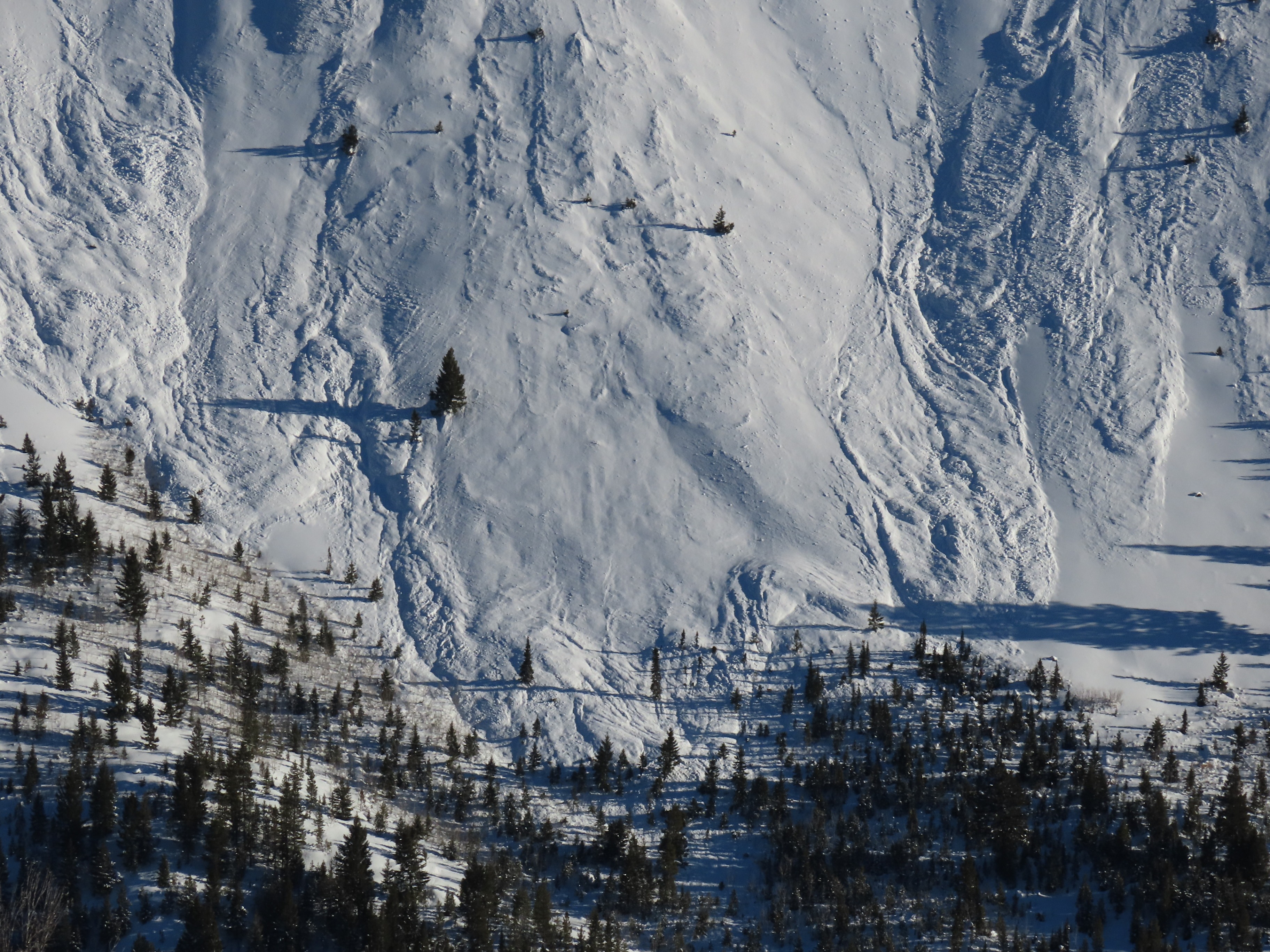
No pits today, just moving through miles of terrain under a cold winter sun. Rain crust at valley floor faded out by 8,500'. This was a true rain crust down low, with an obvious 1.5mm water ice lens capped with 1-2cm of melt-freeze polycrystals. Above the rain crust surfaces were soft and predictable. Solars took a bit of heat, but cold temperautres kept this restricted to specific terrain (steep S-SW, see avalanche entry for photo).
Avalanche
- Size
- D3
- Count
- 10
- Aspect
- NW
- Trigger
- N
- Elevation
- 9500 ft
Wide propagation, deep crown. Calling this a D3, but could argue that it is a D2.5 based on short path length.