
Quick report
Compared to yesterday in the Snake River Range, we saw less reactivity and more stable snow conditions. We didn't see any avalanches on small test slopes or unstable results in snowpits on the weak layer that has caused numerous avalanches the last several days. We investigated the snowpack in similiar terrain to where the recent avalanches have been reported and found the weak layer but less reactivity. This highlights the spatial variability of the weak layer. The weak layer is widespread, and for the time being only reactive in specific locations. This makes it difficult to manage. Digging in the snow and working on small slopes before committing to more consequential terrain can help you manage this problem. This weak layer could be more reactive when it gets loaded with more snow and forms a more cohesive slab.
Broken to scattered cloud cover all day. Cold temperatures with preserved powder on all aspects. Little to no wind affect or slab developement observed in upper elevation alpine terrain.
Snowpack
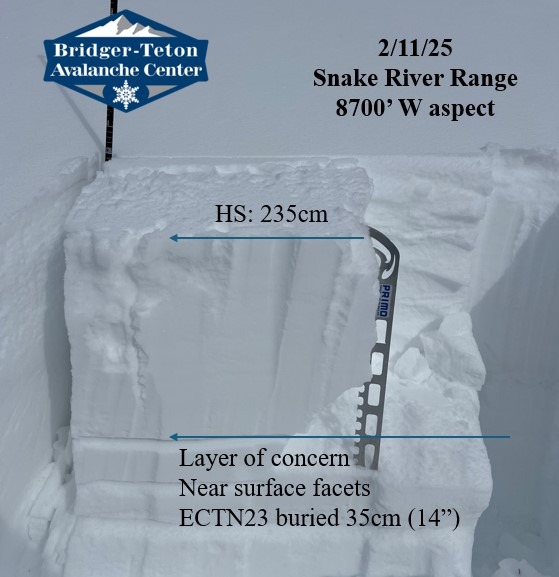
We dug numerous snowpits to test the weak interface buried 2/6 that has been the culprit of numerous avalanches the last two days. To our surprise we found no unstable tests results. The slab quality above the layer was not very cohesive. We also performed propagation saw tests on the weak layer buried 1/31 that were comprised of rounding facets in both locations. The 1/31 weak layer is becoming more stubborn to triggering.
8750' N aspect HS: 270cm ECTN18 on near surface facets buried 30cm (12") below the surface. PST 50/90 on the 1/31 persistent weak layer.
8700' W aspect HS: 235cm ECTN23 on near surface facets buried 35cm (13.5") below the surface. PST 40/70 on the 1/31 persistent weak layer.