
Quick report
- Collapsing
- isolated
A warm day with great skiing up high, and a concerning persistent slab problem at all elevations. It was warm and wet enough down low that trees were dripping and dropping their seasonal accumulation of snow. Where the recent snow is sitting on the solstice crust it would have been easy to push small wet snow goobers. I experienced a few muffled collapses involving the 12/13 weak layer. These occurred in both sheltered and slightly winded terrain. I traveled on an existing skin track in terrain that has been traveled through a few times already this season. Between the fading light and the water vapor in the air I had poor visibility of the surrounding terrain and was not able to glass around for recent activity.
Weather
Warm and wet out there, a real coastal feel to the day. Occasionally snowing S-1 to S3 (big, fat, moist flake clusters) on the drive north shortly before noon. I found 12-14cm of moist new snow sitting on the 12/21 (solstice) crust at highway level. This increased to 20cm of dry snow at upper elevations. Low and mid level clouds peeled back quickly in the mid afternoon, making for a lovely sunset. Very steep SW and W may have taken a slight crust, but lower angle slopes remained cold (trees and the solar w all of my skin tracks were melting a bit).
Snowpack
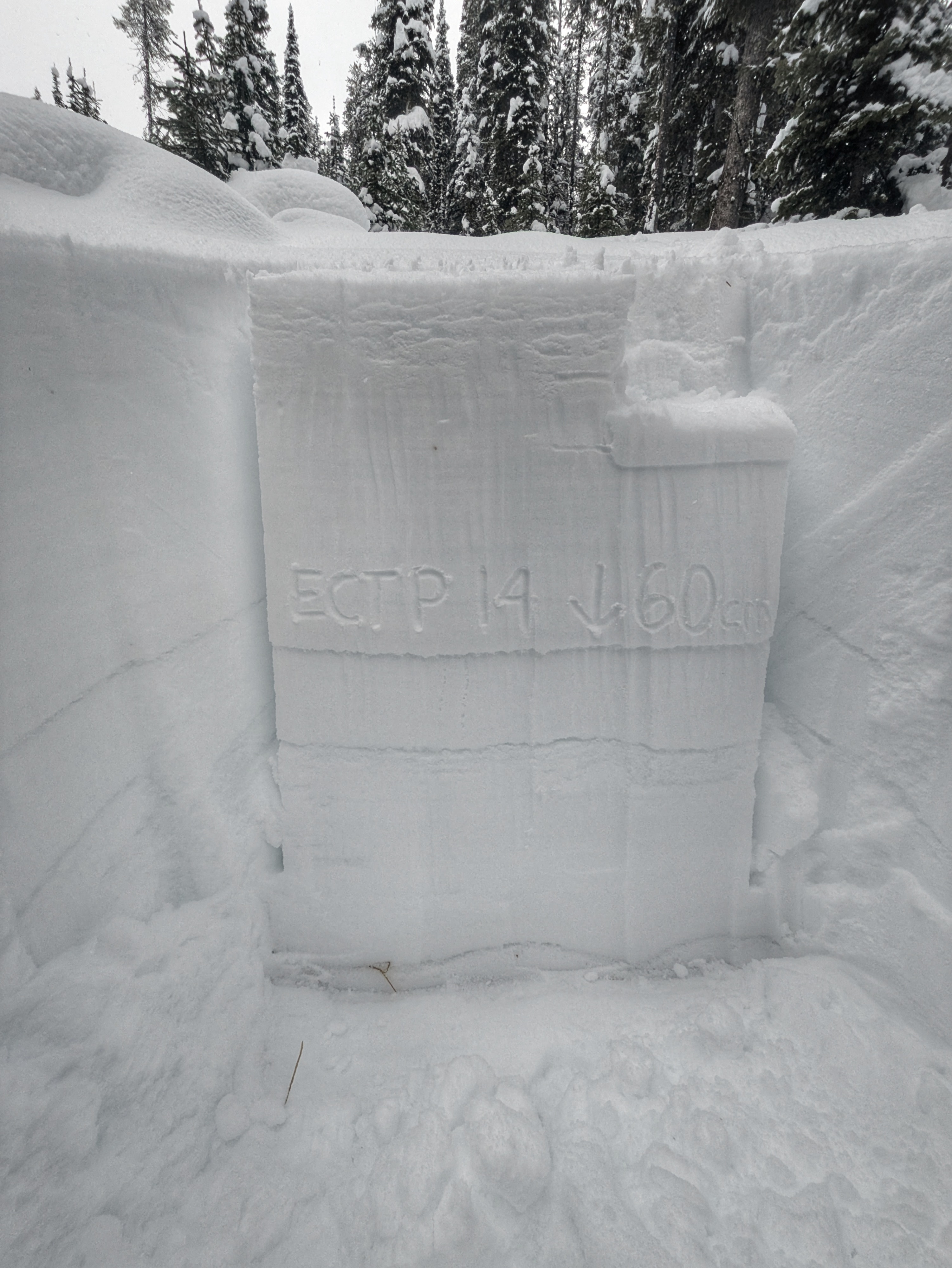
Weather stations report 2-3" of SWE at highway level since 12/13!. This likely increases with elevation. The problem associated with the 12/13 interface has graded into a true persistent slab problem here: slopes harboring this weak layer have a strong slab overlying the weak layer, even in areas sheltered by the wind! (this is important). I dug to look at this layer in sheltered terrain at 7,000' on an E/NE slope. I found the layer down 60cm (2 feet) underneath a slab that quickly graded from F to 4F in the upper half; the lower half of the slab was 1F. There was some nice standing SH at this interface (up to 8mm) and some small FCsf (1-2mm). This layer produced 2 x ECTP14.
Avalanche
I observed several D1 dry loose sluffs in steep terrain at upper and middle elevations. In subtly winded terrain one of these sluffs flanked out a bit down about 30cm; this may have been the 12/21 layer? Low confidence in that.