
Quick report
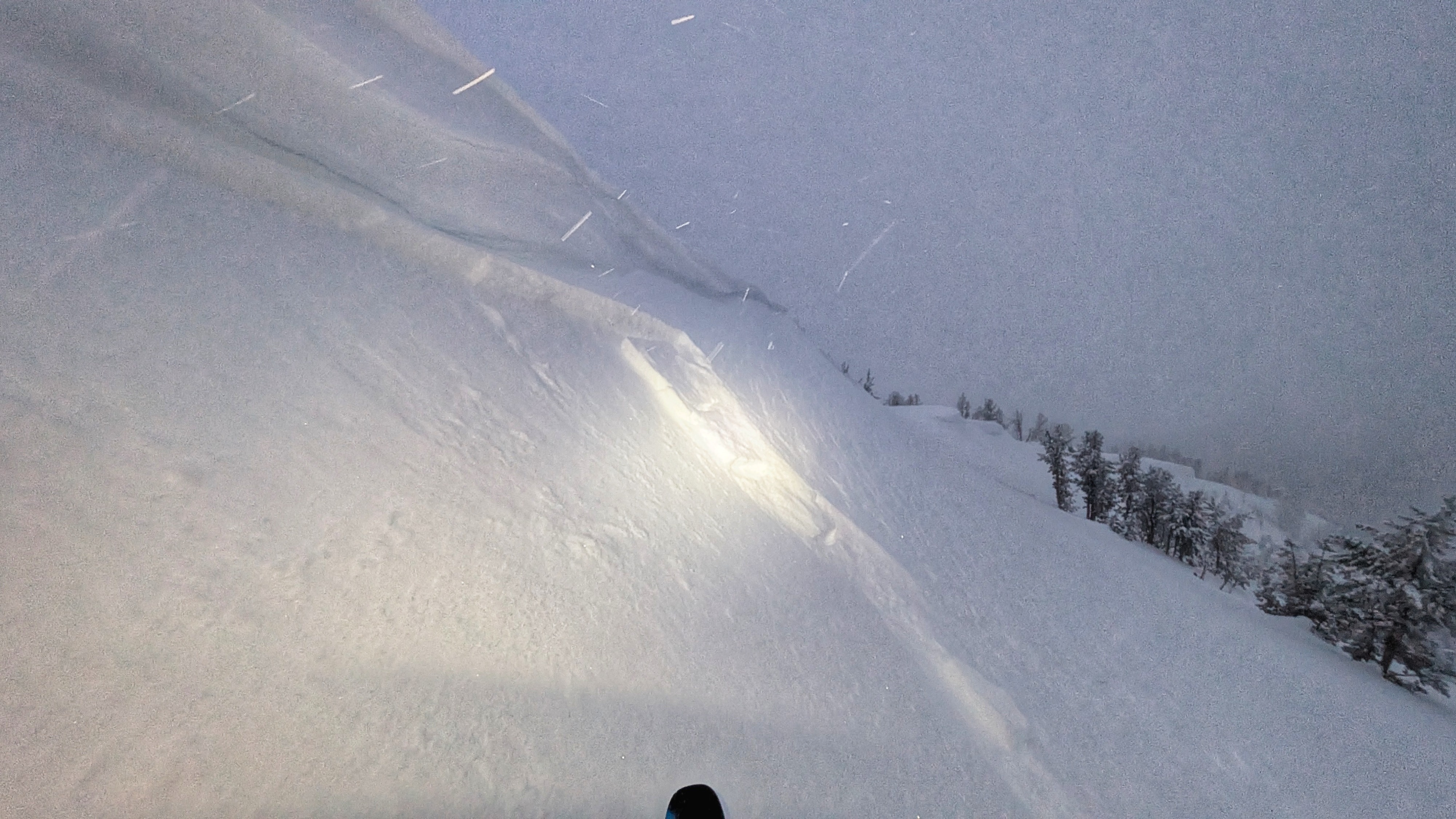
I traveled through miles of terrain that had not seen a human this season and experienced no cracking/collapsing outside of the single, small wind slab reported below. I did not dig today (so bizarre!), observations are just from moving through terrain. Ski quality was excellent on most aspects. Even with just 6-8 inches of snow on top of the New Year's crust I was able to ski solar aspects and rarely, barely touch the crust. The crust was loud to the ski poles but quiet to the skis... you love to see it. The New Year's weak layer and what exactly happened to the snow between 1/1 and 1/3 are a bit of an unanswered question. There was some pretty ugly snow developing here, but warm temperatures, warm precipitation, large amounts of reflected ambient radiation, and moisture from mountain-clinging clouds being sucked into the snow seem to have softened these problems some. However, I'm paying close attention to what is going on at this interface as snow piles up above the New Years surface. The small wind slab I intentionally triggered was the only sign of instability in my travels today.
Weather
6-8 inches of new snow on top of New Year's crust. A few hours of variable sun in the middle of the day. It looked like the Sawtooths and south may have been getting enough radiation during this period to do a tiny bit of melting? I did not observe this directly in the terrain I traveled through. Winds were light and variable, moving small amounts of snow. More snow was being transported across the road on the west side of 75. Snowfall beginning in the late afternoon, a mix of graupel and large stellars. Brief periods of intense snowfall (over an inch an hour) but generally more like S-1 to S1 (less than a half inch per hour).
Snowpack
Upper snowpack: new snow since New Years, sitting on a crust on solars and somewhat generic near surface facets on shaded slopes. Did not find surface hoar here, but was only hand pitting around. Middle snowpack: This is a whopping slab of dense snow with a variety of crusts that vary with elevation from vacillating rain lines during December storms. Lower snowpack: late-November facets sit on mid-November rain crusts. Snow depth of 1-2 feet at valley floor (easily travelable, but there are some sage bits poking through the snow). Snow depth increases to 4-5.5 feet by 8,500'.
Avalanche
I was able to intentionally trigger one very small wind slab on a 40 degree test slope on a N aspect at 9,600'. It broke about 50 feet wide, failing only within the dense, wind drifted snow immediately adjacent to an exposed ridgeline. I had to work pretty hard to find this sensitive slab.