
Quick report
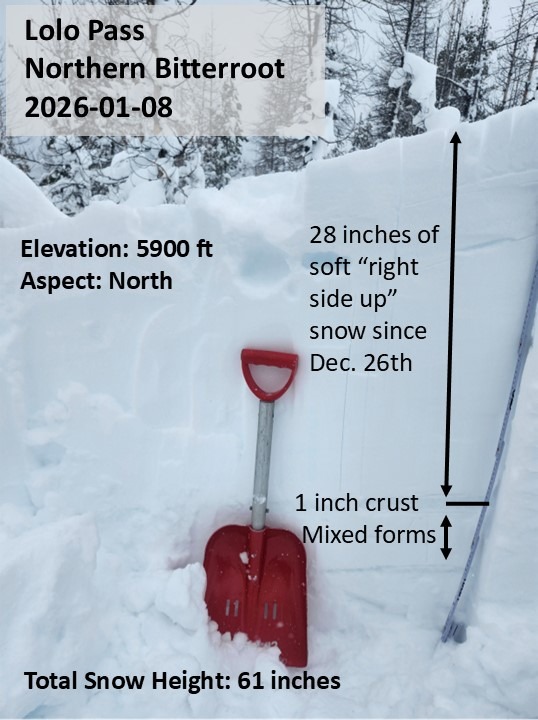
I spent most of the day digging as a means to learn about our buried crusts. I found a crust 1-inch thick, buried about 28 inches. I did not get any results on this crust in compression tests or extended column tests. Unlike in the southern Bitterroot, there was not an obvious layer of facets underneath it.
Where I travelled, the new snow was low-density and lacked slab properties. I did not get above 6000 feet, but I could see that the wind was moving snow up high. If I had travelled to ridge top, I would have avoided wind-loaded slopes over 30 degrees.
Where it isn't wind affected, new snow could produce a small dry loose avalanche. I skied a slope that was just barely 30 degrees and did not experience any sluffing. However, on small, steeper rolls I could get the top 5 inches of snow to sluff. I suspect human-triggered dry loose avalanches are possible on isolated slopes over 35 degrees. While small, these avalanches are still dangerous if they push you into a terrain trap, such as a cliff, tree, or gulley.
Weather
- Air Temp
- 24
- Cloud Cover
- broken
- Wind Loading
- previous
- Rain Elevation
- N/A
- Recent Snowfall
- 10
- Snow Avail For Transport
- large amounts
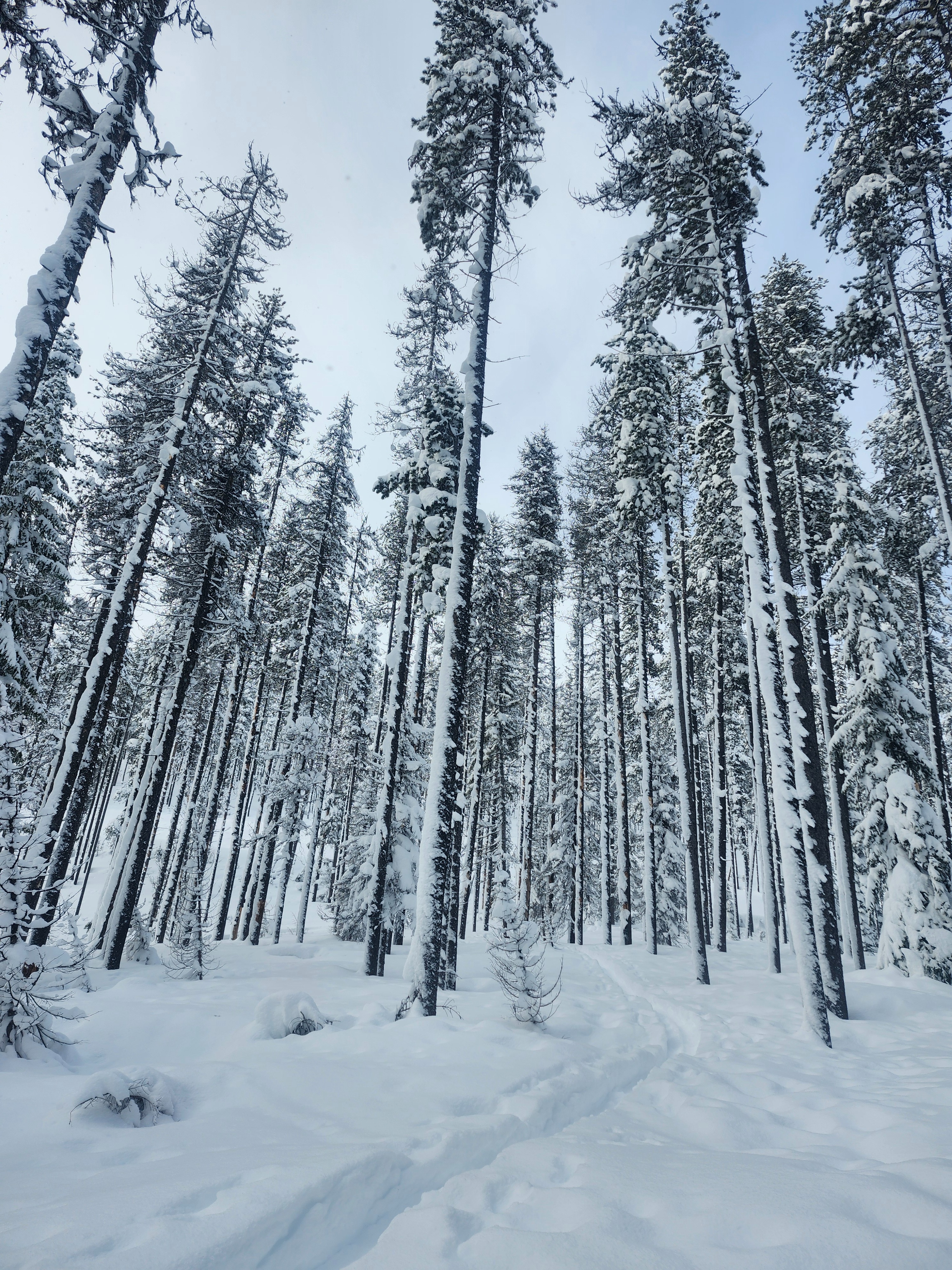
Previous wind loading suspected at ridge tops only. Snowfall occurred on and off. At its heaviest, snow fell at a rate of an inch an hour, though usually for less than 20 minutes at a time. I occasionally saw the sun through the clouds.
Snowpack
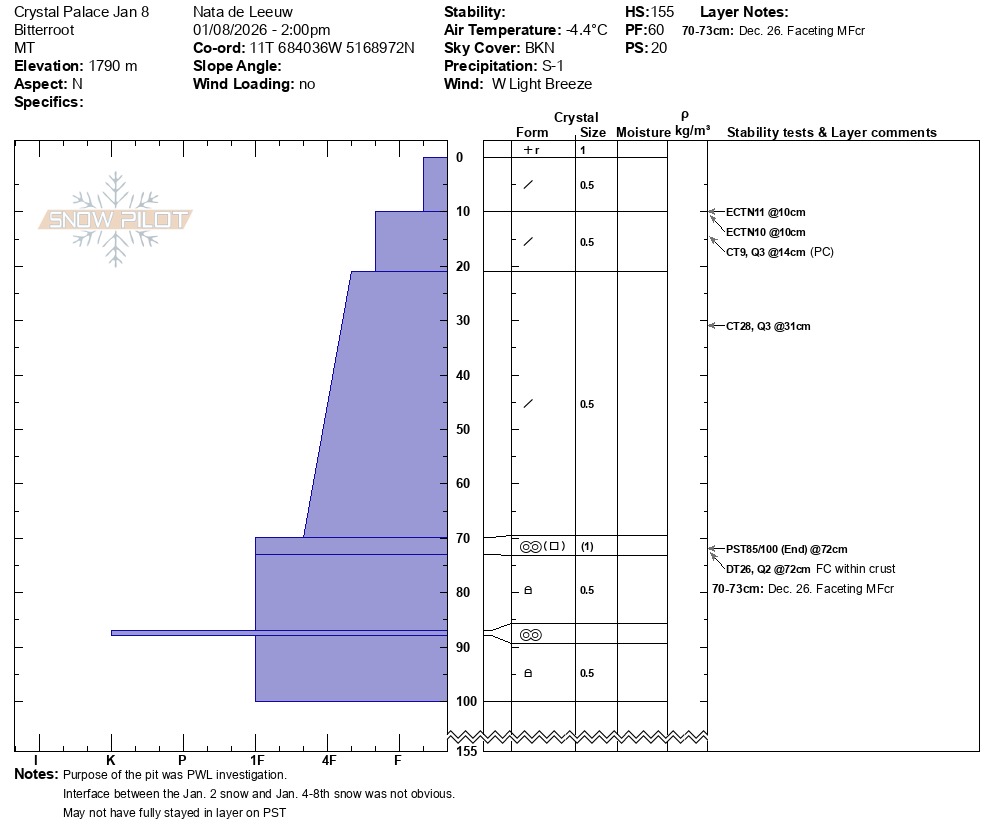
I dug at 5880 feet on a north aspect. The top 27.5 inches (70 cms) was soft "right side up" snow from the past week. I had a few non-propagating ECT results and poor shear quality compression test results within the top 6 inches (ECTN10,11 dn 10cm) (CT9 dn 14cm (PC), and one slightly deeper (CT28 dn 31cm (BRK).
Buried 27.5 inches was the 1-inch (3 cm) thick melt-freeze crust that formed from warm temperatures around Christmas and was first buried on December 26th. There was no facet layer underneath it, although the crust itself is starting to facet out. I did two extended column tests and two compression tests, and got no results on this layer. I did get a failure on hard taps in a deep tap test (DT26 (RP)). This occurred on a continuous layer of facets within the crust. I did a PST on this layer and pulled the saw nearly to the end of the column before it propagated. (PST 85/100 (END)). However, I can't be fully confident that I stayed within the most faceted part of the crust, as it was poorly defined and non-continuous.