
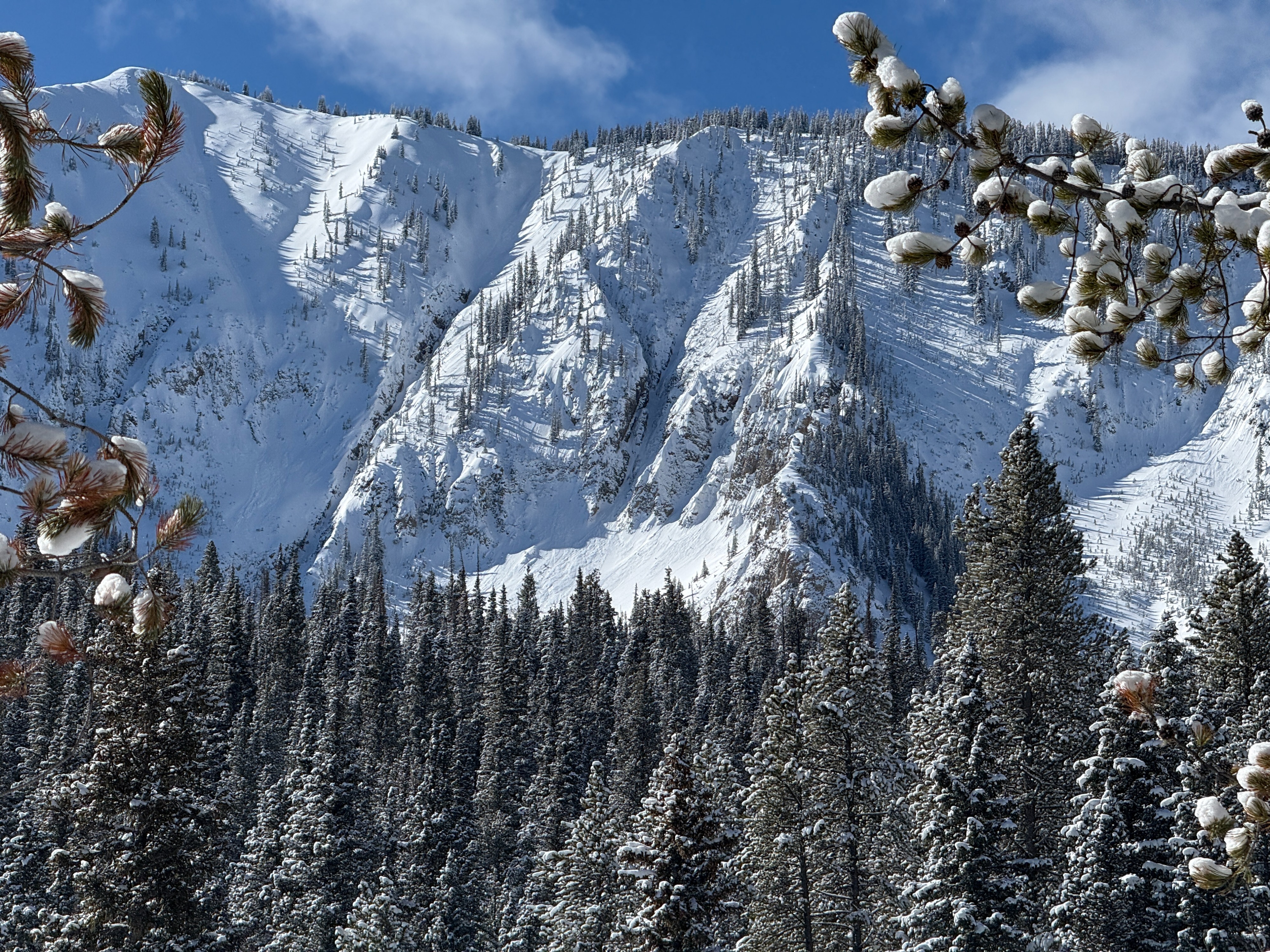
Quick report
Loose avalanches seemed to be the most likely problem to encounter. On shady features, there is up to a foot (generally less) of entrainment on steep slopes. On sunny slopes, strong solar radiation battled with cool air temperatures, and the sun prevailed. Sunny terrain produced some natural avalanche activity from daytime heating, but human triggered slides seemed probable on slopes around 40 degrees or steeper.
I didn't target wind drifts on shady aspects where the new snow accumulated on facets above a crust, so I remain wary of drifting on northerly terrain.
Weather
- Wind Loading
- previous
- Recent Snowfall
- 20
- Snow Avail For Transport
- moderate amounts
Mostly clear skies. Storm totals varied from 5 inches near Kebler TH to almost a foot on Ruby Peak. Sheltered northerly terrain on AMR held 9 inches.
Snowpack
While touring through southerly terrain near treeline, I didn't experience cracking while ascending through drifted terrain features with soft textures up to two feet deep. Hasty hand shear pits revealed marginal bonding between the new snow and old crusts. This interface was slightly faceted. I speculate that this was a product of a moist, not fully frozen crust when the recent snow began to accumulate. The recent storm snow became moist before noon and created a loose avalanche problem on steep terrain features.
On northerly terrain in the Anthracite Range, the new snow remained soft without cohesion. Small, Dry Loose avalanches were probable on features around 40 degrees. The storm snow accumulated on a thin layer of facets above last week's friable rain crust. Not enough snow accumulated to create a slab avalanche problem in sheltered areas.
Avalanche
- Size
- D1.5
- Type
- SS
- Count
- 10
- Aspect
- N
- Trigger
- N
- Elevation
- 11800 ft
Early in the morning, numerous small Dry Loose avalanches were observed on most aspects at upper elevations. By midday, a few natural loose avalanches began to run on steep rocky terrain features in the sun. On Mount Axtell a few natural slabs were visible in the morning; these avalanches had minimal propagation but were not point releases.