
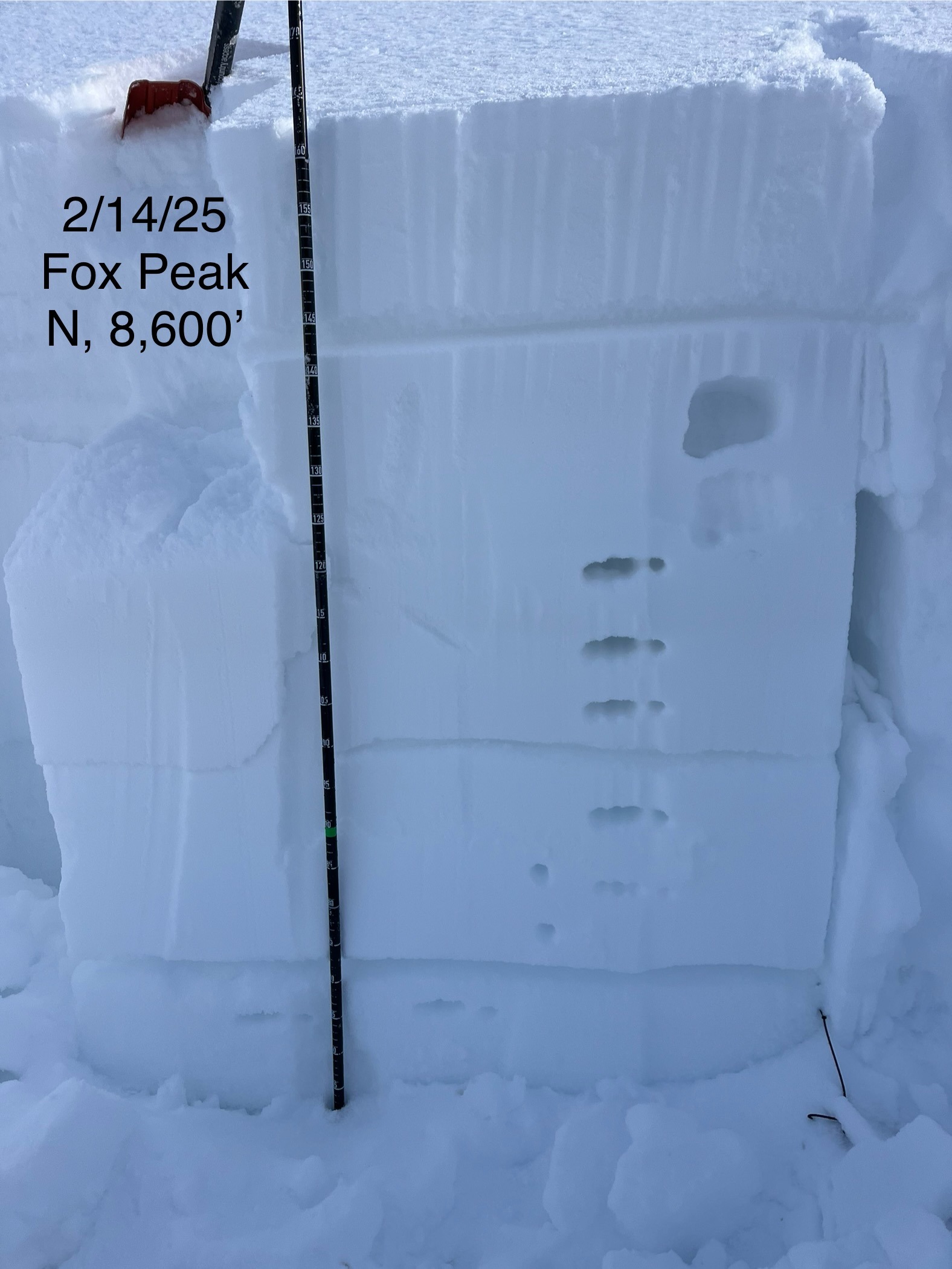
Quick report
The new snow was light and not forming slabs in sheltered terrain. Once the sun came out in full force, it quickly reminded me it was mid-February. It rapidly deteriorated ski quality on the south-facing slopes and triggered a wet loose cycle in the Boulders. Tree bombs were also setting off small dry loose avalanches in the fresh snow.
Weather
- Cloud Cover
- broken
- Wind Loading
- light
- Recent Snowfall
- 1-2 cm
- Snow Avail For Transport
- large amounts
Morning snow showers followed by periods of sun. Big cumulous clouds over the Boulders mid day with frontal passage.
Snowpack
The afternoon cold front brought some rimed snow (almost graupel sized) which fell on the surface. The 2/13 storm was about 23 cm thick of light density snow and didn't pop with small column tests. I didn't do any grain identification on the 2/13 and 2/6 interfaces as I didn't have a crystal card. Large columns test performed ECTN20s down 63 cm on a 1/31 mid storm density change. I performed two propagation saw tests on the 1/31 layer of facets with PST23/100 (End) results. The 1/31 layer is rounding facets and about 4F- hardness. As I was pulling my block off, a layer popped off down 37 cm. That was likely the 2/6 interface which is still a soft slab in this sheltered location. South slopes were melting with February sun and warmer temperatures. A 1-3 cm thick crust formed depending on the steepness of the slope.
Avalanche
- Size
- D2
- Aspect
- N
- Trigger
- N
- Elevation
- 8600 ft
The Boulders had a good wet loose cycle on the SE slopes, one may have been D2 but it was milky skies at the time.