
Quick report
Travel is slow and bushy with ski pen of 55cms and a total snowpack height not much deeper. New snow amounted to 10 cms in the last 24 hours at valley floors and increased to 15 cms 1000' up. A storm slab is gradually building, however still did not have enough cohesion in this location to produce signs of instability or results in ECT tests. This scenario will be different at upper elevations where there is any stiffening of the surface snow due to wind redistribution. At 2700' there is now 40-45 cms of new snow since the the weather switched from clear and cold to overcast with light precipitation on the 26th. Buried surface hoar exists at this interface and will be important to watch with more snow in the forecast that will gradually add to stress on this layer.
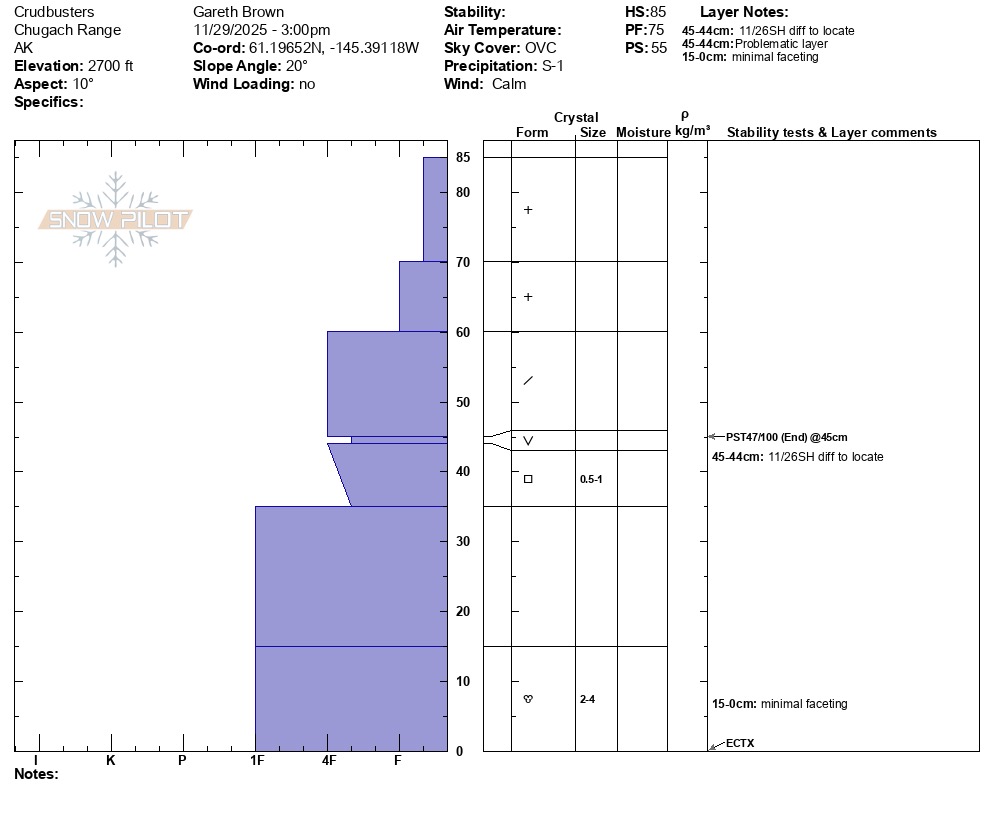
Stability tests: hand shears-hard, ECTX, PST END(47/100) down 40 cms, 11262025 BSH.
As mentioned in previous observations, the snowpack is currently stable in the mid and lower elevations due to a lack of a cohesive slab at the surface. This scenario can change very quickly with an increase in temperature or if snowfall moves from the current light and incremental to heavy. The strength of the snowpack is low and will not be able to accept a major loading event without a marked rise in sensitivity.
No signs of instabilityWeather
- Cloud Cover
- overcast
- Wind Loading
- none
- Rain Elevation
- N/A
- Recent Snowfall
- 15
- Snow Avail For Transport
- moderate amounts
Snowpack
Once again found an unconsolidated snowpack. Structure is good, Strength is low, and Stress is low. Total snowpack height is 80-90 cms at 2700'. Surface Hoar that was buried on 11/26 is now buried ~40 cms at this location and was identifiable; however, it is difficult to isolate on a crystal card, likely being mixed and pushed into the soft snow beneath. Snow at the ground consisted of 2-4 mm meltform chains and was less faceted than what was found in slightly thinner pit locations of Cracked Ice and Gully 1. See full pit profile for more snowpack info.