
Quick report
- Slope Angle
- 35°
Avalanche
- Slab Width
- 15 m
- Weak Layer
- New Snow
- Trigger Type
- Skier
- Vertical Fall
- 46 m
- Avalanche Type
- Soft Slab
- Slab Thickness
- 20 cm
- Trigger Detail
- Unintentionally Triggered
- Start Zone Aspect
- North
- Avalanche Problem
- New Snow
- Start Zone Elevation
- 3170 m
Skied in the Alta periphery today. Began in Dry Fork where instability, interestingly, was hard to come by. Likely related to the aspects we chose. As skiers began to venture to the Lake Catherine area, instability quickly became obvious and surprising. Widespread almost certain D1 soft slab activity was found on the E through N slopes above Lake Catherine. "Almost Certain" doesn't appropriately describe the reactivity. As I cut a traverse to ski the Sunset doors, I triggered first a D1 soft slab at my feet before the cliff (pictured, skier in photo), and past the cliff, a D1 soft slab broke 50 feet above me, and ran past me, luckily without sweeping me off my feet. (Pictured: crownline photo without the skier - if you can't make out the crown, it runs the width of the photo 8" deep or so). This is the avalanche I am citing in this report, though another party triggered a similar avalanche from the top of Rocky Pt. Didn't get a photo.
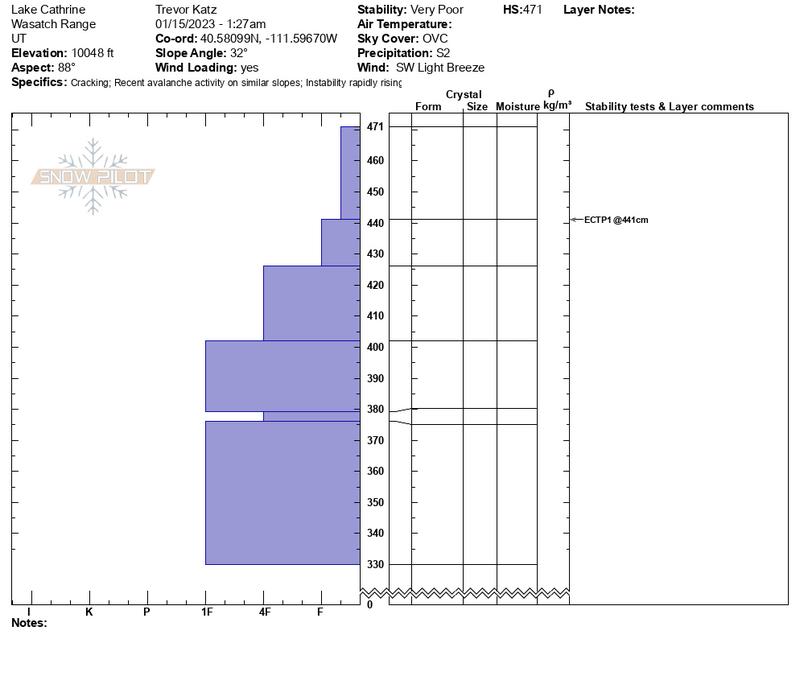
As I escaped to non avalanche terrain, I was more than curious to dig. Propagation within the new snow? Blower pow acting as a slab? Sign me up. Snowpit attached. I found that the weak grain in question appeared to be buried stellar dendrites, and I couldn't tell, but maybe some needles were included. In any case, these grains (pictured) reliably produced failures 30cm down on all aspects in handpits. I don't know what changed within the new snow to create this instability, as the snowpack is otherwise rightside up. It should be noted, however, that, for the moment, these avalanches can be triggered remotely; are not limited to breaking at our feet. My hackles are up.