

Quick report
- Collapsing
- isolated
Looked along the entirety of our route, trying to identify and test the sensitivity of the 12/22 BSH. Signs of instability were not present besides one steep and wind loaded test slope at ~3800' where some small compression cracks occurred as well as a 3'x10' pocket of snow that released that was 20cms deep consisting of wind loaded snow, BSH not identified at the failure plane.
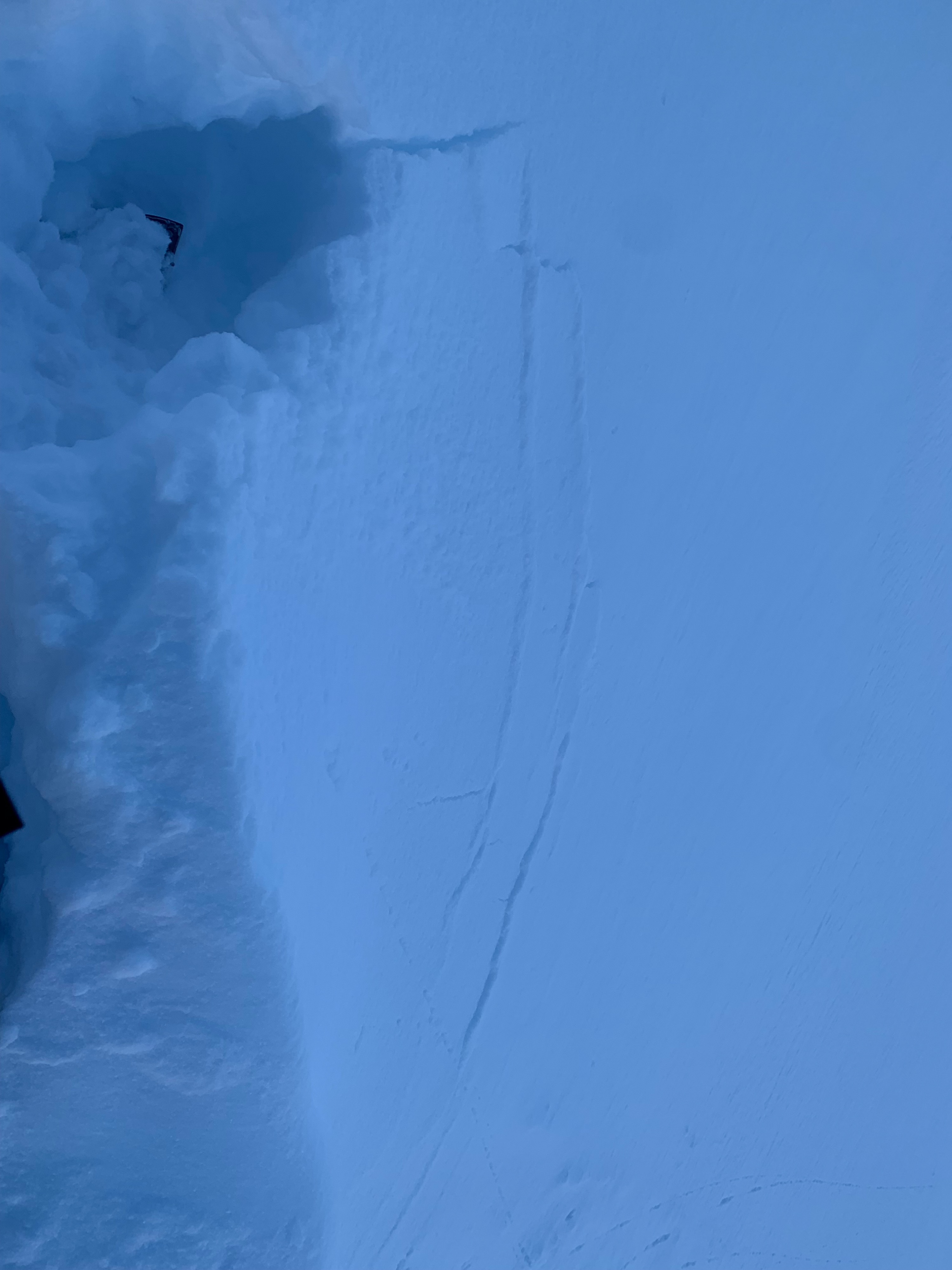
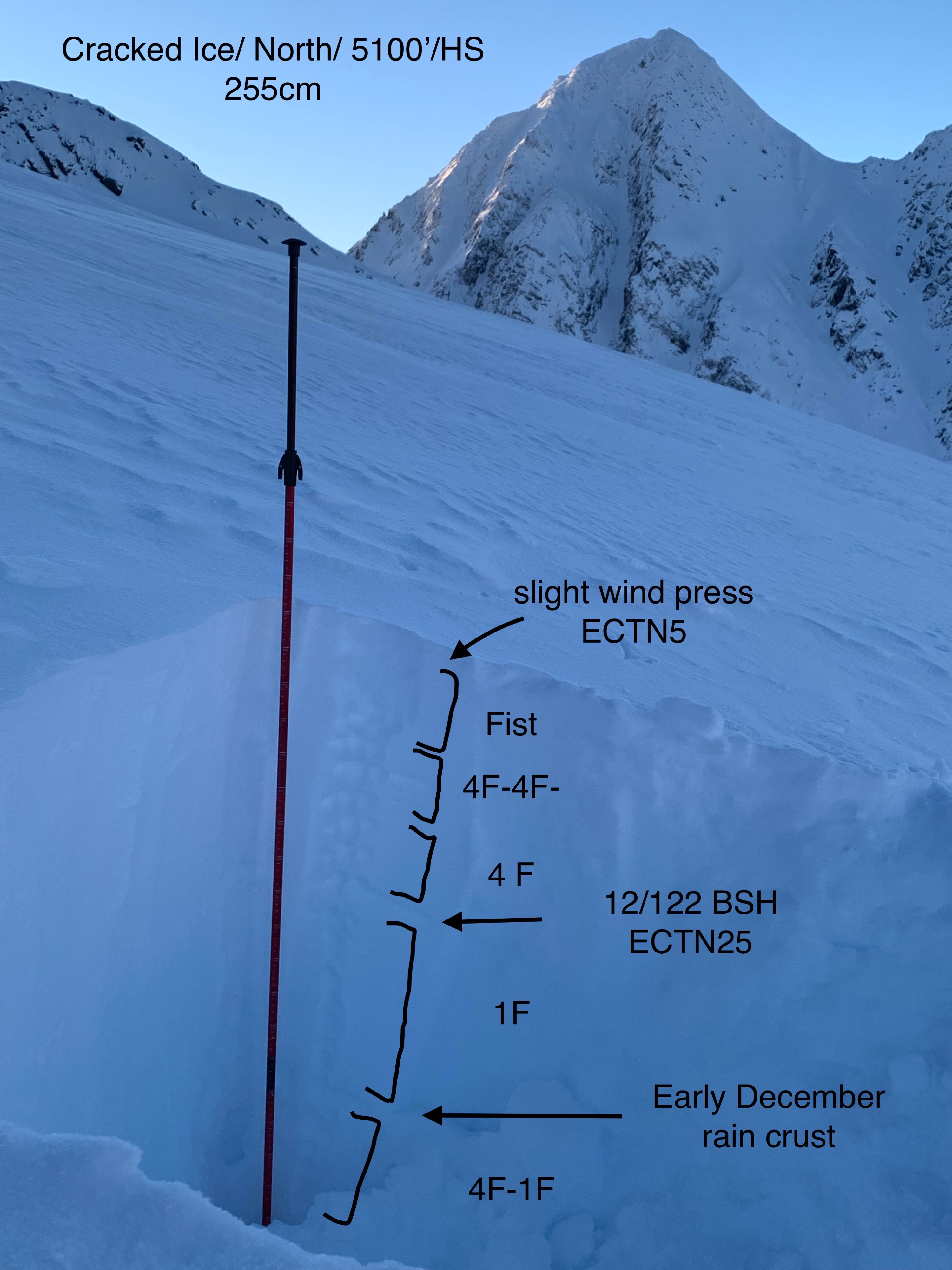
Dug quick pits at 2800' and 3600' with moderate to hard ECT results and no propagation on BSH down 40 cms. At 5100', dug a more thorough snowpit and found a snowpack with good structure and strength. ECT results were ECTN5 down 10 cms below a layer of slightly wind pressed snow and ECTN25 down 40 cms (12/22 BSH). The 12/22 BSH was difficult to identify in the pit face and when exposed was mixed with other grains, but a clean shear was present.
Skied slopes up to 35° without signs of instability.
New surface hoar formation 1-4 mm was observed up to 4000' with the larger grains existing at lower elevations.
The only signs of instability that were observed occurred on a small steep, wind loaded test slope with small stress cracks appearing and one 5' wide pocket up to 20 cms deep and 3 meters wide. Cracking was isolated with no propagation energy observed.Weather
- Cloud Cover
- clear
- Wind Loading
- light
- Recent Snowfall
- 25 cms
- Snow Avail For Transport
- large amounts
Clear and calm with only mild previous wind redistribution
Snowpack
Below 3500': 30-40 cms of uncohesive snow sits on top of 12/22 Buried Surface Hoar. This layer was challenging to locate and appears to already be in the process of being absorbed by the soft snow beneath. 12/10 rain crust is down 40-60 cms (16-24 inches) and is continuing to show signs of breaking down and losing strength. Melt forms that are faceting are below this layer with another rain crust from 12/5 10 cms below the 12/10 layer.
Above 3500': Surface snow became more cohesive due to previous light winds. 12/22 Buried Surface Hoar became slightly easier to locate but again was mixed with other grain types as it appears to be in the process of being absorbed by the snow beneath in this location. Wind effect on the surface snow was very minimal. Early December rain crust was present, but very thin.
Avalanche
A few D1 dry loose were observed that naturally released from steep south facing terrain in the bowl East of Averys/5800' . 1 - D-1 soft slab released from a steep rollover near the toe of the RFS Glacier. NW aspect 4000'. Both probably released on 12/28 during latest snowfall