


Quick report
Good travel in open areas due to supportable rain crust. Surface hoar growth over a firm crust will be a mid elevation concern once more snow arrives. Rain crust went higher in elevation than what was observed on the other side of the road, creating a lower likelihood of triggering an avalanche in the weak snow that has been found in the mid elevations elsewhere. This may seem like an unimportant detail however, it shows that the variabilty of rain crust elevations.
Where the most recent rain crust exists and is supportable, it is unlikely but not impossible to effect the mid elevation facets. In areas where the most recent rain crust (1/15) does not go as high in elevation as the mid elevation facets(3000-3500), human triggered avalanches remain possible and high consequence on slopes that have not already avalanched. This is a very specific elevation band and nuanced problem, but deadly if initiated due to the density and depth of the slab.
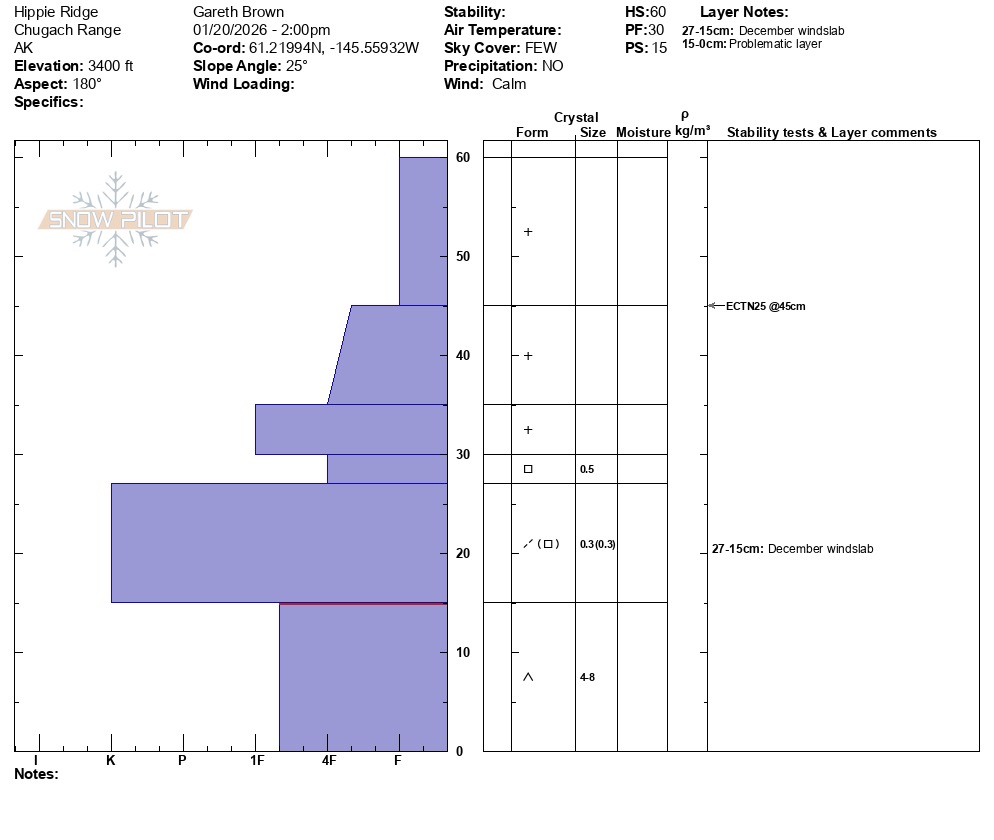
Above 3k there was a very thin variable snowpack. Many areas showed the most recent snow directly on the ground, while others had some thin, old knife hard wind slab overlying 1F- depth hoar that was not reactive in stability tests.
Weather
- Cloud Cover
- few
- Wind Loading
- none
- Rain Elevation
- 3200
- Snow Avail For Transport
- small smounts
Snowpack
Breakable rain crust in the forest. In more open areas rain crust was supportable and went up to 3200'. Surface hoar was widespread on the rain crust up to 2500' with up to 1 cm grains observed peaking at 2k and tapering in size above and disapearing by 2500'.
Structure was poor in the mid elevations , but strong rain crust was bridging weak snow. Once the most recent rain crust faded (1/15). The underlying snowpack transitioned to areas previously scoured to ground intermixed with knife hard wind slabs over depth hoar.