
Quick report
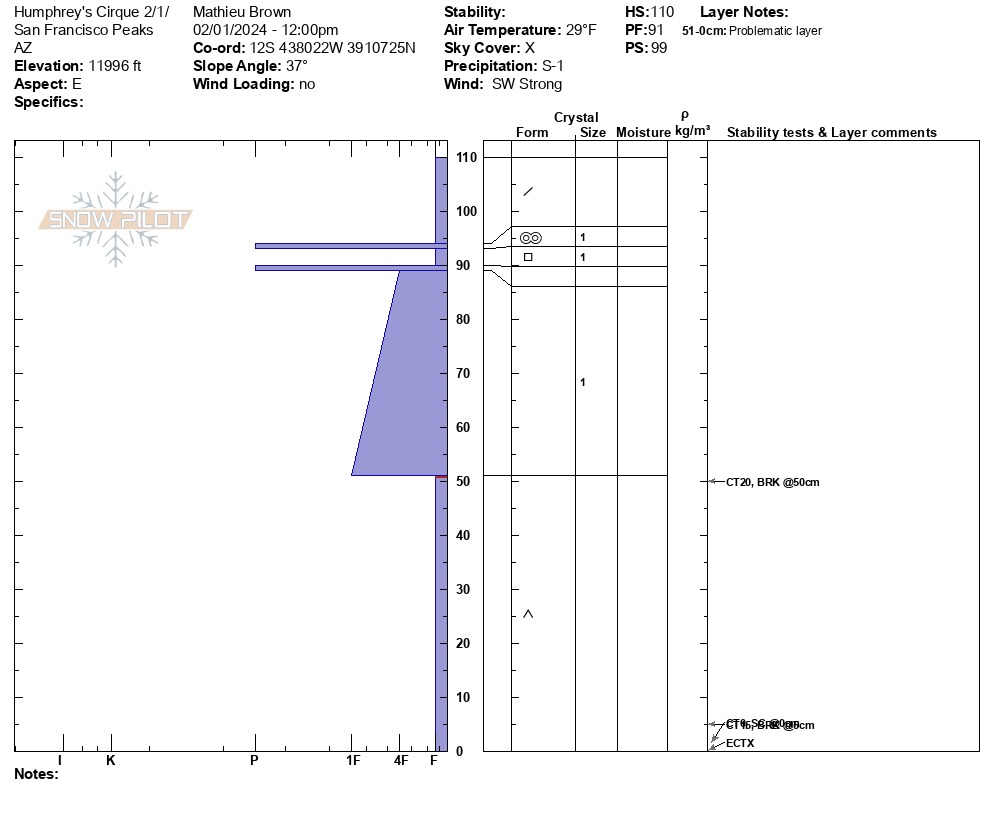
Our objective was to assess the reactive crusts on east facing slopes in the Humphrey's Cirque that were first noted a week ago. Due to inclimate weather conditions only one data pit was dug, depth assessments were conducted in a few locations across the cirque and on approach. The upper level snowpack crusts were non-reactive in 3 CT tests and in 1 ECT test. No signs of instability were noted. These upper level snowpack crusts have simplified with the warm weather of the last five days.
No signs of instability. Newly loaded hard windpockets noted, but no collapsing, cracking, etc.Weather
- Air Temp
- 28 F
- Cloud Cover
- obscured
- Wind Loading
- light
- Rain Elevation
- 11,000
- Recent Snowfall
- Trace
- Snow Avail For Transport
- small smounts
Stormy weather. Winds gusting as high as 40 mph, likely out of the SSW. Limited visibility of less than 50 feet. Snow less than 1 cm/hr.
Snowpack
Radiant heat has formed a surface crust on most aspects from E to W in widespread locations. Some sheltered areas and locations of subtly northern positions contained little to only minor crusts. The 3 layer crust and facets found a week ago have largely dissipated. The remnants of these layers were less reactive. By and large, in most locations, only two thin crusts were noted beneath new snow and wind deposits from last Thursday's storm. This has simplified the stratigraphy in this pit location. Hasty pits and pole probes showed this to be the case on most east facing aspects. The layer of greatest concern remains the basal facets. An ECTX was recorded in this pit. However, we suspect that due to spatial variability, one could record an ECTN in near-by locations. On the southern aspects of BTL and NTL, the snowpack in specific locations now consists of a pencil-hard suncrust with facets from there to the ground with depths varying between 30 and 60 cm.