
Quick report
- Cracking
- Observed
- Collapsing
- Observed
See avalanches and snowpack summary. Continuing to observe and catalog the extensive avalanche activity from the past week. I experienced dozens of collapses, both small and large. Crust at/near the surface from rain/wet snow/warm temps extends up into the middle 8,000's, gradually fading as you gain elevation. At valley floor there is a hint of a true rain crust with a thin water-ice lens in this 2-3cm crusty package, but in general it would be better described as a melt-freeze crust composed of melt-freeze polycrystals. I experienced dozens of collapses, both small and large. Down low in the flats these were small, even in wind loaded areas. As I began ascending and got into areas where the wind had built stiffer drifts the collapses involved much larger areas. Much of this wind transport had happened previously, and may not have been obvious to an untrained eye. As I continued climbing, the slab of consolidated snow overlying the weak snow near the base of the snowpack became thicker and collapses were much more difficult to trigger.
Weather
Afternoon tour. Occasional sputters of light snowfall, generally dominated by rimed stellars. Light winds out of the W/NW. Temps were near freezing at valley floor, with a touch of ambient melting occurring in the snow on top of the 1/3 heat/wet snow/rain crust.
Snowpack
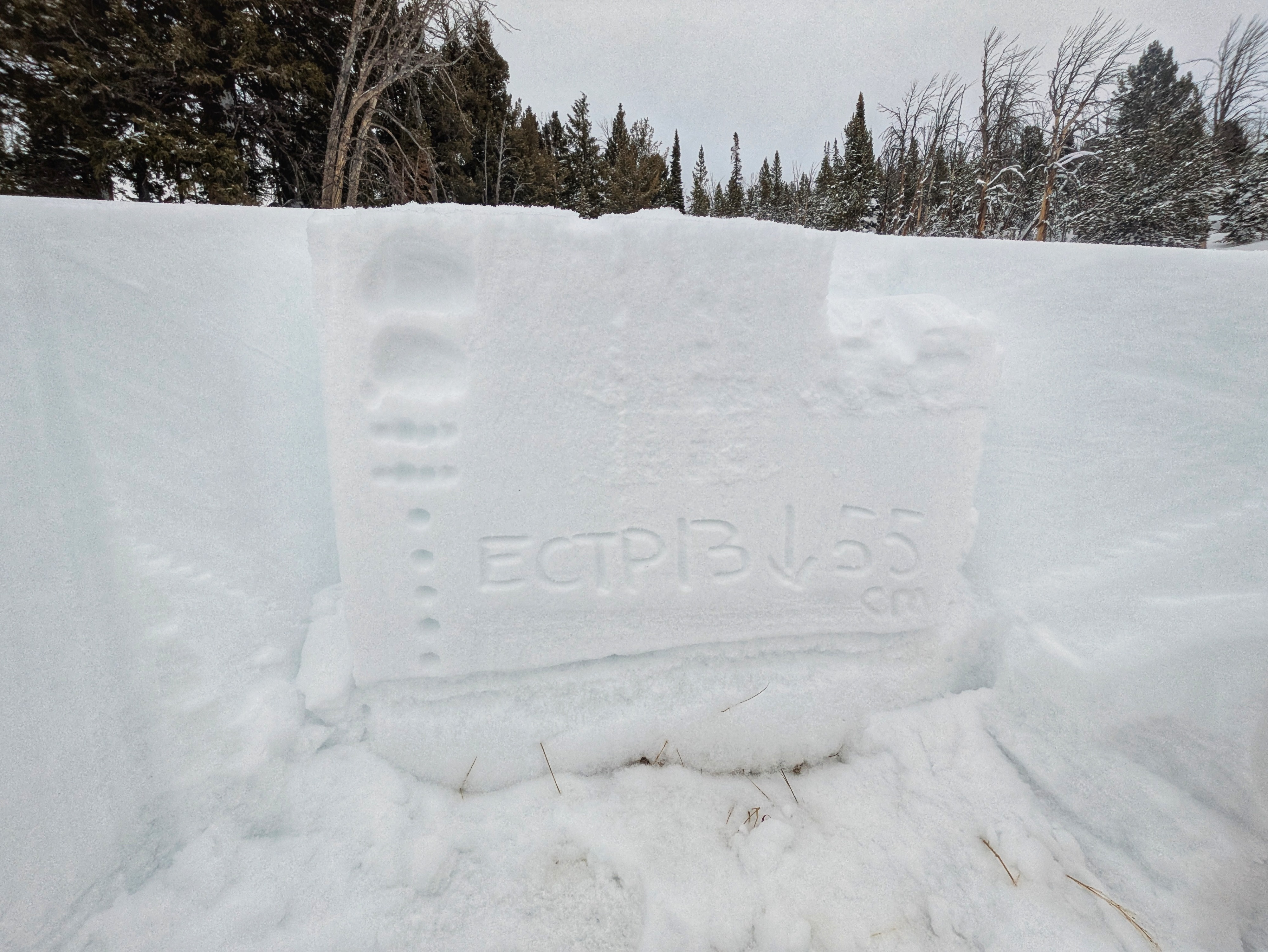
There is more complexity than reflected here, but in a general sense there is a 2+ foot thick slab of snow overlying the weak snow that developed earlier in the season. In areas with a thinner snowpack (like where I was today), this weak snow presents as a simple basal facet/depth hoar problem, with an obvious, degrading crust below the weakest snow grains (from pre-Thanksgiving rain/warm storm). I dug on a SW-facing slope at 8,800' after triggering a very large collapse. I received ECTP13 and ECTP 14 down 55-60cm on a layer of advanced 2-3mm facets that were starting to striate, but no visible cupping (this means these facets are trending towards becoming depth hoar). See attached photo. The overlying slab graded from F at the top to 1F at the base, and the lower half of the slab was 1F. Other layering was present in the slab, but it was acting as a strong structural unit.
Avalanche
- Size
- D2.5
- Count
- 6
- Aspect
- N
- Trigger
- N
- Elevation
- 9400 ft
Continuing to observe and catalog the extensive avalanche activity from the past week.