
Quick report
Dug at 8400' on SE aspect investigating the mid elevation problem which seems to be the biggest concern right now due to the widespread nature of the weak layer and higher sensitivity over the last week. Similar pit location to Christian Santelices' from 2 days ago with similar results showing increasing strength (ECT24 vs ECTX)
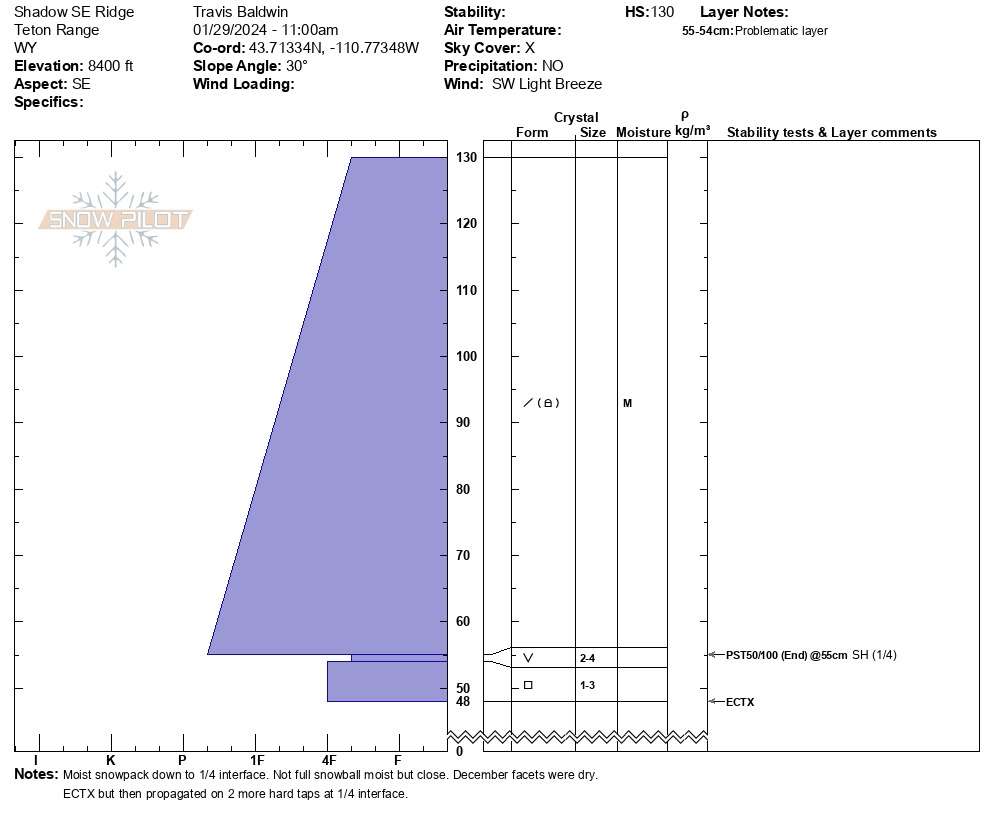
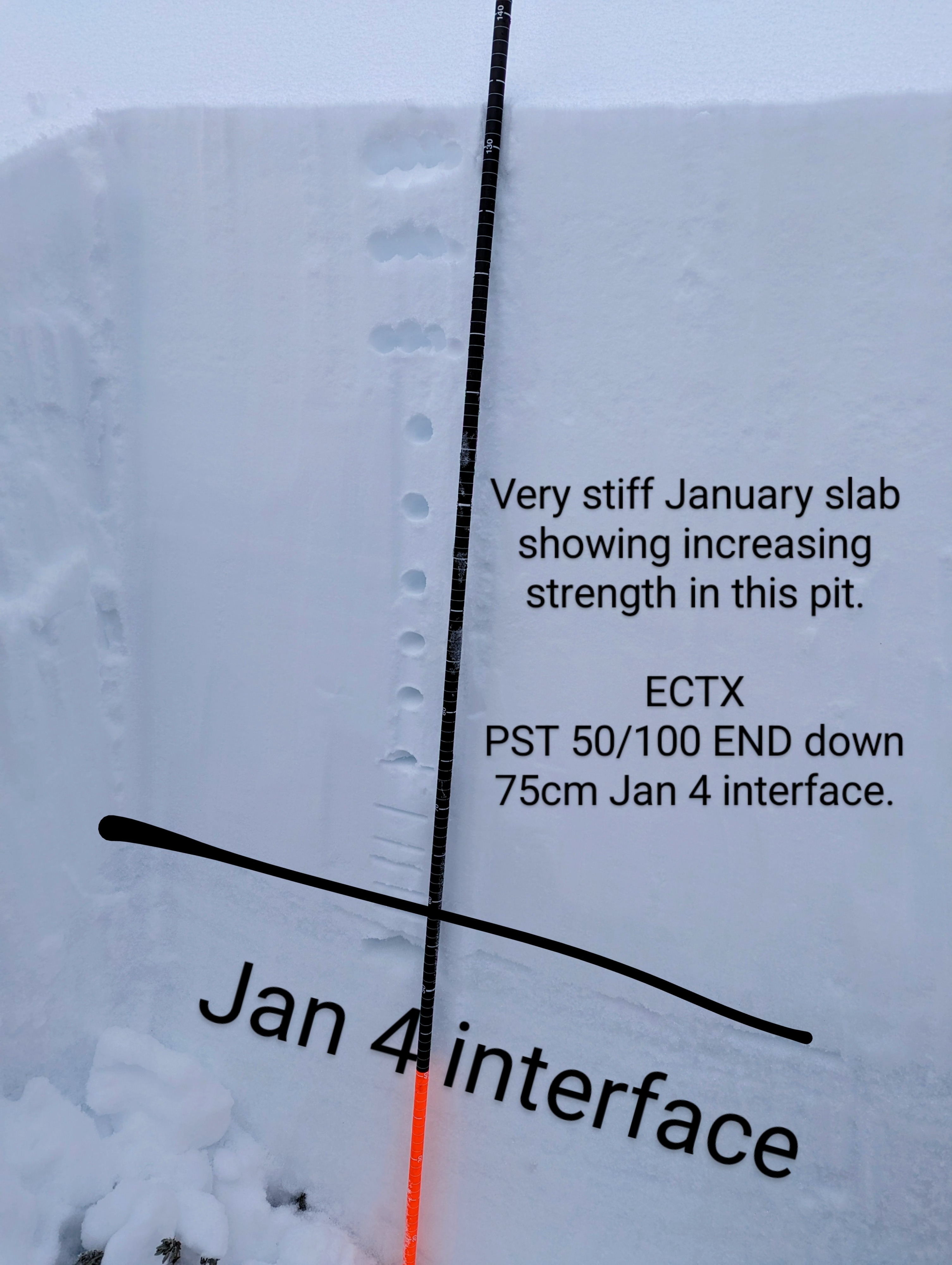
January slab is well settled and stiff and is 30" (75 cm) thick at this location. Hardness ranged from 4 finger minus down to pencil minus.
Results:
ECTX but propagated on Jan 4 interface 30" down with 2 extra hard taps (32). This slab is borderline too thick and stiff for an effective ECT so a PST was also performed.
PST 50/100 END down 30"
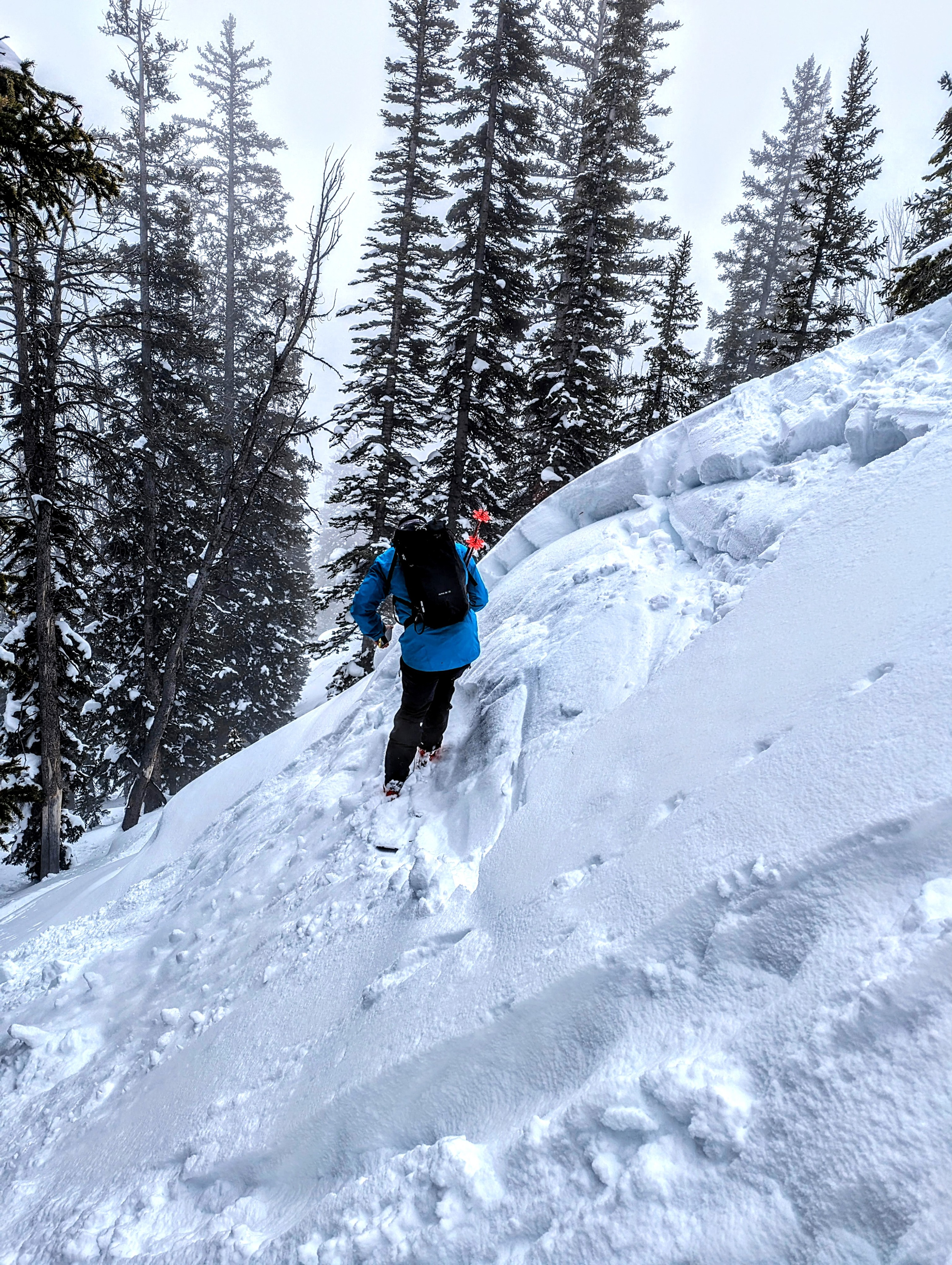
Good skiing above 8k (although a little heavy), and wet, grabby, challenging skiing below.
Discussion:
We were surprised with the PST score. Per American Avalanche Association and Forest Service Snow, Weather and Avalanche Observation Guidlines for a PST, "Fracture propagation is considered to be likely only if fracture propagates to the end of the column along the same layer and initiates when the length of the saw cut is less than 50% of the length of the column."
Well, we were at 50% in our pit. We were expecting propagation at less than 50%. This is only one data point with lots of variables, not something I would hang my hat on by itself. That said, we are roughly a week out from the last reported natural avalanche and the only human triggered avalanches in the last few days have been a D1.5 wind slab in upper elevation exposed terrain and a D1 small pocket in upper elevation confined terrain. Also one report of a small wind slab remotely triggered just south of JHMR. Reports of collapsing are also trending down. However, pits are still showing propagation (albeit higher strength scores) on a widespread weak layer and slab thicknesses vary which contributes to uncertainty.
My partner posed the question on our tour - If you wanted to trigger an avalanche today, where exactly would you go? My answer was steep, northerly, mid elevation convexities and thin rocky areas. Or maybe high elevation steep wind-loaded zones. Small pockets that pull out and send you into terrain traps or trees could still catch you off gaurd and small wind slabs above consequential terrain are worth some respect. As I was writing this I saw an observation just posted today about a natural D2.5 on a south aspect at 10,000'. I guess I would also add steep south aspects on large connected slopes around rocky (thin) areas during the heat of the day when the slab is most sensitive...
I find this snowpack challenging. Going into a few days of very warm temps and what might be some intense solar input on steep southerly aspects just makes my brain hurt a little more.
When in doubt, bump up your safety margin.
Weather
- Cloud Cover
- obscured
- Wind Loading
- none
Mid elevation fog through mid afternoon from 7500-9500'. Temps were warm, 37 at the car when we got down early afternoon. Light SW wind on ridges.
Snowpack