
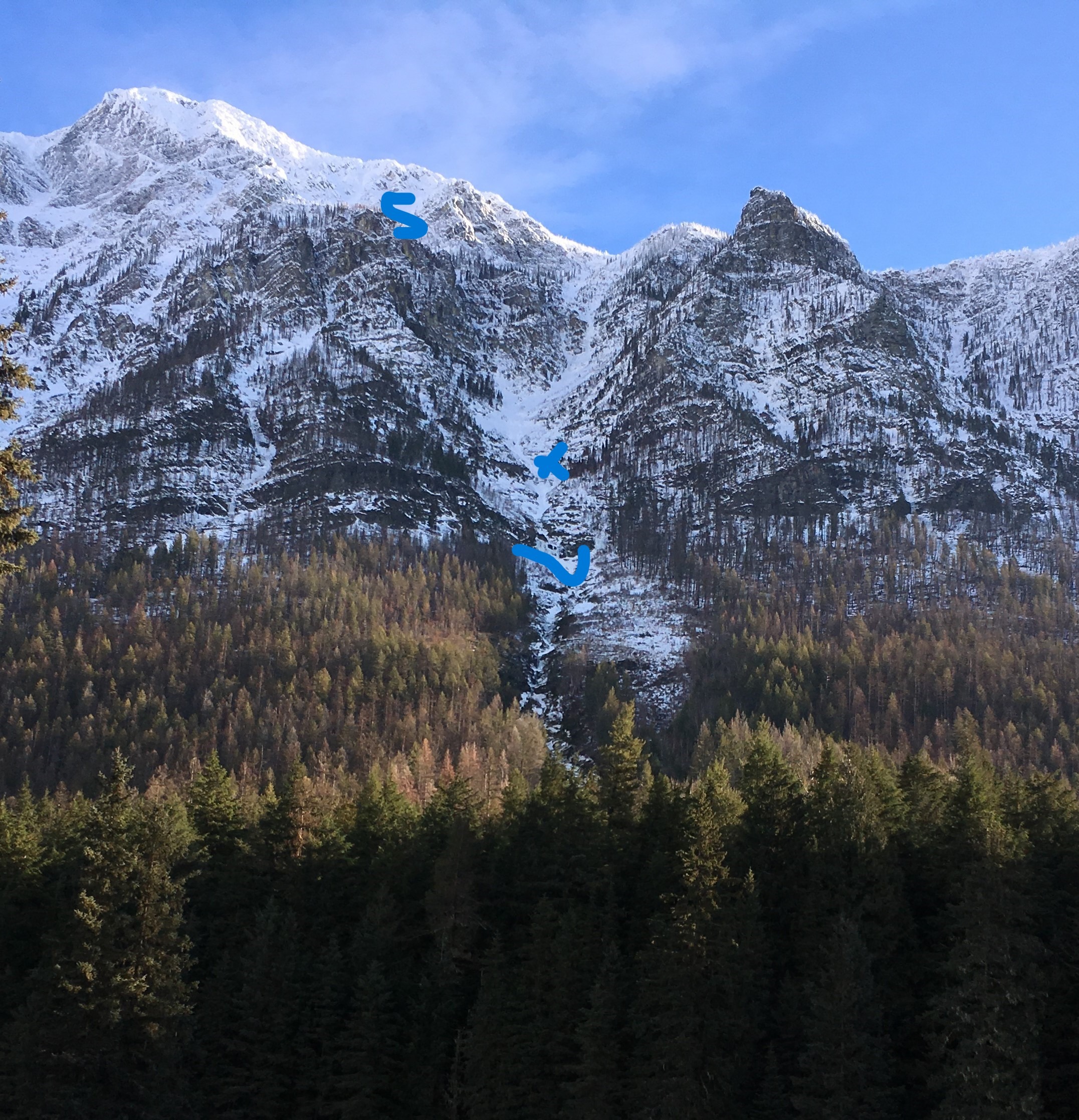
Quick report
A climber was caught and injured when he was overrun by a large natural avalanche on the northwest face of Mt. Brown. He and his partner self-evacuated.
- The accident occurred during a storm with moderate snowfall intensity and seemingly calm conditions.
- The party was exploring a climb known as the Right Gully, or, if completed to the summit, Mile of Smiles.
- They were on the 1st pitch of technical climbing. The leader had set an anchor and belay on the climber's right side of the gully, below where it forks. The 2nd a was partway up the pitch on a relatively easy snow slope, also on the climber's right side of the gully.
- The 2nd climber reported seeing a powder cloud blooming overhead. The debris ran below him in the gully.
- A second, much larger slide followed very quickly after. The 2nd climber took two steps to escape the debris but couldn't climb out of the gully. He crouched and anchored himself with his tools.
- The debris from the slide washed over the 2nd climber for roughly a minute. It pushed him downhill and when he came tight against the rope, it folded him over, ribs against pelvis. He was able to get a hand above the debris.
- When the debris stopped, the victim climbed to the belay where he and the leader - who was only hit by the powder cloud - rigged a rappel.
- Several more natural slides followed, all smaller and confined to the gully.
- After 2 rappels, the party was able to escape into lower angled trees to climber's right.
- An urgent care visit day after the accident revealed the victim had suffered injured ribs, possibly cracked.
The victim noted that the forecast for snow the previous night had concerned him. They left the trailhead before reading the day's avalanche forecast, which rated the danger as Low (Level 1 of 5) at all elevations and identified Wind Slabs as the primary avalanche problem (possible, D1-1.5).
On Dec. 23rd, wind sensors at the nearest weather stations (Sperry Glacier and Garden Wall) were rimed so no wind speed measurements are available for the hours leading up to the accident. On the night of Dec. 22-23, Garden Wall did record southerly winds averaging in the mid teens with gusts to 28. The Flattop Mountain snotel recorded 0.3 inches of SWE and 3 inches of new snow on Dec. 23, with winds veering from southeast to northwest about daybreak.
The party had an exploratory mindset, because the terrain was new and it was their first technical climb of the winter. They were aware of the potential overhead hazard and potential conseqences of the terrain they planned to explore. On their approach, they saw no spindrift and didn't hear winds above them. The new snow was cohesionless and accumulations did not seem significant. They were surprised by the abrupt onset of natural avalanching, as well as the amount of snow entrained by the slides and the distance the slides ran. Although they're still digesting the event, the victim noted "I won't be getting into gullies during seemingly inconsequential storms anymore."
The FAC forecast team is glad the party is relatively unscathed. Thanks for sharing the event so our community can learn.
Natural slides from overhead, not triggered.Weather
- Cloud Cover
- obscured
- Wind Loading
- none
- Recent Snowfall
- 10
- Snow Avail For Transport
- small smounts
Party reported band of snow as they drive up Lake McDonald. Started snowing at the trailhead at low-moderate intensities (S1). Several bands of higher intensity snow as they approached climb, but only 1 intense enough to put up hoods (S2). Accumulations at low elevation amounted to 2-4" over the course of the day. The party felt no wind, heard no wind above them, and could hear McDonald Creek during their climb.
Snowpack
On the ascent, the new snow was loose and dry. On the descent, it had started forming thin, cohesive slabs.
Avalanche
- Size
- D2.5
- Type
- U
- Count
- 2
- Aspect
- NW
- Trigger
- N
- Elevation
- 6900 ft
6 natural avalanches in short period, all apparently starting above 6500 feet. Largest put debris down to about 5000 feet, below waterfall. It is unknown whether the slides involved slabs of drifted snow or sluffs of loose, dry snow.