
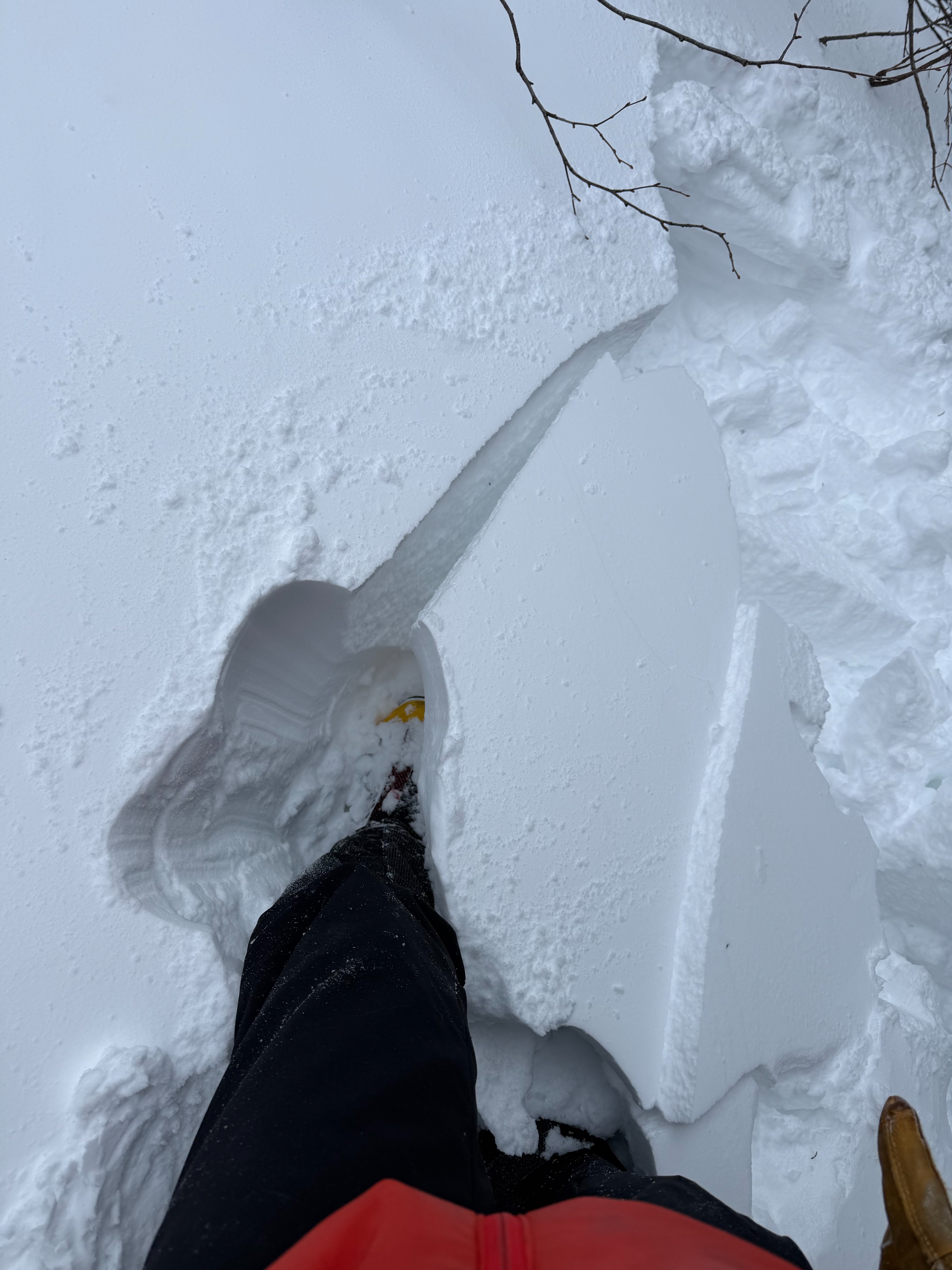
Quick report
- Cracking
- specific
Today was a day of surprises for me. I expected to travel up the TRT on a wind-scoured, icy trail and I expected to arrive at Hermit Lake to see wind-scoured surfaces with isolated areas of deeper snow drifts. What I found was vastly different than what I was expecting.
The TRT was covered in mostly drifts of new snow with a few areas of exposed rain crust. At Hermit Lake, drifts were much deeper and much more reactive than I anticipated. Drifts over 2 feet were common and it wasn't hard to find drifts up to 3 feet deep. These areas were reactive to the weight of a person and shooting cracks propagated out with a single foot step.
Two people reported crossing the Summer Lion Head Traverse and described it as "crazy" and "scary." They described a wind slab that was up to 4 feet thick and generating long shooting cracks with each footstep. On their way back, their uptrack had completely filled in.
It's important to note that what I saw today was significantly misaligned with my forecast this morning. Even though 100mph winds have likely scoured exposed areas, open faces, and ridgelines, based on what I saw lower in the terrain (and what I heard about in protected terrain at mid-elevations), there was an opportunity today to find highly sensitive and deep wind-slabs in avalanche terrain where the terrain provides good protection from the wind.
Weather
- Air Temp
- 3
- Cloud Cover
- obscured
- Wind Loading
- intense
- Recent Snowfall
- 6
Obscured conditions from blowing snow in high westerly winds with very cold temps around 0 degrees F.
Snowpack
The depth of new snow drifts was highly variable based on wind protection. I found drifts up to 4 feet deep on the Tuckerman Ravine Trail above Hermit Lake. These drifts were strong-over-weak in structure with 4-finger hardness on top of fist-hardness. The slab felt cohesive and seemed to translate energy easily based on hand sheers and slab propagation from footsteps.