
Quick report
- Aspect
- Northeast
- Red Flags
- Poor Snowpack Structure
- Elevation
- 3444 m
- Slope Angle
- 18°
- Red Flags Comment
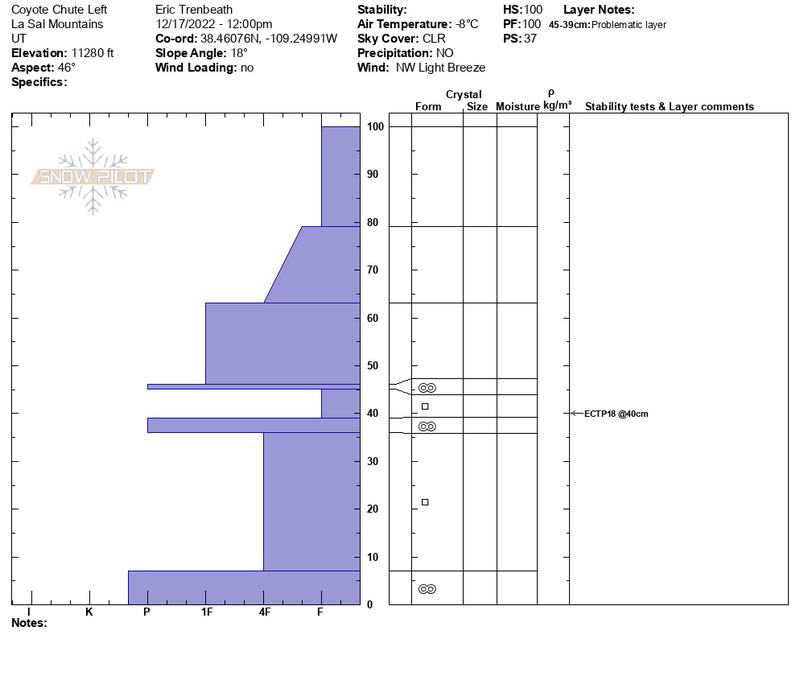
- <p>Poor snowpack structure exists and we now have a slab over a facet/crust combination that developed during the November dry period. Beneath the mid-pack, facet/crust sandwich, it's pretty much faceted all the way to the ground except for a melt freeze layer at the very bottom. Incremental loading this week has added 24" of snow at 1.8" SWE. A remarkably small amount of collapsing has been observed given the underlying structure. A handful of natural avalanches ran during the height of the stormy period on the 13th. Avalanche activity was somewhat "pockety" in nature, and it was far from a widespread cycle. Fractures were between 2'-3' deep, and widths were from 60'-150' wide. </p>
An extended column test produced results of ECTP 18, with failure occurring on facets between the crusts. Slab was 1F hardness at failure. This test was performed on a NE aspect at 11,300'.
We're trending toward a classic Continental Snowpack/Persistent Weak Layer/Moderate Danger situation. Human triggered avalanches are becoming less likely, but they are still quite possible, and the consequences remain the same. The greatest danger exists on steep, northerly aspects, especially on slopes where wind loading has created hard slabs and added additional stress to the weak layer. I'll personally be avoiding these slopes for the foreseeable future.
Snowpack
24" of low density snow fell between Dec 12-15. Cold temperatures and a lack of wind have preserved conditions and the powder remains excellent. The north winds from last night did not transport, or damage as much snow as I had anticipated. Even with sunny skies the last couple of days, many southerly aspects still hold dry snow.