
Quick report
- Aspect
- Southeast
- Red Flags
- Recent Avalanches, Heavy Snowfall
- Elevation
- 3048 m
- Slope Angle
- 30°
- Red Flags Comment
- <p>There was widespread evidence of natural activity on all aspects and elevations above 9500 ft. However, these were now nearly completely buried and the clues were flagged vegetation and small uneven piles on low angle slopes below steeper paths. </p>
Photos: 1. Pit wall 2. Sun crust 3. Visibility at its greatest
Snowpack
- Instability Comment
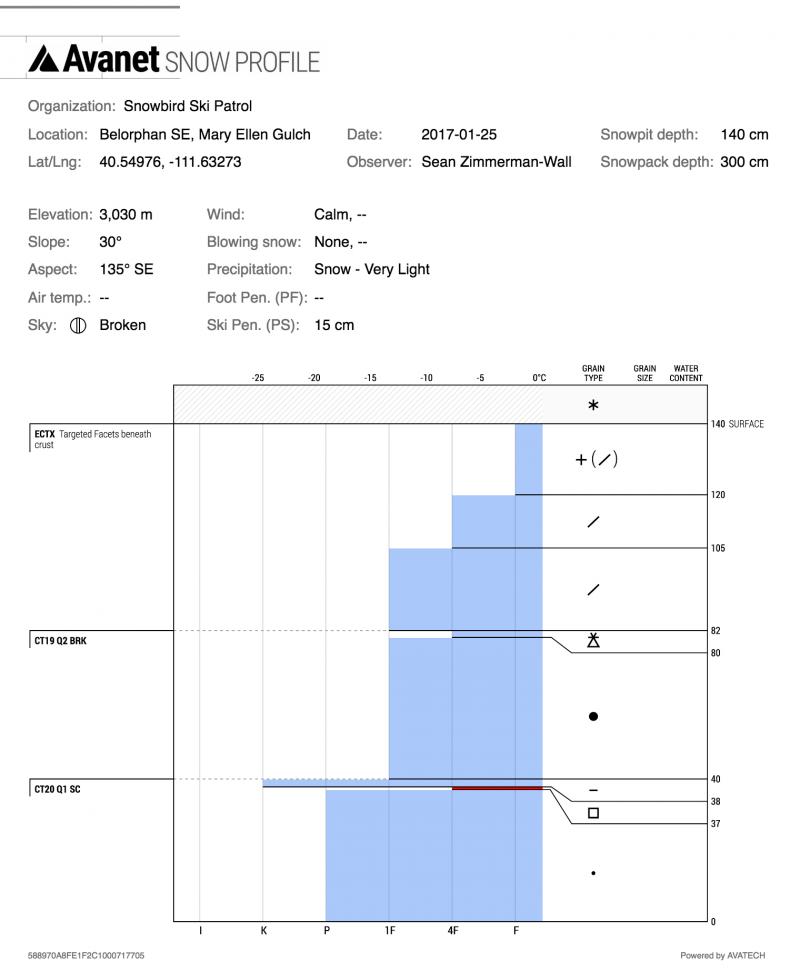
- <p>New snow instabilities within the storm slab such as preserved stellars and graupel are probably the most likely and widely distributed problem. Although these won't be large avalanches, in consequential or confining terrain it could be a problem. The winds at the upper elevations in the NW flow were sustained moderate and believe the new light density will be drifted into small windslabs that will become a problem overnight. These wind effected areas today were quite stiff along on the LCC/AF rim.</p> <p>Targeted the sun crust/facet combo specifically today on the slopes visited. SE through SW in Mary Ellen Gulch. The snow cover is rather uniform at 275 to 300cm deep. A buried crust is 100cm down at 9k to 10k. This crust has small grained facets beneath it that were reactive in CT (CT20 Q1 SC), but neither an ECT or PST showed any propagation. I would suspect in the right terrain features you could find this crust closer to the surface and potentially collapse it. On a large, connected slope I believe it is unlikely to get a slab avalanche failing on this weak layer, but not impossible. Thus, I kept the slope angles around 30 to 33 degrees with out exposure to larger slopes or terrain traps. </p>
HST 100cm settled since 1/20. Snowpack is mostly right side up and trailbreaking was easy. Graupel pools down 60cm or so were active during storm, but seem to have settled out. Although noticeable in the pit wall, they did no present the same concern as Monday. However, there is a buried suncrust from our previous spell of high pressure under the meter of storm snow. This crust is 2cm thick at most with small grained facets beneath. Despite intermittent sun, the snow never picked up any heat.