
Quick report
- Cracking
- isolated
- Collapsing
- isolated
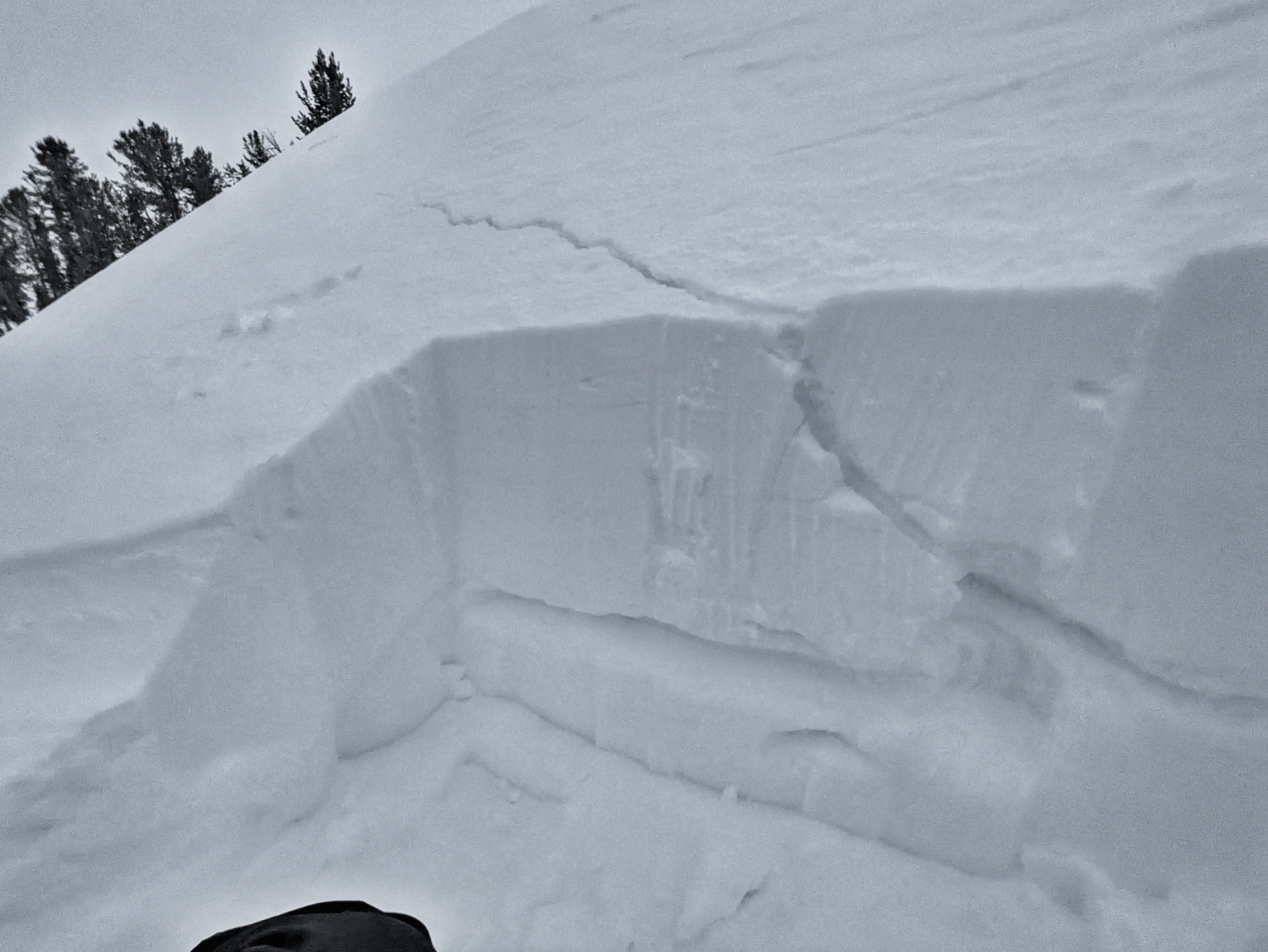
I went to look at the skier triggered avalanche that was reported on 12/21. I traveled through a good bit of terrain facing the southern portion of the compass en route to the slide and did not experience any cracking or collapsing here, even in wind loaded terrain. I experienced a single large, loud collapse (less of a sharp crack/gunshot, more of a loud but muted pop followed immediately by a crystalline gooshing sound as the hard slab dropped into the glassy facets below). Collapse story: I got to the top of the slope above the avalanche and found a hard slab of snow which I assumed was sitting on the 12/13 facets below. I jumped up and down quite aggressively on the slope to see if I could get it to collapse, but was unsuccessful. After a bit I stopped jumping to catch my breath, looked around at the fading light of sunset, and gently slid into a lunge position to stretch my sore hip flexors...and then triggered the collapse. Man, snow sure does move in mysterious ways.
Snowpack
There is a new, thin rain crust extending into middle elevation terrain. On Sunday (12/22) evening I found this buried ~1cm down underneath a thin pile of graupel with a few snowflakes. It seemed to be fading out to a whisper by around 8,000', but my time was limited. 12/21 weak layer: We are introducing a new weak layer! Based on my recent observations I'm most concerned about this layer on solar slopes at middle and upper elevations. Here, a series of crusts and associated facets (I found between 3 and 5 crusts in my hand pits, depending on aspect, elevation, and slope angle) makes up the upper snowpack above the prominent 12/13 MFcr. Temperatures have been mild, cloud cover has been intermittent, and strong winds have been blowing out of the W-NW: these factors all seem to have helped to make this layer look not as bad on shaded aspects. This is an inversion of the pattern exhibited by the 11/10 and 12/13 weak layers, which are at their worst on shaded slopes. Reactive cruts+facet combos that form in the spring are often restricted to the solar margins (E/SE and WSW). However, with a low sun angle and short days this combo can be spread more broadly across the southern half of the compass. Complexity increases. Surfaces up in the alpine have been taking a real beating. The crust+facet combos are less well preserved there. Instead, I was finding very slick, icy crusts that were occasionally hard to get my ski edges into (though my edges are pretty rough right now...it is mid-December...).
Avalanche
I went to look at the reported skier-triggered avalanche. Coding this as: HS-ASu-R2-D1.5-O (hard slab, unintentionally triggered by a skier, relatively small compared to the path and in destructive size, failing on old snow). The crown was just below 9,800' at a steep convexity (rollover) on the slope, less than 100' from the ridgeline. The slide occurred in a confined gully feature with ribs on either side which is concave in the cross slope direction. There was a dense slab of snow that had not slid sitting on a low-30s (degree) slope guarding the approach to the crown. I did not feel comfortable descending to the crown without a partner (and at sunset with fading light). I dug about 30-40 feet above the crown, at the site of the triggered collapse and associated cracking. The slide stopped relatively high on the runout, and debris appeared to fan out and thin as it slowed down. Where I dug the slab overlying 12/13 weak layer was very dense (1F at top grading to P- at base). It may have been somewhat less dense below, but the chunky nature of the debris leads me to believe that most of what slid was pretty firm. I did not see any indications that this stepped down to a deeper weak layer.